



 Chat with AI
Exam 11: Power Amplifiers

Exam 1: Fundamental Solid-State Principles35 Questions
Exam 2: Diodes32 Questions
Exam 3: Common Diode Applications: Basic Power Supply Circuits30 Questions
Exam 4: Common Diode Applications: Clippers, Clampers, Voltage Multipliers, and Displays33 Questions
Exam 5: Special Applications Diodes30 Questions
Exam 6: Bipolar Junction Transistors32 Questions
Exam 7: DC Biasing Circuits30 Questions
Exam 8: Introduction to Amplifiers30 Questions
Exam 9: Common-Emitter Amplifiers31 Questions
Exam 10: Other BJT Amplifiers29 Questions
Exam 11: Power Amplifiers31 Questions
Exam 12: Field-Effect Transistors32 Questions
Exam 13: Mosfets33 Questions
Exam 14: Amplifier Frequency Response32 Questions
Exam 15: Operational Amplifiers32 Questions
Exam 16: Additional Op-Amp Applications27 Questions
Exam 17: Tuned Amplifiers34 Questions
Exam 18: Oscillators31 Questions
Exam 19: Solid-State Switching Circuits34 Questions
Exam 20: Thyristors and Optoelectronics Devices30 Questions
Exam 21: Discrete and Integrated Voltage Regulators25 Questions
Select questions type


Class C amplifiers usually contain

Free
(Multiple Choice)
4.7/5  (85)
(85) Correct Answer: Verified
B
A class AB amplifier has a value of VCC = 15 Vdc. The value of VCEoff) for either transistor is approximately equal to
Free
(Multiple Choice)
5.0/5 (74)
(74) Correct Answer:Verified
VerifiedC
When properly used, diode bias will prevent
Free
(Multiple Choice)
4.9/5 (72)
(72) Correct Answer:Verified
VerifiedA
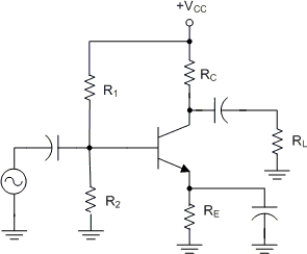 -The circuit in Figure has the following values: VCC = 12 V, R1 = 48 kΩ, R2 = 15 kΩ, RC = 4.7 kΩ, RE = 2.2 kΩ, RL = 12 kΩ, and hfe = hFE = 200 What is the ac cut off voltage for this circuit?
 (Multiple Choice)
4.9/5 (74)
(74) A class A amplifier has a compliance of 6 Vpp and a load resistance of 120 Ω. What is the maximum theoretical load power for the circuit?
(Multiple Choice)
4.8/5 (86)
(86) A transformer-coupled class A amplifier has a transformer with a 3:1 turns ratio and values of RL = 100 Ω, VCEQ = 6 V, and ICQ = 8 mA. What is the value of vceoff) for the circuit?
(Multiple Choice)
4.7/5 (77)
(77) 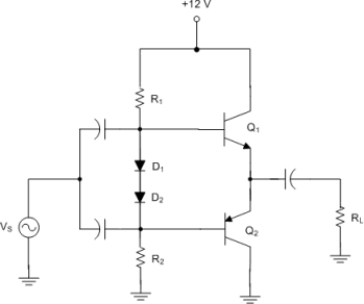 Figure 11-2
-The circuit in Figure 11-2 is an example of a amplifier.
Figure 11-2
-The circuit in Figure 11-2 is an example of a amplifier. (Multiple Choice)
4.7/5 (89)
(89)
-The circuit in Figure has the following values: VCC = 12 V, R1 = 48 kΩ, R2 = 15 kΩ, RC = 4.7 kΩ, RE = 2.2 kΩ, RL = 12 kΩ, and hfe = hFE = 200 What is the ac saturation current for this circuit?
-The circuit in Figure has the following values: VCC = 12 V, R1 = 48 kΩ, R2 = 15 kΩ, RC = 4.7 kΩ, RE = 2.2 kΩ, RL = 12 kΩ, and hfe = hFE = 200 What is the ac saturation current for this circuit? (Multiple Choice)
4.9/5 (83)
(83) An amplifier has values of 2ICQrC = 8.6 V and 2VCEQ = 12 V. If the ac output voltage exceeds 8.6 Vpp, the amplifier will experience
(Multiple Choice)
4.9/5 (90)
(90) When troubleshooting a class AB amplifier, you determine that one of the two transistors is faulty. At this point, you should
(Multiple Choice)
4.8/5 (83)
(83) Figure 11-2
-The circuit in Figure 11-2 has the following values: VCC = 16 V, R1 = R2 = 470 Ω, RL = 8 Ω, and hfe = hFE = 200
Determine the values of ICsat) and VCEoff) for the transistors.
Figure 11-2
-The circuit in Figure 11-2 has the following values: VCC = 16 V, R1 = R2 = 470 Ω, RL = 8 Ω, and hfe = hFE = 200
Determine the values of ICsat) and VCEoff) for the transistors. (Multiple Choice)
4.9/5 (82)
(82) A class B amplifier has a maximum theoretical efficiency of
(Multiple Choice)
4.9/5 (76)
(76)
-A circuit like the one in Figure has values: I1 = 1 mA, ICQ = 50mA, VCC = 15 V, PP = 9.3 V, and RL = 680 Ω
What is the maximum efficiency of the amplifier?
-A circuit like the one in Figure has values: I1 = 1 mA, ICQ = 50mA, VCC = 15 V, PP = 9.3 V, and RL = 680 Ω
What is the maximum efficiency of the amplifier? (Multiple Choice)
4.8/5 (75)
(75) A transformer-coupled class A amplifier has a transformer turns ratio of 4:1 and a load resistance of 25 Ω. The peak-to-peak value of VCE is 12 V. What is the approximate load power for the circuit?
(Multiple Choice)
4.9/5 (82)
(82) The maximum theoretical efficiency of an RC-coupled class A amplifier is
(Multiple Choice)
4.7/5 (90)
(90)
-A circuit like the one in Figure has values: VCC = 10 V, I1 = 450 μA, and ICQ = 10.55 mA How much power is the circuit drawing from the dc power supply?
-A circuit like the one in Figure has values: VCC = 10 V, I1 = 450 μA, and ICQ = 10.55 mA How much power is the circuit drawing from the dc power supply? (Multiple Choice)
4.9/5 (77)
(77) A given transistor has a power derating factor of 1.8mW/°C and a power dissipation rating of 400 mW at 25°C. How much power can the device dissipate at 120°C?
(Multiple Choice)
4.7/5 (75)
(75) The maximum value of VCE in a transformer-coupled class A amplifier will be greater than VCC. This is caused by
(Multiple Choice)
4.8/5 (73)
(73) 
Filters
- Essay(0)
- Multiple Choice(0)
- Short Answer(0)
- True False(0)
- Matching(0)