



 Chat with AI
Exam 10: Other BJT Amplifiers

Exam 1: Fundamental Solid-State Principles35 Questions
Exam 2: Diodes32 Questions
Exam 3: Common Diode Applications: Basic Power Supply Circuits30 Questions
Exam 4: Common Diode Applications: Clippers, Clampers, Voltage Multipliers, and Displays33 Questions
Exam 5: Special Applications Diodes30 Questions
Exam 6: Bipolar Junction Transistors32 Questions
Exam 7: DC Biasing Circuits30 Questions
Exam 8: Introduction to Amplifiers30 Questions
Exam 9: Common-Emitter Amplifiers31 Questions
Exam 10: Other BJT Amplifiers29 Questions
Exam 11: Power Amplifiers31 Questions
Exam 12: Field-Effect Transistors32 Questions
Exam 13: Mosfets33 Questions
Exam 14: Amplifier Frequency Response32 Questions
Exam 15: Operational Amplifiers32 Questions
Exam 16: Additional Op-Amp Applications27 Questions
Exam 17: Tuned Amplifiers34 Questions
Exam 18: Oscillators31 Questions
Exam 19: Solid-State Switching Circuits34 Questions
Exam 20: Thyristors and Optoelectronics Devices30 Questions
Exam 21: Discrete and Integrated Voltage Regulators25 Questions
Select questions type


A Darlington pair has values of hfcl = hfc2 = 150. What is the overall value of Ai for the pair?
(Multiple Choice)
4.8/5  (94)
(94) Which of the following statements is true for a midpoint-biased emitter follower?
(Multiple Choice)
4.7/5 (76)
(76) 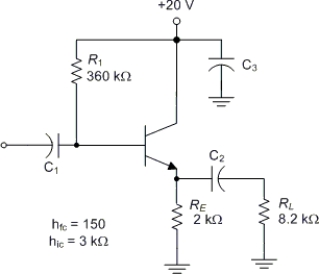 -What is the approximate value of Ai for the circuit in Figure ?
 (Multiple Choice)
4.9/5 (76)
(76) 
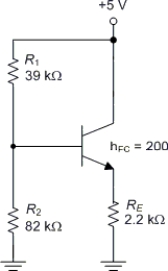 -Is the circuit in Figure midpoint biased?
An emitter follower has the following values: hic = 3 kΩ, hfc = 150, and RE = 1.5 kΩ. What is the approximate value of Av for the circuit?
(Multiple Choice)
4.8/5 (81)
(81) A common-base amplifier can be used to match a resistance source to a resistance load.
(Multiple Choice)
4.9/5 (73)
(73) Which of the following statements about the common-base amplifier is true?
(Multiple Choice)
4.8/5 (90)
(90) 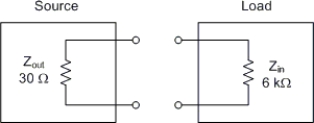 - Which of the following would be used to properly couple the source to the load?
 (Multiple Choice)
4.8/5 (86)
(86) 
Filters
- Essay(0)
- Multiple Choice(0)
- Short Answer(0)
- True False(0)
- Matching(0)