



 Chat with AI
Exam 9: Common-Emitter Amplifiers

Exam 1: Fundamental Solid-State Principles35 Questions
Exam 2: Diodes32 Questions
Exam 3: Common Diode Applications: Basic Power Supply Circuits30 Questions
Exam 4: Common Diode Applications: Clippers, Clampers, Voltage Multipliers, and Displays33 Questions
Exam 5: Special Applications Diodes30 Questions
Exam 6: Bipolar Junction Transistors32 Questions
Exam 7: DC Biasing Circuits30 Questions
Exam 8: Introduction to Amplifiers30 Questions
Exam 9: Common-Emitter Amplifiers31 Questions
Exam 10: Other BJT Amplifiers29 Questions
Exam 11: Power Amplifiers31 Questions
Exam 12: Field-Effect Transistors32 Questions
Exam 13: Mosfets33 Questions
Exam 14: Amplifier Frequency Response32 Questions
Exam 15: Operational Amplifiers32 Questions
Exam 16: Additional Op-Amp Applications27 Questions
Exam 17: Tuned Amplifiers34 Questions
Exam 18: Oscillators31 Questions
Exam 19: Solid-State Switching Circuits34 Questions
Exam 20: Thyristors and Optoelectronics Devices30 Questions
Exam 21: Discrete and Integrated Voltage Regulators25 Questions
Select questions type


When using an oscilloscope to verify the operation of a CE amplifier, you must remember to
(Multiple Choice)
4.9/5  (65)
(65) The input and output signal voltages for a common-emitter amplifier are
(Multiple Choice)
4.8/5 (77)
(77) The base input impedance of a BJT is listed on its spec sheet as
(Multiple Choice)
4.8/5 (89)
(89) 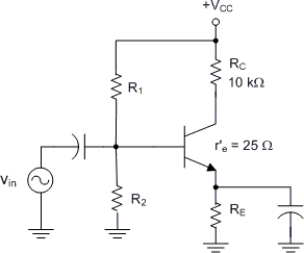 -The amplifier in Figure has values of RC = 10 kΩ, rʹe = 25 Ω, and Ai = 15. What is the value of Ap for the circuit?
 (Multiple Choice)
4.8/5 (88)
(88) By design, the reactance of a coupling capacitor is extremely at the amplifierʹs lowest operating frequency.
(Multiple Choice)
4.8/5 (73)
(73) By design, the reactance of a bypass capacitor is extremely at the amplifierʹs lowest operating frequency.
(Multiple Choice)
4.7/5 (90)
(90) 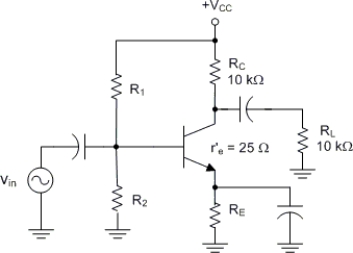 -Which of the following would indicate that the load in Figure has opened?
 (Multiple Choice)
4.8/5 (81)
(81) For circuit analysis purposes, the most commonly used h-parameters are
(Multiple Choice)
4.8/5 (85)
(85) 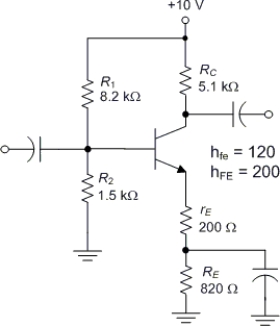 - If a 10 kΩ load resistance is connected to the circuit, the voltage gain
 (Multiple Choice)
4.9/5 (73)
(73) 
Filters
- Essay(0)
- Multiple Choice(0)
- Short Answer(0)
- True False(0)
- Matching(0)