



 Chat with AI
Exam 2: Diodes

Exam 1: Fundamental Solid-State Principles35 Questions
Exam 2: Diodes32 Questions
Exam 3: Common Diode Applications: Basic Power Supply Circuits30 Questions
Exam 4: Common Diode Applications: Clippers, Clampers, Voltage Multipliers, and Displays33 Questions
Exam 5: Special Applications Diodes30 Questions
Exam 6: Bipolar Junction Transistors32 Questions
Exam 7: DC Biasing Circuits30 Questions
Exam 8: Introduction to Amplifiers30 Questions
Exam 9: Common-Emitter Amplifiers31 Questions
Exam 10: Other BJT Amplifiers29 Questions
Exam 11: Power Amplifiers31 Questions
Exam 12: Field-Effect Transistors32 Questions
Exam 13: Mosfets33 Questions
Exam 14: Amplifier Frequency Response32 Questions
Exam 15: Operational Amplifiers32 Questions
Exam 16: Additional Op-Amp Applications27 Questions
Exam 17: Tuned Amplifiers34 Questions
Exam 18: Oscillators31 Questions
Exam 19: Solid-State Switching Circuits34 Questions
Exam 20: Thyristors and Optoelectronics Devices30 Questions
Exam 21: Discrete and Integrated Voltage Regulators25 Questions
Select questions type


When tested with an ohmmeter, a diode should have forward resistance and reverse resistance.
(Multiple Choice)
4.8/5  (96)
(96) The stripe on the body of a pn-junction diode is used to identify the .
(Multiple Choice)
4.7/5 (85)
(85) When substituting one diode for another, you must consider the
(Multiple Choice)
4.8/5 (66)
(66) Which diode type can be best utilized as a panel indicator?
(Multiple Choice)
4.9/5 (76)
(76) 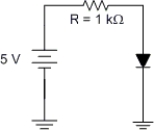 -The voltage across the diode in Figure is
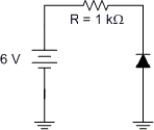 -The voltage across the resistor in Figure is
A silicon diode has a bulk resistance of 12 Ω and a forward current of 7 mA. The forward voltage drop across the diode is approximately
(Multiple Choice)
4.9/5 (71)
(71) The color of an LED is typically determined by the magnitude of the diode current.
(True/False)
4.9/5 (82)
(82) An LED is typically wired in series with a current-limiting resistor.
(True/False)
4.9/5 (76)
(76) The diode model is typically used in circuit development applications.
(Multiple Choice)
4.8/5 (84)
(84) 
Filters
- Essay(0)
- Multiple Choice(0)
- Short Answer(0)
- True False(0)
- Matching(0)