



 Chat with AI
Exam 15: Financial Instruments: Complex Debt and Equity

Exam 12: Financial Liabilities and Provisions78 Questions
Exam 13: Financial Instruments: Long-Term Debt74 Questions
Exam 14: Shareholders Equity181 Questions
Exam 15: Financial Instruments: Complex Debt and Equity135 Questions
Exam 16: Corporate Income Tax122 Questions
Exam 17: Tax Losses98 Questions
Exam 18: Leases234 Questions
Exam 19: Post-Employment Benefits92 Questions
Exam 20: Earnings Per Share153 Questions
Exam 21: Accounting Changes157 Questions
Exam 22: Financial Statement Analysis165 Questions
Select questions type


General debt carries a firm commitment to interest payments and repayment of capital at maturity.
(True/False)
4.8/5  (78)
(78) For each type of financial instrument, the reporting enterprise should disclose:
(Multiple Choice)
4.8/5 (66)
(66) On January 1st, 20x9, GHI Inc.granted options to its twenty employees allowing for the purchase of 12,000 shares at $5 per share.The options vest evenly over the 3 years following the date of issue.The options are only exercisable as of December 31st, 20x11.The fair value of these options (using an Option Pricing model)is $30,000.
Part A: Assume that all options have vested but that none were exercised on December 31st, 20x11.Provide the required journal entry.
Part B: Assume that all options have vested and all were exercised on December 31st, 20x11.Provid the required journal entry.
Part C: Suppose that some of the options were forfeited by the employees.Actual and estimated forfeiture data are provided in the table below: 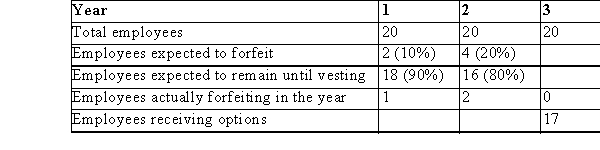 Provide the required journal entries to record the accrual of compensation expense and the exercise o the options as per IFRS.
Part D: Suppose that some of the options were forfeited by the employees.Actual and estimated forfeiture data are provided in the table below:
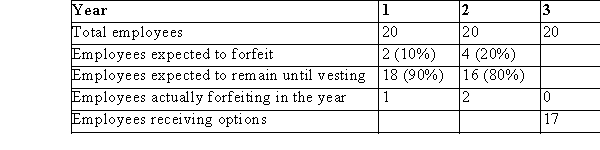 Provide the journal entries required under ASPE.
Provide the required journal entries to record the accrual of compensation expense and the exercise o the options as per IFRS.
Part D: Suppose that some of the options were forfeited by the employees.Actual and estimated forfeiture data are provided in the table below: Provide the journal entries required under ASPE. (Essay)
4.8/5 (78)
(78) Primary securities that have both debt and equity characteristics are called:
(Multiple Choice)
4.8/5 (81)
(81) Futures contracts are traded on public exchanges while forward contracts are not.
(True/False)
4.9/5 (72)
(72) If a company issues debt that is convertible at the corporation's option, in substance, the debt is equity.
(True/False)
4.9/5 (76)
(76) An investor purchases a $10,000 bond convertible into common shares at a price of $50.How many shares are available for conversion?
(Essay)
4.8/5 (66)
(66) Stock options have no intrinsic value when the market price of the share exceeds its conversion price.
(True/False)
5.0/5 (81)
(81) The crucial aspect of debt on the financial statements is:
(Multiple Choice)
4.8/5 (96)
(96) An instrument may be classified as equity even though the investor can demand payment.
(True/False)
4.8/5 (71)
(71) Under ASPE, forfeitures which occur under a stock-based compensation structure are accrued throughout the vesting period.
(True/False)
4.9/5 (83)
(83) Amanda Corp.owned a major business building in a small Canadian city.The building has a
$1,555,000 mortgage that is held by a Canadian financial institution (FI).Amanda Corp.has had recent cash flow problems, in part, due to the low vacancy rates in the business buildings.Interest is 15 months in arrears and totals $132,000.After discussions with the FI, they agree to a financial reorganization in that they accept $50 preferred shares at a value of $1,490,000, retractable in 15 yea time at book value.The shares have first claim on the proceeds of the business building, should it be sold.
Required:
Prepare the journal entry to record the exchange.
(Essay)
4.7/5 (77)
(77) Embedded derivatives are those that can be detached and separately sold from their host contracts.
(True/False)
4.8/5 (84)
(84) With respect to convertible bonds, whose conversion is mandatory, only the interest stream is valued as debt; the bond principal and conversion features are considered equity.
(True/False)
4.8/5 (87)
(87) ASPE records complex financial instruments in keeping with their legal form, while IFRS records these based on their substance.
(True/False)
4.8/5 (69)
(69) 
Filters
- Essay(0)
- Multiple Choice(0)
- Short Answer(0)
- True False(0)
- Matching(0)