



 Chat with AI
Exam 19: Post-Employment Benefits

Exam 12: Financial Liabilities and Provisions78 Questions
Exam 13: Financial Instruments: Long-Term Debt74 Questions
Exam 14: Shareholders Equity181 Questions
Exam 15: Financial Instruments: Complex Debt and Equity135 Questions
Exam 16: Corporate Income Tax122 Questions
Exam 17: Tax Losses98 Questions
Exam 18: Leases234 Questions
Exam 19: Post-Employment Benefits92 Questions
Exam 20: Earnings Per Share153 Questions
Exam 21: Accounting Changes157 Questions
Exam 22: Financial Statement Analysis165 Questions
Select questions type


Changes in defined benefit pension plans that eliminate or reduce, for a significant number of employees, the accrual of defined benefits for some or all of their future services are:
(Multiple Choice)
4.8/5  (83)
(83) XYZ sponsors a defined contribution plan for its employees.On January 1, Year 1, the company paid $120,000 to the plan's trustee.The trustee called for annual payments of $90,000 to be made annually into the plan.Which of the following best describes the effects of this plan on XYZ's Year 1 financial statements?
(Multiple Choice)
4.9/5 (77)
(77) The formula used to calculate pension expense must necessarily be the same as the formula used to calculate funding to the plan.
(True/False)
4.8/5 (73)
(73) The balance of pension plan assets at fair value, as of any measurement date, reflects the cumulative: (Choose from the four Choices provided below) 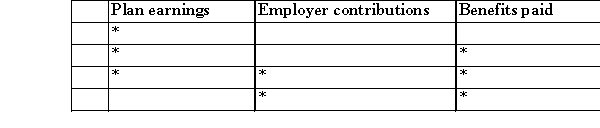
(Multiple Choice)
4.8/5 (73)
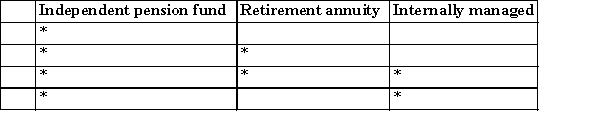
(73) 
Costs related to a new pension plan that are necessary to "catch up" for services rendered prior to the inception of the pension plan are classified as:
(Multiple Choice)
4.9/5 (82)
(82) Today is John's 57th birthday and he has served 14 years for his firm.John is expected to retire on his 65th birthday.His firm expects to incur $5,000 of annual net health care claims costs for John beginning one year after his retirement date and continuing each year for a total of seven years (assume seven end of year payments in all).To be fully eligible for these benefits, John must work 20 years.Compute expected post-retirement benefit obligation for John today if the discount rate is 8%.
(Multiple Choice)
4.8/5 (84)
(84) Under the simplified approach to accounting for defined benefit pension plans under ASPE there may be a pension asset ceiling.
(True/False)
4.8/5 (71)
(71) Jamieson's balance sheet as per IFRS for Year 2 would show a net:
(Multiple Choice)
4.9/5 (77)
(77) Jamieson's pension expense as per ASPE for Year 2 would be:
(Multiple Choice)
4.8/5 (82)
(82) All three funding approaches result in full funding of a pension plan over time.
(True/False)
4.9/5 (82)
(82) Benefits pursuant to a pension plan that are not contingent upon an employee's continuing service are referred to as:
(Multiple Choice)
4.8/5 (77)
(77) Jamieson Corp. sponsors a defined benefit plan for its employee group. The following data pertains to the plan's first 2 years in existence:
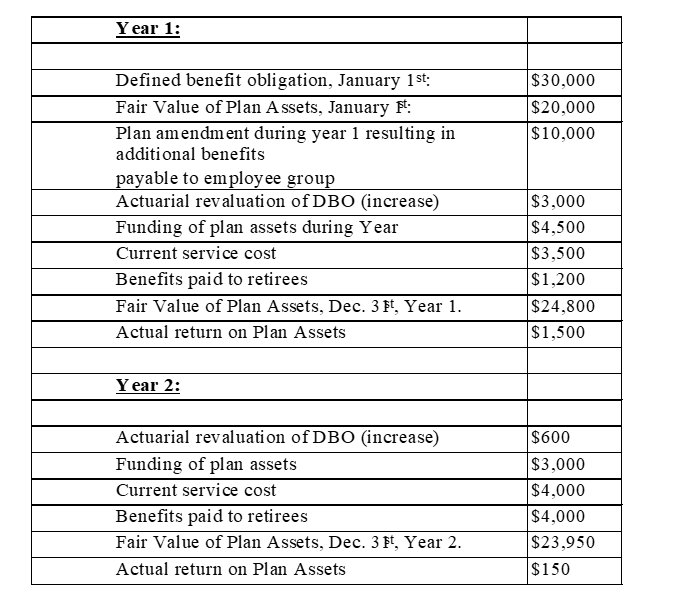 - The plan was started on January 1st, Year 1, with $20,000 of funding
- The company has a December 31st, year-end.
- The plan is non-contributory.
- The company's long-term debt is subject to a 6% discount rate.
-Jamieson's pension expense as per IFRS for Year 2 would be:
- The plan was started on January 1st, Year 1, with $20,000 of funding
- The company has a December 31st, year-end.
- The plan is non-contributory.
- The company's long-term debt is subject to a 6% discount rate.
-Jamieson's pension expense as per IFRS for Year 2 would be: (Multiple Choice)
4.7/5 (71)
(71) Under IFRS, net interest (finance)revenue or expense on defined benefit obligations must always be included within pension expense.
(True/False)
4.9/5 (78)
(78) All of the following are relevant policy disclosures suggested by the AcSB except:
(Multiple Choice)
4.9/5 (78)
(78) Employees are not allowed to make contributions to a defined contribution pension plan.
(True/False)
4.8/5 (69)
(69) Pension plans that are registered meet Revenue Canada requirements and hence qualify for tax advantages.
(True/False)
4.9/5 (70)
(70) A non-funded pension plan is one where the employee must bear a part of the cost of the plan.
(True/False)
4.9/5 (74)
(74) 
Filters
- Essay(0)
- Multiple Choice(0)
- Short Answer(0)
- True False(0)
- Matching(0)