



 Chat with AI
Exam 22: Financial Statement Analysis

Exam 12: Financial Liabilities and Provisions78 Questions
Exam 13: Financial Instruments: Long-Term Debt74 Questions
Exam 14: Shareholders Equity181 Questions
Exam 15: Financial Instruments: Complex Debt and Equity135 Questions
Exam 16: Corporate Income Tax122 Questions
Exam 17: Tax Losses98 Questions
Exam 18: Leases234 Questions
Exam 19: Post-Employment Benefits92 Questions
Exam 20: Earnings Per Share153 Questions
Exam 21: Accounting Changes157 Questions
Exam 22: Financial Statement Analysis165 Questions
Select questions type


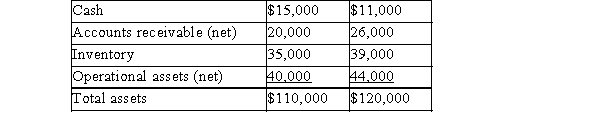
The following data was reported by JSB for a two-year period: 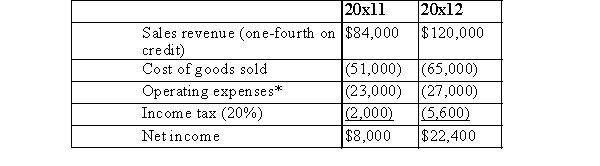 Assets:
 Liabilities:
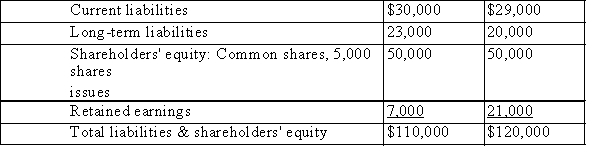 *Includes interest expense, $2,500 (pre-tax)
(a)Compute the following ratios for 20x12:
(1)Receivable turnover
(2)Inventory turnover
(3)Creditors' equity to total assets
(4)Acid test ratio
(5)Return on owners' equity
(6)Profit margin on sales
(7)Current ratio
(8)Return on total assets
(9)Owners' equity to total assets
(10)Financial leverage
(b)Briefly explain and interpret financial leverage.
Assets: Liabilities: *Includes interest expense, $2,500 (pre-tax)
(a)Compute the following ratios for 20x12:
(1)Receivable turnover
(2)Inventory turnover
(3)Creditors' equity to total assets
(4)Acid test ratio
(5)Return on owners' equity
(6)Profit margin on sales
(7)Current ratio
(8)Return on total assets
(9)Owners' equity to total assets
(10)Financial leverage
(b)Briefly explain and interpret financial leverage. (Essay)
4.9/5  (78)
(78) A primary reason for the analysis of financial statements is identification of major changes and to provide relative relationships among dollar amounts.
(True/False)
4.9/5 (76)
(76) A company's return on investment is affected by the market price of its shares.
(True/False)
4.9/5 (83)
(83) To apply a vertical analysis to the balance sheet, the base amount usually selected is:
(Multiple Choice)
4.7/5 (77)
(77) All of the following are examples of regulatory decisions except:
(Multiple Choice)
4.8/5 (66)
(66) Recording the payment (as distinguished from the declaration)of a cash dividend whose declaration was already recorded will:
(Multiple Choice)
4.9/5 (71)
(71) What are multi-industry corporations and what problems, if any are associated with them (i.e.when analyzing their statements)?
(Essay)
4.9/5 (88)
(88) The following information for JG Ltd.is available to you: 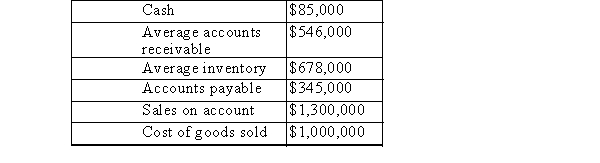 Required:
1.Calculate the accounts receivable turnover ratio
2.You determined that the industry average was 4.5 and that JG Ltd.had turnovers in previous years of 3.5, 3.8, 4.4, and 4.7.Based on this information, can you make any conclusions?
Required:
1.Calculate the accounts receivable turnover ratio
2.You determined that the industry average was 4.5 and that JG Ltd.had turnovers in previous years of 3.5, 3.8, 4.4, and 4.7.Based on this information, can you make any conclusions? (Essay)
5.0/5 (68)
(68) A qualified auditors' opinion is given when the financial statements present information in conformity with GAAP.
(True/False)
4.8/5 (84)
(84) There is a section in every annual report that detail the accounting policies used by a company.Explain why this is important to users and what some of the limitations are.
(Essay)
4.9/5 (79)
(79) Liquidity ratios essentially provide information about a company's ability to meet its short term obligations, while solvency ratios evaluate a company's long-term
going-concern potential.
(True/False)
4.8/5 (77)
(77) Examination of comparative financial statements does not enable financial statement users to better identify long-term trends.
(True/False)
4.9/5 (87)
(87) An improvement to a public company's credit rating where the fair value option is used will adversely affect the company's solvency ratios.
(True/False)
4.7/5 (79)
(79) Upon reading the notes to the financial statements of JMR Ltd., you notice that the policies they have chosen tend to recognize revenue early in the earnings cycle while deferring costs to later periods.This approach leads you to believe that JMR Ltd.is employing a(n):
(Multiple Choice)
4.7/5 (78)
(78) Earnings per share is computed by dividing the number of shares issued into the net income for the period.
(True/False)
4.8/5 (81)
(81) LMN reported the following 2014 data in 000's:  LMN's average age of the receivables was (in days): (Assume 360 days in a year)
 (Multiple Choice)
5.0/5 (82)
(82) A company with sales terms of n/30 would prefer a receivable turnover of:
(Multiple Choice)
5.0/5 (73)
(73) What are the possible decisions that can be made with the use of financial analysis?
(Essay)
4.9/5 (79)
(79) 
Filters
- Essay(0)
- Multiple Choice(0)
- Short Answer(0)
- True False(0)
- Matching(0)