



 Chat with AI
Exam 3: Compounds and Molecules

Exam 1: Measuring Matter and Energy99 Questions
Exam 2: Atomic Structure and Nuclear Radiation135 Questions
Exam 3: Compounds and Molecules164 Questions
Exam 4: Chemical Quantities and Chemical Reactions135 Questions
Exam 5: Changes of State and the Gas Laws85 Questions
Exam 6: Organic Chemistry: Hydrocarbons95 Questions
Exam 7: Organic Chemistry and Biomolecules101 Questions
Exam 8: Solutions, Colloids and Membranes93 Questions
Exam 9: Acids and Bases112 Questions
Exam 10: The Reactions of Organic Functional Groups in Biochemistry87 Questions
Exam 11: Carbohydrates: Structure and Function78 Questions
Exam 12: Lipids: Structure and Function108 Questions
Exam 13: Proteins: Structure and Function122 Questions
Exam 14: Nucleotides and Nucleic Acids107 Questions
Exam 15: Energy and Metabolism117 Questions
Select questions type


Calcium carbonate has the formula CaCO3. What is the charge on the polyatomic carbonate ion?
(Multiple Choice)
4.8/5  (80)
(80) What is the meaning of the "wedge bond" in the following structure? 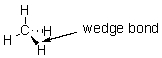
(Multiple Choice)
4.7/5 (77)
(77) Ethanol is an alcohol found in wine and beer and it is also used as a fuel. It has the structure shown below. What is the strongest type of intermolecular interaction attracting molecules of ethanol together? 
(Multiple Choice)
4.9/5 (72)
(72) According to this diagram showing the boiling of liquid water, what happens to liquid water when it boils? 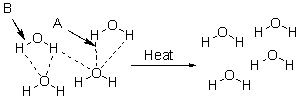
(Multiple Choice)
4.9/5 (88)
(88) Water (H2O) has a higher boiling point than methane (CH4) because water has _______ between molecules.
(Multiple Choice)
4.8/5 (84)
(84) Carbon tetrafluoride is a refrigerant and potent greenhouse gas. Which of the following is the molecular formula for this compound?
(Multiple Choice)
4.9/5 (89)
(89) What is the name of CaCO3, a common calcium supplement and antacid?
(Multiple Choice)
4.8/5 (86)
(86) When determining the shape of a molecule, it is necessary to count electron groups. Which of the following is NOT an electron group?
(Multiple Choice)
4.8/5 (78)
(78) Below is an illustration of an atom of fluorine. Which arrow points to the part of the atom involved in bonding? 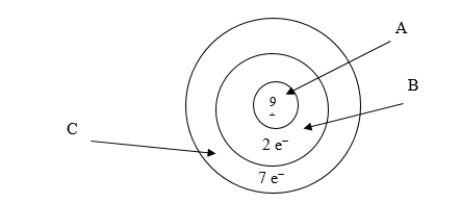

(Multiple Choice)
4.8/5 (87)
(87) Which of the following wedge-dash drawings best represents the ball-and-stick model of methane as it is drawn below?
(Multiple Choice)
4.8/5 (84)
(84) The electronegativity difference between C and O is ____ and therefore the C-O bond is a(n)____ bond.
(Multiple Choice)
4.7/5 (80)
(80) What is the purpose of Valence Shell Electron Pair Repulsion (VSEPR) theory?
(Multiple Choice)
4.9/5 (91)
(91) Which of the following models does NOT contain a carbon with tetrahedral geometry? Assume that all atoms in all structures are visible.
(Multiple Choice)
4.8/5 (90)
(90) Atom X in a molecule has tetrahedral electron geometry but a bent molecular shape. Which of the following describes the identity of atom X?
(Multiple Choice)
4.7/5 (65)
(65) Why do electrons around a central atom arrange themselves as far apart from one another as possible, while still remaining attached to the central atom?
(Multiple Choice)
4.9/5 (77)
(77) The structure below is the Lewis structure of methane. The Lewis structure tells us many things about methane that are useful. However, it also suggests one characteristic of methane that is, in fact, false. What is this one characteristic? 
(Multiple Choice)
4.7/5 (83)
(83) 
Filters
- Essay(0)
- Multiple Choice(0)
- Short Answer(0)
- True False(0)
- Matching(0)