



 Chat with AI
Exam 5: Changes of State and the Gas Laws

Exam 1: Measuring Matter and Energy99 Questions
Exam 2: Atomic Structure and Nuclear Radiation135 Questions
Exam 3: Compounds and Molecules164 Questions
Exam 4: Chemical Quantities and Chemical Reactions135 Questions
Exam 5: Changes of State and the Gas Laws85 Questions
Exam 6: Organic Chemistry: Hydrocarbons95 Questions
Exam 7: Organic Chemistry and Biomolecules101 Questions
Exam 8: Solutions, Colloids and Membranes93 Questions
Exam 9: Acids and Bases112 Questions
Exam 10: The Reactions of Organic Functional Groups in Biochemistry87 Questions
Exam 11: Carbohydrates: Structure and Function78 Questions
Exam 12: Lipids: Structure and Function108 Questions
Exam 13: Proteins: Structure and Function122 Questions
Exam 14: Nucleotides and Nucleic Acids107 Questions
Exam 15: Energy and Metabolism117 Questions
Select questions type


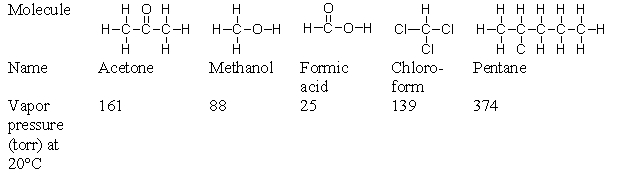

Why is water (H2O) a liquid at room temperature while methane (CH4) is a gas?
(Multiple Choice)
4.8/5  (85)
(85) Which atom has the highest electronegativity in this molecule of acetone? 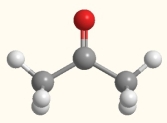
(Multiple Choice)
4.8/5 (71)
(71) How does the pressure of a gas change when it is heated in a sealed container with a constant volume (note: it is not a good idea to do this without special equipment)?
(Multiple Choice)
4.8/5 (71)
(71) 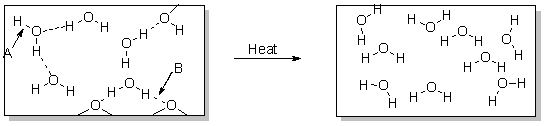
Two sealed boxes are filled with gas. The first box contains more molecules moving faster and therefore a higher pressure. The second box contains fewer molecules moving slower and therefore a lower pressure. Why does the first box have a higher pressure?
(Multiple Choice)
4.7/5 (77)
(77) Which statement best describes how the kinetic molecular view of gases can be used to explain the effect of gas temperature on gas pressure?
(Multiple Choice)
4.8/5 (71)
(71) The temperature of a gas at 1.00 atm and 8.00C is increased to 20.0C, resulting in a change of pressure. What is the new pressure?
(Multiple Choice)
4.9/5 (79)
(79) A scuba diver dives down to 15 m, where the pressure is 2.5 atm. The scuba diver then inhales 500. mL of air and holds his breath while ascending to the water surface, where the pressure is 1 atm. What is the volume of the air in the diver's lungs at the surface? Assume that T and n are constant.
(Multiple Choice)
4.8/5 (79)
(79) Which of the following statements best describes why a higher concentration of carbon dioxide is present in exhaled breath compared to inhaled breath?
(Multiple Choice)
4.9/5 (81)
(81) You have a balloon containing 1.4 L of gas in it at standard temperature and pressure. Which conversion factor would you use to convert this number to moles?
(Multiple Choice)
4.9/5 (79)
(79) Atmospheric pressure at sea level is ________. At elevations higher than sea level, atmospheric pressure is_________.
(Multiple Choice)
4.8/5 (76)
(76) Air is primarily composed of nitrogen (594 torr) and oxygen (160 torr). There is also carbon dioxide and water vapor in the air. Assuming that atmospheric pressure is 760 torr, what is the partial pressure of carbon dioxide and water vapor combined?
(Multiple Choice)
4.8/5 (77)
(77) In which of the following phase changes is energy transferred to a substance?
(Multiple Choice)
5.0/5 (78)
(78) Which of the following circumstances does NOT cause decompression sickness?
(Multiple Choice)
4.9/5 (85)
(85) 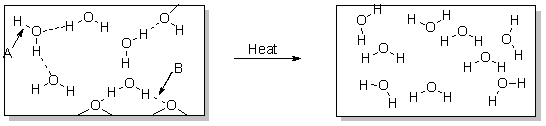
Which of the following is the common treatment for the bends?
(Multiple Choice)
4.8/5 (83)
(83) What is the relationship between polarity and vapor pressure?
(Multiple Choice)
4.9/5 (84)
(84) Which molecule in this table has the highest boiling point? 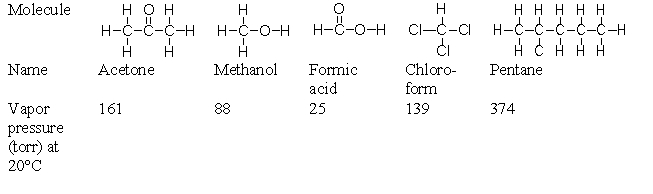
(Multiple Choice)
4.9/5 (81)
(81) Which of the following changes of state is correctly named?
(Multiple Choice)
4.8/5 (71)
(71) 
Filters
- Essay(0)
- Multiple Choice(0)
- Short Answer(0)
- True False(0)
- Matching(0)