



 Chat with AI
Exam 9: Nontariff Barriers to Imports

Exam 1: International Economics Is Different60 Questions
Exam 2: The Basic Theory Using Demand and Supply60 Questions
Exam 3: Why Everybody Trades: Comparative Advantage59 Questions
Exam 4: Trade: Factor Availability and Factor Proportions Are Key48 Questions
Exam 5: Who Gains and Who Loses From Trade60 Questions
Exam 6: Scale Economies, Imperfect Competition, and Trade59 Questions
Exam 7: Growth and Trade Part II: Trade Policy60 Questions
Exam 8: Analysis of a Tariff60 Questions
Exam 9: Nontariff Barriers to Imports60 Questions
Exam 10: Arguments for and Against Protection60 Questions
Exam 11: Pushing Exports52 Questions
Exam 12: Trade Blocs and Trade Blocks60 Questions
Exam 13: Trade and the Environment60 Questions
Exam 14: Trade Policies for Developing Countries60 Questions
Exam 15: Multinationals and Migration: International Factor Movements60 Questions
Exam 16: Payments Among Nations60 Questions
Exam 17: The Foreign Exchange Market56 Questions
Exam 18: Forward Exchange and International Financial Investment60 Questions
Exam 19: What Determines Exchange Rates44 Questions
Exam 20: Government Policies Toward the Foreign Exchange Market56 Questions
Exam 21: International Lending and Financial Crises60 Questions
Exam 22: How Does the Open Macroeconomy Work59 Questions
Exam 23: Internal and External Balance With Fixed Exchange Rates59 Questions
Exam 24: Floating Exchange Rates and Internal Balance60 Questions
Exam 25: National and Global Choices: Floating Rates and the Alternatives60 Questions
Select questions type


Briefly discuss different methods of allocating quota licenses to the importers by the government. Also explain the inefficiency implications of each method.
(Essay)
4.8/5  (80)
(80) The figure given below shows the market for moped imports in the country. DM and SX are the domestic demand for imports and export supply curves respectively. 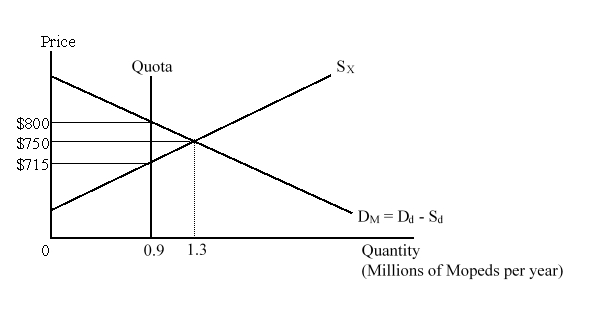 As a result of the quota being imposed on moped imports by this country, the world as a whole will:
 (Multiple Choice)
5.0/5 (90)
(90) Suppose a country's government is deciding whether or not to impose an import quota to protect the domestic automobile industry. Will the domestic steel-producing firms be in favor of a quota designed to protect the local automobile producers? Why or why not?
(Essay)
4.8/5 (90)
(90) Which of the following mandates that an import distributor must buy a certain percentage of the product locally?
(Multiple Choice)
4.8/5 (70)
(70) What is the percent reduction in import quantity in a country due to the tariffs imposed by the government, if the country's import tariffs are all 10 percent. The total imports affected by the tariffs are 40 percent of the GDP and the net national loss from the tariffs as a percentage of GDP is 0.6 percent.
(Multiple Choice)
4.9/5 (86)
(86) Explain how the cost of a country's tariffs is calculated as a percentage of GDP. Which effects are captured in this process? Why is the true cost of import protection probably larger than what can be shown in simple graphs or as calculated by the net national loss formula?
(Essay)
4.9/5 (80)
(80) Which of the following is a means of allocating import licenses by assigning the licenses without competition, applications, or negotiation?
(Multiple Choice)
4.7/5 (78)
(78) Governments choose to use voluntary export restraints rather than tariffs because:
(Multiple Choice)
5.0/5 (87)
(87) The figure given below shows the domestic demand (Dd) and supply (Sd) curves of mopeds in a country before an import quota is imposed by the government. After the imposition of quota, the total available supply curve becomes Sd + QQ. 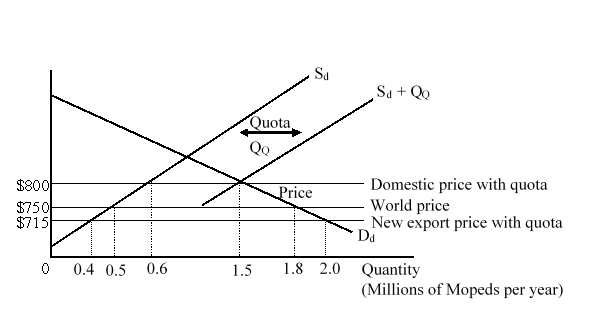 If the government auctions the quota licenses, the importing nation will:
 (Multiple Choice)
4.7/5 (80)
(80) With a voluntary export restraint (VER), the economic rent created for the quantitatively limited on trade is collected by:
(Multiple Choice)
4.8/5 (81)
(81) A small country imports T-shirts. With free trade at a world price of $10, domestic production is 10 million T-shirts and domestic consumption is 42 million T-shirts. The country's government now decides to impose a quota to limit T-shirt imports to 20 million per year. With the import quota in place, the domestic price rises to $12 per T-shirt and domestic production rises to 15 million T-shirts per year. If the government auctions the quota licenses, calculate the revenue collected by the government.
(Multiple Choice)
4.8/5 (78)
(78) Which of the following allows the president of the United States to negotiate to eliminate unfair trade practices put in place by foreign governments?
(Multiple Choice)
5.0/5 (78)
(78) The figure given below shows the market for MP3 players in a small country. Dd and Sd are the domestic demand and domestic supply curves of the MP3 players before the imposition of the quota. (Sd + QQ) is the total available domestic supply curve after the quota has been imposed. According to the figure, if import licenses are allocated based on a resource-using procedure, the loss to the economy will be: 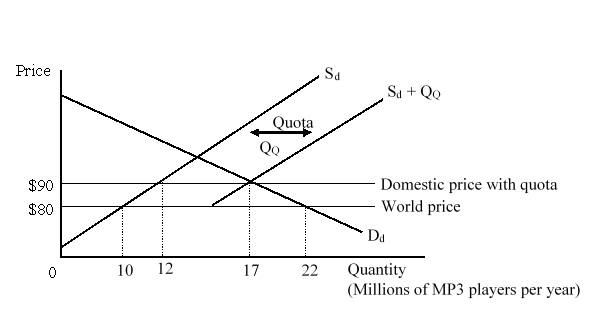
(Multiple Choice)
4.8/5 (73)
(73) In the case of a small country, the effects of a quota and a tariff are (almost) identical if:
(Multiple Choice)
4.9/5 (85)
(85) Which of the following is NOT true of the Uruguay Round of the multilateral trade negotiations?
(Multiple Choice)
4.9/5 (80)
(80) The revenue earned by the government in allocating quota licenses through resource-using application procedures is approximately equal to the revenue that it would earn from a tariff that resulted in the same import quantity.
(True/False)
5.0/5 (77)
(77) In an attempt to restrict imports in a country, imposition of a tariff is likely to be more efficient than using voluntary export restraints.
(True/False)
4.9/5 (82)
(82) A small country imports T-shirts. With free trade at a world price of $10, domestic production is 10 million T-shirts and domestic consumption is 42 million T-shirts. The country's government now decides to impose a quota to limit T-shirt imports to 20 million per year. With the import quota in place, the domestic price rises to $12 per T-shirt and domestic production rises to 15 million T-shirts per year. The quota on T-shirts causes domestic consumers to:
(Multiple Choice)
4.9/5 (88)
(88) 
Filters
- Essay(0)
- Multiple Choice(0)
- Short Answer(0)
- True False(0)
- Matching(0)