



 Chat with AI
Exam 19: Corporate Formation, Reorganization, and Liquidation

Exam 1: An Introduction to Tax110 Questions
Exam 2: Tax Compliance, the Irs, and Tax Authorities112 Questions
Exam 3: Tax Planning Strategies and Related Limitations107 Questions
Exam 4: Individual Income Tax Overview, Exemptions, and Filing Status126 Questions
Exam 5: Gross Income and Exclusions131 Questions
Exam 6: Individual Deductions107 Questions
Exam 7: Investments75 Questions
Exam 8: Individual Income Tax Computation and Tax Credits154 Questions
Exam 9: Business Income, Deductions, and Accounting Methods99 Questions
Exam 10: Property Acquisition and Cost Recovery94 Questions
Exam 11: Property Dispositions110 Questions
Exam 12: Compensation102 Questions
Exam 13: Retirement Savings and Deferred Compensation115 Questions
Exam 14: Tax Consequences of Home Ownership111 Questions
Exam 15: Entities Overview70 Questions
Exam 16: Corporate Operations140 Questions
Exam 17: Accounting for Income Taxes100 Questions
Exam 18: Corporate Taxation: Nonliquidating Distributions98 Questions
Exam 19: Corporate Formation, Reorganization, and Liquidation100 Questions
Exam 20: Forming and Operating Partnerships102 Questions
Exam 21: Dispositions of Partnership Interests and Partnership Distributions100 Questions
Exam 22: S Corporations134 Questions
Exam 23: State and Local Taxes117 Questions
Exam 24: The US Taxation of Multinational Transactions100 Questions
Exam 25: Transfer Taxes and Wealth Planning123 Questions
Select questions type


Which of the following amounts is not included in the computation of a property's adjusted basis in an exchange?
(Multiple Choice)
4.8/5  (64)
(64) In December 2017, Jill incurred a $50,000 loss on the sale of Crown Corporation stock that shepurchased in 2010. The stock satisfied all of the §1244 stock requirements at the time of issue. Jill is married to Jack and together they file a joint tax return. How much of the loss can Jack and Jilldeduct in 2017, assuming they do not have capital gains in the current or prior years, and what is thecharacter of the loss?
(Essay)
4.9/5 (68)
(68) A liquidated corporation will always recognize loss in a complete liquidation where none of the shareholders is a corporation.
(True/False)
4.9/5 (77)
(77) Which of the following statements best describes the impact of receiving boot in a section 351 transaction?
(Multiple Choice)
4.9/5 (77)
(77) Katarina transferred her 10 percent interest to Spartan Company as part of a complete liquidation of the company. In the exchange, she received land with a fair market value of $200,000. Katarina's basis in the Spartan stock was $100,000. The land had a basis to Spartan Company of $50,000. What amount of gain does Spartan recognize in theexchange and what is Katarina's basis in the land she receives?
(Multiple Choice)
4.9/5 (86)
(86) Which of the following statements best describes the requirement that must be met in a tax-deferred Type B stock-for-stock reorganization?
(Multiple Choice)
4.7/5 (71)
(71) Mike and Michelle decided to liquidate their jointly owned corporation, Pennsylvania Corporation. Afterliquidating its remaining inventory and paying off its remaining liabilities, Pennsylvania had the following tax accounting balance sheet.  Under the terms of the agreement, Mike will receive the $200,000 cash in exchange for his 40 percent interest in Pennsylvania. Mike's tax basis in his Pennsylvania stock is $50,000. Michelle will receive the building and land in exchange for her 60 percent interest in Pennsylvania. Her tax basis in the Pennsylvania stock is$100,000.What amount of gain or loss does Pennsylvania recognize in the complete liquidation?
 (Essay)
4.9/5 (77)
(77) Jamie transferred 100 percent of her stock in Fox Company to Otter Corporation in aType A merger. In exchange, she received stock in Otter with a fair market value of$400,000 plus $600,000 in cash. Jamie's tax basis in the Fox stock was $600,000. What amount of gain does Jamie recognize in the exchange and what is her basis in the Otter stock she receives?
(Multiple Choice)
4.8/5 (89)
(89) M Corporation assumes a $200 liability attached to property transferred to it by Jane in a section 351 transaction. In all cases, the assumed liability will be treated as boot received by Jane.
(True/False)
4.9/5 (79)
(79) Generally, before gain or loss is realized for tax purposes, the taxpayer must engage in atransaction.
(True/False)
4.8/5 (88)
(88) In December 2017, Zeb incurred a $100,000 loss on the sale of Pike Corporation stock that he purchased in 2010. The stock satisfied all of the §1244 stock requirements at the time of issue. In addition, Zeb reported a long-term capital gain of $40,000 in 2017. Zeb is single. How much of the loss can Zeb deduct in 2017, and what is the character of the loss?
(Essay)
4.8/5 (85)
(85) Robin transferred her 60 percent interest to Cardinal Company as part of a completeliquidation of the company. In the exchange, she received land with a fair market value of $800,000. Robin's basis in the Cardinal stock was $900,000. The land had a basis to Cardinal Company of $1,000,000. What amount of loss does Cardinal recognize in the exchange and what is Robin's basis in the land she receives? The distribution was non pro rata to Robin, a related person.
(Multiple Choice)
4.8/5 (75)
(75) Red Blossom Corporation transferred its 40 percent interest to Tea Company as part of a complete liquidation of the company. In the exchange, Red Blossom received land with a fair market value of $500,000. The corporation's basis in the Tea Company stock was$300,000. The land had a basis to Tea Company of $600,000. What amount of gain doesRed Blossom recognize in the exchange and what is its basis in the land it receives?
(Multiple Choice)
4.9/5 (78)
(78) Don and Marie formed Paper Lilies Corporation on January 2. Don contributed cash of $400,000 in return for50 percent of the corporation's stock. Marie contributed a building and land with the following fair market values and tax-adjusted bases in return for 50 percent of the corporation's stock.  To equalize the exchange, Paper Lilies Corporation paid Marie $50,000 in addition to her stock. a. What amount of gain or loss does Marie realize on the formation of the corporation?b. What amount of gain or loss, if any, does she recognize?c. What is Marie's tax basis in the stock she receives in return for her contribution of property to the corporation?d. What adjusted basis does Paper Lilies Corporation take in the land and building received from Marie?
 (Essay)
4.9/5 (70)
(70) Keegan incorporated his sole proprietorship by transferring inventory, a building, and land to the corporation in return for 100 percent of the corporation's stock. The property transferred to the corporation had the following fair market values and tax-adjusted bases. 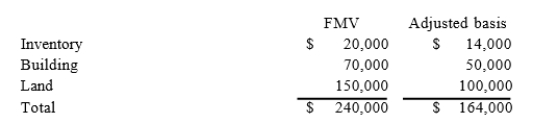 The fair market value of the corporation's stock received in the exchange equaled the fair market value of the assets transferred to the corporation by Keegan.Assuming the gain or loss realized in this problem is deferred under §351, what is Keegan's basis in the stock he receives in his corporation?
 (Essay)
4.9/5 (80)
(80) Which of the following requirements do not have to be met in a section 351 transaction?
(Multiple Choice)
4.8/5 (84)
(84) The City of Boston made a capital contribution of land to Fenway Company as an inducement to the company to build a manufacturing plant in the city. Boston paid $600,000 for the land several years ago and it currently has a fair market value of $1,000,000. What is the tax basis of the land toFenway Company?
(Essay)
4.8/5 (87)
(87) Which of the following statements best describes the tax law approach to recognizing gain or loss realized in an exchange?
(Multiple Choice)
4.9/5 (76)
(76) Roberta transfers property with a tax basis of $400 and a fair market value of $500 to a corporation in exchange for stock with a fair market value of $350 in a transaction that qualifies for deferral under section 351. The corporation assumed a liability of $150 on the property transferred. What is the amount realized by Roberta in the exchange?
(Multiple Choice)
4.9/5 (81)
(81) Billie transferred her 20 percent interest to Jean Company as part of a completeliquidation of the company. In the exchange, she received land with a fair market value of $200,000. Billie's basis in the Jean stock was $100,000. The land had a basis to Jean Company of $400,000. What amount of loss does Jean recognize in the exchange and what is Billie's basis in the land she receives? Billie is not considered a related party to Jean Company.
(Multiple Choice)
4.8/5 (77)
(77) 
Filters
- Essay(0)
- Multiple Choice(0)
- Short Answer(0)
- True False(0)
- Matching(0)