



 Chat with AI
Exam 3: Tax Planning Strategies and Related Limitations

Exam 1: An Introduction to Tax110 Questions
Exam 2: Tax Compliance, the Irs, and Tax Authorities112 Questions
Exam 3: Tax Planning Strategies and Related Limitations107 Questions
Exam 4: Individual Income Tax Overview, Exemptions, and Filing Status126 Questions
Exam 5: Gross Income and Exclusions131 Questions
Exam 6: Individual Deductions107 Questions
Exam 7: Investments75 Questions
Exam 8: Individual Income Tax Computation and Tax Credits154 Questions
Exam 9: Business Income, Deductions, and Accounting Methods99 Questions
Exam 10: Property Acquisition and Cost Recovery94 Questions
Exam 11: Property Dispositions110 Questions
Exam 12: Compensation102 Questions
Exam 13: Retirement Savings and Deferred Compensation115 Questions
Exam 14: Tax Consequences of Home Ownership111 Questions
Exam 15: Entities Overview70 Questions
Exam 16: Corporate Operations140 Questions
Exam 17: Accounting for Income Taxes100 Questions
Exam 18: Corporate Taxation: Nonliquidating Distributions98 Questions
Exam 19: Corporate Formation, Reorganization, and Liquidation100 Questions
Exam 20: Forming and Operating Partnerships102 Questions
Exam 21: Dispositions of Partnership Interests and Partnership Distributions100 Questions
Exam 22: S Corporations134 Questions
Exam 23: State and Local Taxes117 Questions
Exam 24: The US Taxation of Multinational Transactions100 Questions
Exam 25: Transfer Taxes and Wealth Planning123 Questions
Select questions type


The timing strategy is particularly effective for cash basis taxpayers.

Free
(True/False)
4.9/5  (77)
(77) Correct Answer: Verified
True
Which of the following is not required to determine the best timing strategy?
Free
(Multiple Choice)
4.7/5 (85)
(85) Correct Answer:Verified
VerifiedC
Which of the following tax planning strategies is based on the present value of money?
Free
(Multiple Choice)
4.8/5 (83)
(83) Correct Answer:Verified
VerifiedD
The downside of tax avoidance includes the potential of stiff monetary penalties and imprisonment.
(True/False)
4.8/5 (75)
(75) Assume that Jose is indifferent between investing in a corporate bond that pays 10% interest and a stock with no growth potential that pays an 8% dividend yield. Assume that the tax rate on dividends is 15%. What is Jose's marginal tax rate?
(Multiple Choice)
5.0/5 (87)
(87) The business purpose, step-transaction, and substance-over-form doctrines may limit the income shifting strategy.
(True/False)
4.7/5 (93)
(93) If tax rates will be higher next year, taxpayers should defer their income to next year regardless of their after-tax rate of return.
(True/False)
4.7/5 (72)
(72) Lucky owns a maid service that cleans several local businesses nightly. Lucky, a high-tax ratetaxpayer, would like to shift some income to his son Rocco. Lucky tells all of his customers (who are always timely in their payments) to pay Rocco and then Rocco will report 50% of the income as a collection fee. Lucky will report the remaining 50%. Will this shift the income from Lucky to Rocco? Why or why not? What doctrines influence your answer? Any suggestions for Lucky?
(Essay)
5.0/5 (81)
(81) Assume that Lucas' marginal tax rate is 30% and his tax rate on dividends is 15%. If a dividend-paying stock (with no growth potential) pays an 8% dividend yield, whatinterest rate would a municipal bond have to offer for Lucas to be indifferent between the two investments from a cash-flow perspective?
(Multiple Choice)
4.8/5 (65)
(65) The value of a tax deduction is higher for a taxpayer with a lower tax rate.
(True/False)
4.8/5 (70)
(70) Investing in municipal bonds to avoid paying tax on interest earned and to earn a higher after-tax yield is an example of:
(Multiple Choice)
4.7/5 (75)
(75) A taxpayer instructing her son to collect rent checks for the taxpayer's property and to report this as taxable income on the son's tax return violates which doctrine?
(Multiple Choice)
4.8/5 (86)
(86) Based only on the information provided for each scenario, determine whether Kristi or Cindy will benefit more from using the timing strategy and why there will be a benefit to that person. Use Exhibit 3.1. 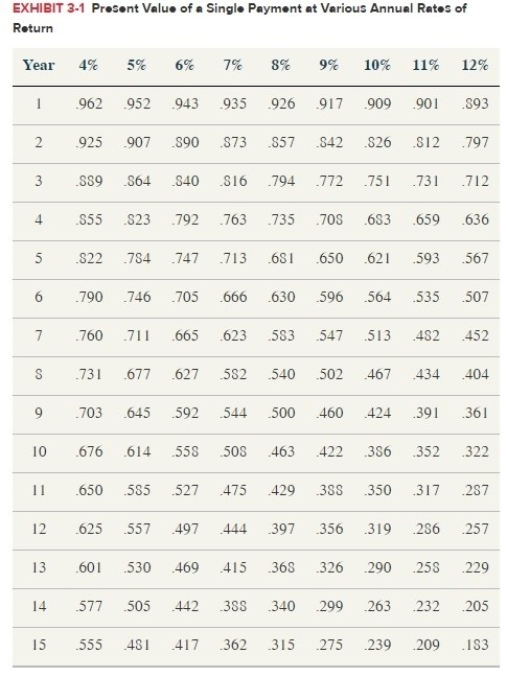 a. Kristi has a 40% tax rate and can defer $20,000 of income. Cindy has a 30% tax rate and can defer $30,000 of income.b. Kristy has a 30% tax rate, a 10% after-tax rate of return, and can defer $25,000 of income for three years. Cindy has a 40% tax rate, an 8% after-tax rate of return, and can defer $20,000 of income for four years.
 (Essay)
4.7/5 (71)
(71) The constructive receipt doctrine is more of an issue for cash basis taxpayers.
(True/False)
5.0/5 (82)
(82) Sal, a calendar year taxpayer, uses the cash-basis method of accounting for his sole proprietorship.In late December he performed $40,000 of consulting services for a client. Sal typically requires his clients to pay his bills immediately upon receipt. Assume that Sal's marginal tax rate is 30% this year and 35% next year and that he can earn an after-tax rate of return of 12% on his investments. Should Sal send his client the bill in December or January? Use Exhibit 3.1. 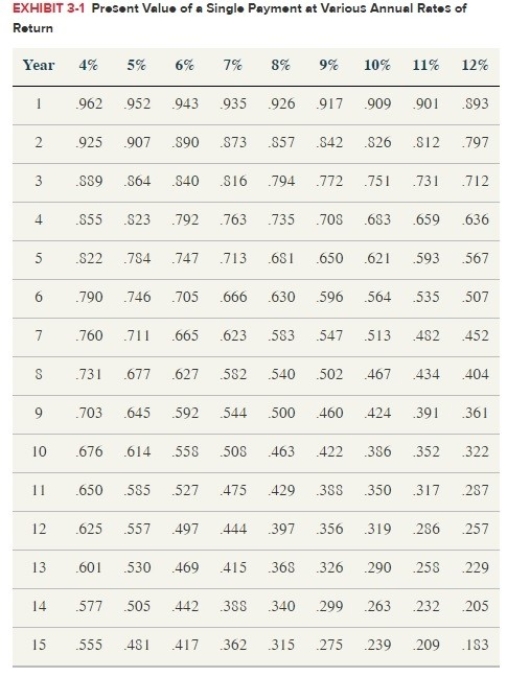
(Essay)
4.8/5 (77)
(77) Lucinda is contemplating a long range planning strategy that will allow her to defer sizable portions of her income for 10 years. What type of planning strategy is she contemplating? What are some potential risks associated with this type of strategy?
(Essay)
4.9/5 (74)
(74) Joe Harry, a cash basis taxpayer, owes $20,000 in tax deductible accounting fees for his business.Assume that it is December 28 and that Joe Harry can avoid any finance charges if he pays the accounting fees by January 10. Joe Harry's tax rate this year is 30%. His tax rate next year will be33%. His after-tax rate of return is 8%. When should Joe Harry pay the $20,000 fees and why? UseExhibit 3.1. 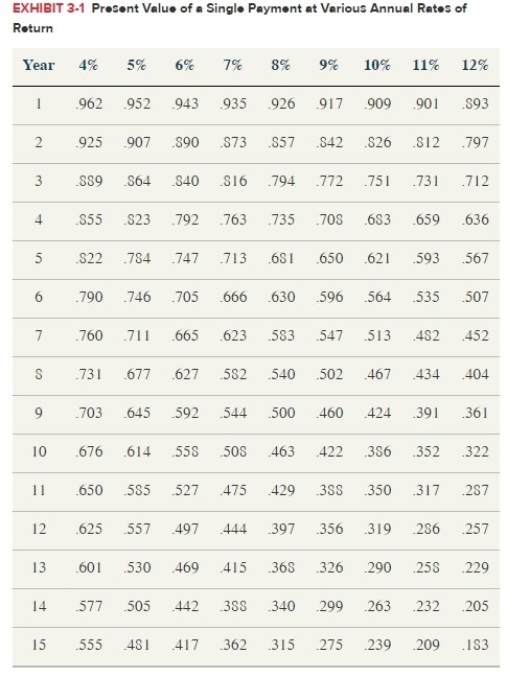
(Essay)
4.9/5 (85)
(85) Tax avoidance is a legal activity that forms the basis of the basic tax planning strategies.
(True/False)
4.8/5 (73)
(73) Danny argues that tax accountants suffer from one-mindedness in their attempts at tax planning (i.e., reducing taxes at all costs). Is Danny's view of tax planning correct - i.e., does he understand whatthe goal of tax planning is? Please elaborate.
(Essay)
4.8/5 (82)
(82) 
Filters
- Essay(0)
- Multiple Choice(0)
- Short Answer(0)
- True False(0)
- Matching(0)