



 Chat with AI
Exam 3: Tax Planning Strategies and Related Limitations

Exam 1: An Introduction to Tax110 Questions
Exam 2: Tax Compliance, the Irs, and Tax Authorities112 Questions
Exam 3: Tax Planning Strategies and Related Limitations107 Questions
Exam 4: Individual Income Tax Overview, Exemptions, and Filing Status126 Questions
Exam 5: Gross Income and Exclusions131 Questions
Exam 6: Individual Deductions107 Questions
Exam 7: Investments75 Questions
Exam 8: Individual Income Tax Computation and Tax Credits154 Questions
Exam 9: Business Income, Deductions, and Accounting Methods99 Questions
Exam 10: Property Acquisition and Cost Recovery94 Questions
Exam 11: Property Dispositions110 Questions
Exam 12: Compensation102 Questions
Exam 13: Retirement Savings and Deferred Compensation115 Questions
Exam 14: Tax Consequences of Home Ownership111 Questions
Exam 15: Entities Overview70 Questions
Exam 16: Corporate Operations140 Questions
Exam 17: Accounting for Income Taxes100 Questions
Exam 18: Corporate Taxation: Nonliquidating Distributions98 Questions
Exam 19: Corporate Formation, Reorganization, and Liquidation100 Questions
Exam 20: Forming and Operating Partnerships102 Questions
Exam 21: Dispositions of Partnership Interests and Partnership Distributions100 Questions
Exam 22: S Corporations134 Questions
Exam 23: State and Local Taxes117 Questions
Exam 24: The US Taxation of Multinational Transactions100 Questions
Exam 25: Transfer Taxes and Wealth Planning123 Questions
Select questions type


An astute tax student once summarized that many of the tax planning strategies merely make use of the variation of taxation across different dimensions. Explain why this is true. Be specific.
(Essay)
4.9/5  (84)
(84) Virtually every transaction involves the taxpayer and two other parties that have aninterest in the tax ramifications of the transaction.
(True/False)
4.9/5 (84)
(84) Bobby and Whitney are husband and wife and Whitney operates a sole proprietorship. They expect their joint taxable income next year to be $225,000, of which $150,000 is attributed to the soleproprietorship. Whitney is contemplating incorporating the sole proprietorship. Using the 2017 married filing joint tax brackets and the corporate tax brackets, how much current tax could this strategy save Bobby and Whitney? How much income should be retained in the corporation? (Use tax rate schedule; Corporate tax rate schedule)
(Essay)
4.8/5 (88)
(88) The conversion strategy capitalizes on the fact that tax rates vary across different activities.
(True/False)
4.9/5 (89)
(89) Assume that Shavonne's marginal tax rate is 50% and her tax rate on dividends is 15%. If a corporate bond pays 10.2% interest, what dividend yield would a dividend-payingstock (with no growth potential) have to offer for Shavonne to be indifferent between the two investments from a cash-flow perspective?
(Multiple Choice)
4.9/5 (79)
(79) Based only on the information provided for each scenario, determine whether Eddy or Scott will benefit more from using the timing strategy and why there will be a benefit to that person. Use Exhibit 3.1. 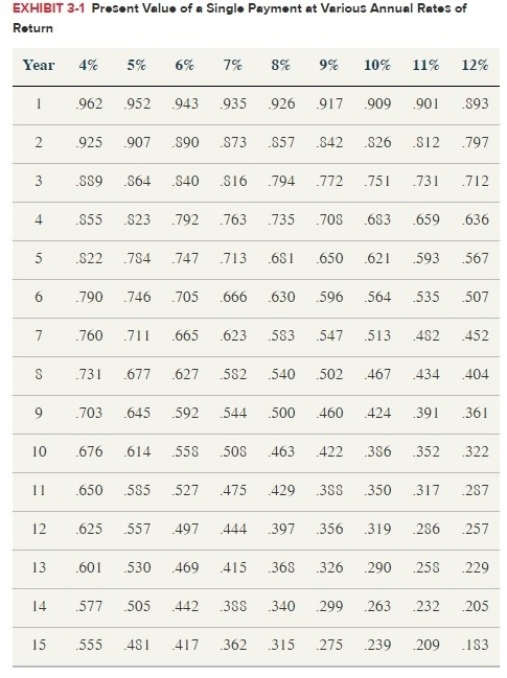 a. Eddy has a 40% tax rate. Scott has a 30% tax rate.b. Eddy and Scott each have a 40% tax rate. Eddy has $10,000 of income that could be deferred; Scott has$20,000 of income that could be shifted.c. Eddy and Scott each have a 40% tax rate and $20,000 of income that could be deferred. Eddy's after-tax rate of return is 8%. Scott's after-tax rate of return is 10%.d. Eddy and Scott each have a 40% tax rate, $20,000 of income that could be deferred, and an after-tax rate of return of 10%. Eddy can defer income up to 3 years. Scott can defer income up to 2 years.
 (Essay)
5.0/5 (72)
(72) 
Filters
- Essay(0)
- Multiple Choice(0)
- Short Answer(0)
- True False(0)
- Matching(0)