



 Chat with AI
Exam 21: Dispositions of Partnership Interests and Partnership Distributions

Exam 1: An Introduction to Tax110 Questions
Exam 2: Tax Compliance, the Irs, and Tax Authorities112 Questions
Exam 3: Tax Planning Strategies and Related Limitations107 Questions
Exam 4: Individual Income Tax Overview, Exemptions, and Filing Status126 Questions
Exam 5: Gross Income and Exclusions131 Questions
Exam 6: Individual Deductions107 Questions
Exam 7: Investments75 Questions
Exam 8: Individual Income Tax Computation and Tax Credits154 Questions
Exam 9: Business Income, Deductions, and Accounting Methods99 Questions
Exam 10: Property Acquisition and Cost Recovery94 Questions
Exam 11: Property Dispositions110 Questions
Exam 12: Compensation102 Questions
Exam 13: Retirement Savings and Deferred Compensation115 Questions
Exam 14: Tax Consequences of Home Ownership111 Questions
Exam 15: Entities Overview70 Questions
Exam 16: Corporate Operations140 Questions
Exam 17: Accounting for Income Taxes100 Questions
Exam 18: Corporate Taxation: Nonliquidating Distributions98 Questions
Exam 19: Corporate Formation, Reorganization, and Liquidation100 Questions
Exam 20: Forming and Operating Partnerships102 Questions
Exam 21: Dispositions of Partnership Interests and Partnership Distributions100 Questions
Exam 22: S Corporations134 Questions
Exam 23: State and Local Taxes117 Questions
Exam 24: The US Taxation of Multinational Transactions100 Questions
Exam 25: Transfer Taxes and Wealth Planning123 Questions
Select questions type


Barry has a basis in his partnership interest of $50,000 when the partnership distributes$60,000 to Barry. As a result of the distribution, Barry reduces his basis in thepartnership interest to $0, has a $60,000 basis in the cash received, and he recognizes a gain of $10,000 on the distribution.
(True/False)
4.8/5  (75)
(75) Jason is a 25% partner in the JJM Partnership when he sells his entire interest to Lavellefor $76,000. At the time of the sale, Jason's basis in JJM is $87,000. JJM does not have any debt or hot assets. Jason's will recognize a gain of $11,000 on the sale of hispartnership interest.
(True/False)
4.9/5 (76)
(76) Which of the following statements is false concerning partnership liquidating distributions?
(Multiple Choice)
4.9/5 (81)
(81) Randolph is a 30% partner in the RD Partnership. On January 1, RD distributes $15,000 cash, inventory with a fair value of $20,000 (inside basis of $10,000), and a parcel ofland with a fair value of $10,000 (inside basis of $5,000) to Randolph in completeliquidation of his interest. RD has no liabilities at the date of the distribution. Randolph's basis in RD is $37,000. What is Randolph's basis in the distributed inventory and land?
(Multiple Choice)
4.8/5 (75)
(75) Scott is a 50% partner in the LS Partnership. Scott has a basis in his partnership interest of $84,000 at the end of the current year, prior to any distribution. On December 31, Scott receives an operating distribution of $9,000 cash and a parcel of land with a $21,000 fair market value and a $12,000basis to the partnership. LS has no debt or hot assets. What is the amount and character of Scott's recognized gain or loss? What is Scott's basis in the distributed property? What is Scott's ending basis in his partnership interest?
(Essay)
4.9/5 (71)
(71) The VRX Partnership (a calendar year-end entity) has the following assets and no liabilities: 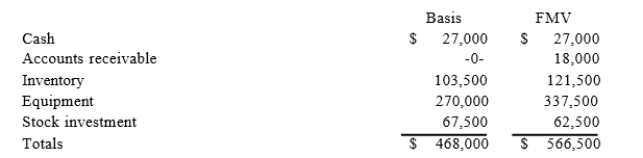 The equipment was purchased for $360,000 and VRX has taken $90,000 of depreciation. The stock was purchased 7 years ago. What are VRX's hot assets for purposes of a sale of partnership interest?
 (Essay)
4.9/5 (84)
(84) If the partnership has hot assets at the time a partnership interest is sold, the sellingpartner must allocate a portion of the sale proceeds to these assets and recognize ordinary income (loss).
(True/False)
5.0/5 (70)
(70) Tyson is a 25% partner in the KT Partnership. On January 1, KT makes a proportionate distribution of $16,000 cash, inventory with a $16,000 fair value (inside basis $8,000), and land with a fair value of $8,000 (inside basis of $12,000) to Tyson. KT has noliabilities at the date of the distribution. Tyson's basis in KT is $24,000. What is Tyson's basis in the distributed inventory and land?
(Multiple Choice)
4.9/5 (65)
(65) Riley is a 50% partner in the RF Partnership and has an outside basis of $56,000 at the end of the year prior to any distributions. On December 31, Riley receives a proportionate operating distribution of $6,000 cash and a parcel of land with a $14,000 fair value and an $8,000 basis to RF. What is Riley's basis in the distributed property?
(Multiple Choice)
4.8/5 (90)
(90) Kathy is a 25% partner in the KDP Partnership and receives $120,000 cash in complete liquidation of her partnership interest. Kathy's outside basis immediately before the distribution is $160,000. KDP currently has a §754 election in effect and has no hot assets or liabilities. Which of the following statements is true?
(Multiple Choice)
4.7/5 (80)
(80) Brian is a 25% partner in the BC Partnership. On January 1, BC distributes $20,000 cash and land with a $16,000 fair value (inside basis $8,000) to Brian. BC has no liabilities at the date of the distribution. Brian's basis in BC is $16,000. What is the amount and character of Brian's gain or loss on the distribution?
(Multiple Choice)
4.9/5 (92)
(92) Ted is a 30% partner in the TDW Partnership with an outside basis of $20,000. TDW distributes $15,000 of cash in complete liquidation of Ted's interest. Ted recognizes a capital loss of $5,000 on the distribution.
(True/False)
4.7/5 (71)
(71) Kristen and Harrison are equal partners in the KH Partnership. The partners formed the partnership 5 years ago by contributing cash. Prior to any distributions Harrison has a basis in his partnership interest of $44,000. On December 31, KH makes a proportionate operating distribution of $50,000 cash to Harrison. What is the amount and character of Harrison's recognized gain or loss and what is his remaining basis in KH?
(Multiple Choice)
4.8/5 (82)
(82) Unrealized receivables include accounts receivable for which of the following partnerships?
(Multiple Choice)
4.9/5 (79)
(79) Katrina is a one-third partner in the KYR partnership (calendar year-end). Katrina decides she wants to exitthe partnership and receives a proportionate distribution to liquidate her partnership interest on January 1. The partnership has no liabilities and holds the following assets as of January 1:  Katrina receives one-third of each of the partnership assets. She has a basis in her partnership interest of$110,000. What is the amount and character of any recognized gain or loss to Katrina? What is Katrina's basis in the distributed assets?
 (Essay)
5.0/5 (71)
(71) A partner that receives cash in an operating distribution recognizes gain if the cashdistributed exceeds the partner's outside basis in the partnership immediately before the distribution.
(True/False)
4.8/5 (82)
(82) Which of the following statements regarding liquidating distributions is true?
(Multiple Choice)
4.7/5 (82)
(82) Randolph is a 30% partner in the RD Partnership. On January 1, RD distributes $15,000 cash and inventory with a fair value of $20,000 (inside basis of $10,000) to Randolph in complete liquidation of his interest. RD has no liabilities at the date of the distribution. Randolph's basis in RD is $27,000. What is the amount and character of Randolph's gain or loss on the distribution?
(Multiple Choice)
4.9/5 (63)
(63) Heidi and Teresa are equal partners in the HT Partnership. The partners formed the partnership seven years ago by contributing cash. Prior to any distributions, the partners each have a $50,000 basis in their partnership interests. On December 31, the partnership makes a pro-rata operating distribution to Heidi of $60,000 cash. What is the amount and character of Heidi's recognized gain or loss? What is Heidi's remaining basis in HT?
(Essay)
4.8/5 (75)
(75) Randolph is a 30% partner in the RD Partnership. On January 1, RD distributes $26,000 cash to Randolph in complete liquidation of his interest. RD has only capital assets and no liabilities at the date of the distribution. Randolph's basis in RD is $37,000. What is the amount and character of Randolph's gain or loss on the distribution?
(Multiple Choice)
4.9/5 (87)
(87) 
Filters
- Essay(0)
- Multiple Choice(0)
- Short Answer(0)
- True False(0)
- Matching(0)