



 Chat with AI
Exam 23: State and Local Taxes

Exam 1: An Introduction to Tax110 Questions
Exam 2: Tax Compliance, the Irs, and Tax Authorities112 Questions
Exam 3: Tax Planning Strategies and Related Limitations107 Questions
Exam 4: Individual Income Tax Overview, Exemptions, and Filing Status126 Questions
Exam 5: Gross Income and Exclusions131 Questions
Exam 6: Individual Deductions107 Questions
Exam 7: Investments75 Questions
Exam 8: Individual Income Tax Computation and Tax Credits154 Questions
Exam 9: Business Income, Deductions, and Accounting Methods99 Questions
Exam 10: Property Acquisition and Cost Recovery94 Questions
Exam 11: Property Dispositions110 Questions
Exam 12: Compensation102 Questions
Exam 13: Retirement Savings and Deferred Compensation115 Questions
Exam 14: Tax Consequences of Home Ownership111 Questions
Exam 15: Entities Overview70 Questions
Exam 16: Corporate Operations140 Questions
Exam 17: Accounting for Income Taxes100 Questions
Exam 18: Corporate Taxation: Nonliquidating Distributions98 Questions
Exam 19: Corporate Formation, Reorganization, and Liquidation100 Questions
Exam 20: Forming and Operating Partnerships102 Questions
Exam 21: Dispositions of Partnership Interests and Partnership Distributions100 Questions
Exam 22: S Corporations134 Questions
Exam 23: State and Local Taxes117 Questions
Exam 24: The US Taxation of Multinational Transactions100 Questions
Exam 25: Transfer Taxes and Wealth Planning123 Questions
Select questions type


Big Company and Little Company are both owned by Mrs. Smith. Big and Little file a consolidated federal tax return. Big manufactures office paper and other paper supplies and is based in Washington. Little operates a logging operation in Montana. Sixty percent of Little's sales are made to Big. Ten percent of Big's raw materials come from Little. There are no common officers or board members. There are no common service providers. What are the factors for and against filing aunitary tax return?
(Essay)
4.8/5  (87)
(87) Public Law 86-272 protects a taxpayer from which of the following taxes?
(Multiple Choice)
5.0/5 (94)
(94) The throwback rule requires a company, for apportionment purposes, to include all sales of inventory sold into a state without nexus rather than from the state from where the inventory was shipped.
(True/False)
4.8/5 (82)
(82) Immaterial violations of the solicitation rules automatically create income tax nexus.
(True/False)
4.9/5 (73)
(73) Mighty Manny, Incorporated manufactures and services deli machinery and distributes them across theUnited States. Mighty Manny is incorporated and headquartered in New Jersey. It has sales and use tax nexus in Connecticut, New Jersey, New York, Pennsylvania, Rhode Island, and South Carolina. Mighty Manny has sales as follows: 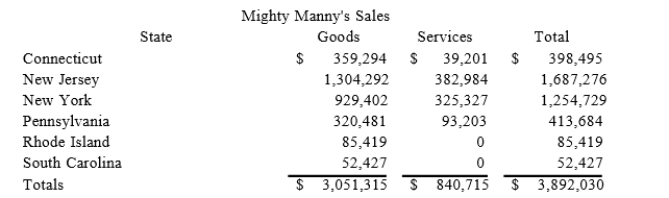 Assume the following sales tax rates: Connecticut (6.75 percent), New Jersey (7.5 percent), New York (8.5 percent), Pennsylvania (6.5 percent), Rhode Island (7.25 percent), and South Carolina (5.5 percent). Assume that Connecticut also taxes Mighty Manny's services. What is Mighty Manny's total sales and use taxliability?
 (Essay)
4.9/5 (80)
(80) Most services are sourced to the state where the services were performed.
(True/False)
4.8/5 (79)
(79) The primary purpose of state and local taxes is to raise revenue to finance state and localgovernment.
(True/False)
5.0/5 (80)
(80) Gordon operates the Tennis Pro Shop in Blacksburg, Virginia. The Shop sells, manufacturers, and customizes tennis racquets for serious amateurs. Virginia has a 5 percent sales tax. Assume that a District of Columbia customer picks up a $2,000 racquet order in the Blacksburg store and drives it back to the District of Columbia (where the sales tax rate is 8.5 percent). Determine the sales and use tax liability (assume the Shop has no sales personnel or property in District of Columbia) of the customer?
(Essay)
4.8/5 (89)
(89) Failure to collect and remit sales taxes by a seller often results in a larger tax liability than failure to pay income taxes.
(True/False)
5.0/5 (89)
(89) Which of the following is incorrect regarding nondomiciliary businesses?
(Multiple Choice)
5.0/5 (74)
(74) Giving samples and promotional materials without charge is a protected solicitation activity.
(True/False)
4.7/5 (70)
(70) Which of the following is not a general rule for calculating the sales factor?
(Multiple Choice)
4.7/5 (79)
(79) Purchases of inventory for resale are typically exempt from sales and use taxes.
(True/False)
4.9/5 (91)
(91) Public Law 86-272 protects only companies selling tangible personal property.
(True/False)
4.8/5 (87)
(87) Businesses must collect sales tax only in states where it has sales and use tax nexus.
(True/False)
4.8/5 (79)
(79) 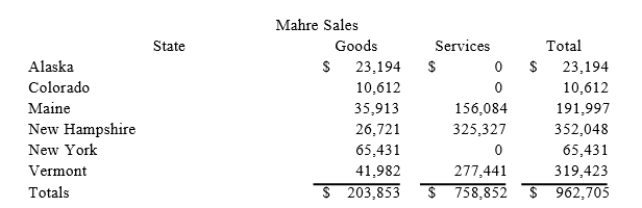 Assume the following sales tax rates: Alaska (6.6 percent), Colorado (7.75 percent), Maine (8.5 percent), New Hampshire (6.75 percent), New York (8 percent), and Vermont (5 percent). How much sales and use tax must Mahre collect and remit in Maine?
 (Multiple Choice)
4.9/5 (79)
(79) Hoosier Incorporated is an Indiana corporation. It properly included, deducted, or excluded t8h1e)following items on its federal tax return in the current year: 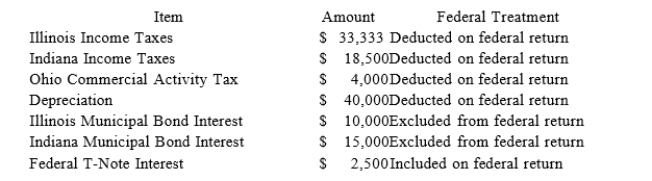 State depreciation expense was $50,000. Hoosier's Federal Taxable Income was $150,300. Calculate Hoosier's Illinois state tax base.
 (Multiple Choice)
4.7/5 (77)
(77) The Quill decision reaffirmed that out-of-state businesses must have physical presence within a state before the state may require the collection of sales taxes from in-state customers.
(True/False)
4.8/5 (86)
(86) 
Filters
- Essay(0)
- Multiple Choice(0)
- Short Answer(0)
- True False(0)
- Matching(0)