



 Chat with AI
Exam 4: Individual Income Tax Overview, Exemptions, and Filing Status

Exam 1: An Introduction to Tax110 Questions
Exam 2: Tax Compliance, the Irs, and Tax Authorities112 Questions
Exam 3: Tax Planning Strategies and Related Limitations107 Questions
Exam 4: Individual Income Tax Overview, Exemptions, and Filing Status126 Questions
Exam 5: Gross Income and Exclusions131 Questions
Exam 6: Individual Deductions107 Questions
Exam 7: Investments75 Questions
Exam 8: Individual Income Tax Computation and Tax Credits154 Questions
Exam 9: Business Income, Deductions, and Accounting Methods99 Questions
Exam 10: Property Acquisition and Cost Recovery94 Questions
Exam 11: Property Dispositions110 Questions
Exam 12: Compensation102 Questions
Exam 13: Retirement Savings and Deferred Compensation115 Questions
Exam 14: Tax Consequences of Home Ownership111 Questions
Exam 15: Entities Overview70 Questions
Exam 16: Corporate Operations140 Questions
Exam 17: Accounting for Income Taxes100 Questions
Exam 18: Corporate Taxation: Nonliquidating Distributions98 Questions
Exam 19: Corporate Formation, Reorganization, and Liquidation100 Questions
Exam 20: Forming and Operating Partnerships102 Questions
Exam 21: Dispositions of Partnership Interests and Partnership Distributions100 Questions
Exam 22: S Corporations134 Questions
Exam 23: State and Local Taxes117 Questions
Exam 24: The US Taxation of Multinational Transactions100 Questions
Exam 25: Transfer Taxes and Wealth Planning123 Questions
Select questions type


Taxpayers are generally allowed to claim deductions for expenditures unless a specifictax provision indicates the expenditure is not deductible.
(True/False)
4.8/5  (76)
(76) It is generally more advantageous from a tax perspective for a married couple to file separately than it is for them to file jointly.
(True/False)
5.0/5 (81)
(81) Jane and Ed Rochester are married with a two-year-old child who lives with them and whom they support financially. In 2017, Ed and Jane realized the following items of income and expense: 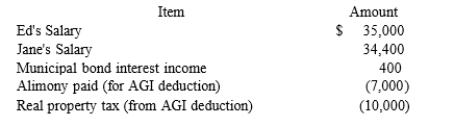 They also qualified for a $1,000 tax credit. Their employers withheld $1,800 in taxes from their paychecks (in the aggregate). Finally, the 2017 standard deduction amount for MFJ taxpayers is $12,700 and the 2017exemption amount is $4,050.What is the couple's gross income?
 (Essay)
4.7/5 (83)
(83) If an unmarried taxpayer provides more than half the support for a cousin who lives in the taxpayer's home for the entire year, the taxpayer will qualify for head of household filing status.
(True/False)
4.9/5 (70)
(70) Jeremy and Annie are married. During the year Jeremy dies. When Annie files her tax return for the year in which her husband dies, she may file under the married filing jointly filing status even if she does not remarry.
(True/False)
4.8/5 (78)
(78) The relationship requirement for qualifying relative includes cousins.
(True/False)
4.9/5 (82)
(82) The relationship requirement is more broadly defined (includes more relationships) for a qualifying relative than it is for a qualifying child.
(True/False)
4.7/5 (75)
(75) Madison's gross tax liability is $9,000. Madison had $3,000 of tax credits available and she had $8,000 of taxes withheld by her employer. What is Madison's taxes due (or taxes refunded) with her tax return?
(Multiple Choice)
5.0/5 (77)
(77) Which of the following statements about a qualifying person for head of household filing status is true?
(Multiple Choice)
4.9/5 (77)
(77) Which of the following types of income are not considered ordinary income?
(Multiple Choice)
4.9/5 (77)
(77) For purposes of the dependency exemption qualification, the test for qualifying children includes an age restriction but the test for qualifying relative does not.
(True/False)
4.8/5 (75)
(75) All of the following are tests for determining qualifying child status except the________.
(Multiple Choice)
4.8/5 (99)
(99) A taxpayer may qualify for the head of household filing status even if she does not have any dependent children.
(True/False)
4.9/5 (83)
(83) Itemized deductions and the standard deduction are deductions from AGI but deductionsfor personal and dependency exemptions are deductions for AGI.
(True/False)
4.9/5 (76)
(76) Jane and Ed Rochester are married with a two-year-old child who lives with them and whom they support financially. In 2017, Ed and Jane realized the following items of income and expense: 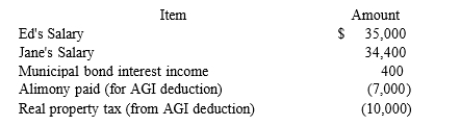 They also qualified for a $1,000 tax credit. Their employers withheld $1,800 in taxes from their paychecks (in the aggregate). Finally, the 2017 standard deduction amount for MFJ taxpayers is $12,700 and the 2017exemption amount is $4,050.What is the couple's taxable income?
 (Essay)
4.8/5 (80)
(80) To be considered a qualifying child of a taxpayer, the individual must be the son or daughter of the taxpayer.
(True/False)
4.8/5 (59)
(59) Which of the following statements regarding realized income is true?
(Multiple Choice)
4.8/5 (79)
(79) Taxpayers who file as qualifying widows/widowers are treated exactly the same for tax purposes in all respects as taxpayers who are married filing jointly for tax purposes.
(True/False)
4.7/5 (72)
(72) 
Filters
- Essay(0)
- Multiple Choice(0)
- Short Answer(0)
- True False(0)
- Matching(0)