



 Chat with AI
Exam 7: Investments

Exam 1: An Introduction to Tax110 Questions
Exam 2: Tax Compliance, the Irs, and Tax Authorities112 Questions
Exam 3: Tax Planning Strategies and Related Limitations107 Questions
Exam 4: Individual Income Tax Overview, Exemptions, and Filing Status126 Questions
Exam 5: Gross Income and Exclusions131 Questions
Exam 6: Individual Deductions107 Questions
Exam 7: Investments75 Questions
Exam 8: Individual Income Tax Computation and Tax Credits154 Questions
Exam 9: Business Income, Deductions, and Accounting Methods99 Questions
Exam 10: Property Acquisition and Cost Recovery94 Questions
Exam 11: Property Dispositions110 Questions
Exam 12: Compensation102 Questions
Exam 13: Retirement Savings and Deferred Compensation115 Questions
Exam 14: Tax Consequences of Home Ownership111 Questions
Exam 15: Entities Overview70 Questions
Exam 16: Corporate Operations140 Questions
Exam 17: Accounting for Income Taxes100 Questions
Exam 18: Corporate Taxation: Nonliquidating Distributions98 Questions
Exam 19: Corporate Formation, Reorganization, and Liquidation100 Questions
Exam 20: Forming and Operating Partnerships102 Questions
Exam 21: Dispositions of Partnership Interests and Partnership Distributions100 Questions
Exam 22: S Corporations134 Questions
Exam 23: State and Local Taxes117 Questions
Exam 24: The US Taxation of Multinational Transactions100 Questions
Exam 25: Transfer Taxes and Wealth Planning123 Questions
Select questions type


Kerri, a single taxpayer who itemizes deductions on Schedule A, incurs $15,000 of interest expense on funds borrowed to acquire taxable bonds. Kerri also has $20,000 of taxable interest income for the year. Assume Kerri is in a 30% marginal tax bracket. How much of the interest expense can she deduct? Assuming the same facts except that the $20,000 of investment income is a qualifyingdividend rather than taxable interest income, what should Kerry do if she wants to minimize her current year tax liability?
(Essay)
4.8/5  (86)
(86) Nondeductible investment expenses (other than investment interest expenses) are carried forward indefinitely.
(True/False)
4.9/5 (91)
(91) What requirements must be satisfied before an investor may receive preferential tax treatment on dividend income, and what preferential treatment will result?
(Essay)
4.8/5 (88)
(88) Investment expenses treated as miscellaneous itemized deductions do not include:
(Multiple Choice)
4.9/5 (72)
(72) When calculating net investment income, gross investment income includes:
(Multiple Choice)
4.9/5 (97)
(97) On the sale of a passive activity, any suspended losses cannot be used to offset income from:
(Multiple Choice)
4.9/5 (78)
(78) On January 1, 20X1, Fred purchased a corporate bond with a face value of $50,000 from thesecondary market at a premium. The bond has a coupon rate of 8 percent and matures in five years. The market rate of the bond is a 6 percent annual before-tax return compounded semiannually. If Fred was trying to minimize interest income, what is the least amount of interest income Fred may report on his 20X1 tax return?
(Essay)
4.8/5 (80)
(80) If an individual taxpayer's marginal tax rate is 35 percent and he holds the following assets for more than one year, which gain will be taxed at the highest rate at the time of sale?
(Multiple Choice)
4.9/5 (67)
(67) The netting process for capital gains (losses) with 0/15/20 percent, 25 percent, and 28 percent capital assets helps maximize the tax benefit of:
(Multiple Choice)
4.9/5 (74)
(74) When electing to include long-term capital gains and qualified dividends in netinvestment income, taxpayers must include all long-term capital gains and dividends recognized for that year.
(True/False)
4.9/5 (70)
(70) Henry, a single taxpayer with a marginal tax rate of 35 percent, sold the following assets during the year: 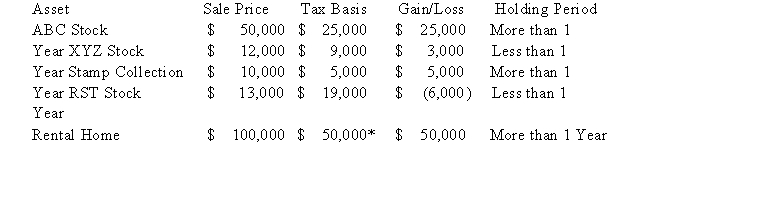 *$25,000 of the gain is a 25 percent gain. The remaining gain is 0/15/20 percent gain. What tax rate(s) will apply to Henry's capital gains or losses?
 (Essay)
4.9/5 (82)
(82) Capital loss carryovers for individuals are carried forward indefinitely.
(True/False)
4.9/5 (82)
(82) A passive activity is any activity that involves a trade or business or rental activity in which the taxpayer does not materially participate.
(True/False)
4.8/5 (66)
(66) To qualify under the passive activity rental real estate exception, the taxpayer must (1) own at least 15 percent of the property and (2) participate in the process of making management decisions.
(True/False)
4.7/5 (80)
(80) Two advantages of investing in capital assets are (1) gains are generally deferred and (2)gains are generally taxed at preferential rates.
(True/False)
4.8/5 (61)
(61) 
Filters
- Essay(0)
- Multiple Choice(0)
- Short Answer(0)
- True False(0)
- Matching(0)