



 Chat with AI
Exam 16: Externalities, Public Goods, and Social Choice

Exam 1: The Scope and Method of Economics68 Questions
Exam 2: The Economic Problem: Scarcity and Choice50 Questions
Exam 3: Demand, Supply, and Market Equilibrium52 Questions
Exam 4: Demand and Supply Applications41 Questions
Exam 5: Elasticity74 Questions
Exam 6: Household Behavior and Consumer Choice50 Questions
Exam 7: The Production Process: the Behavior of Profit-Maximizing Firms64 Questions
Exam 8: Short-Run Costs and Output Decisions59 Questions
Exam 9: Long-Run Costs and Output Decisions87 Questions
Exam 10: Input Demand: the Labor and Land Markets77 Questions
Exam 11: Input Demand: the Capital Market and the Investment Decision66 Questions
Exam 12: General Equilibrium and the Efficiency of Perfect Competition44 Questions
Exam 13: Monopoly and Antitrust Policy45 Questions
Exam 14: Oligopoly53 Questions
Exam 15: Monopolistic Competition31 Questions
Exam 16: Externalities, Public Goods, and Social Choice54 Questions
Select questions type


Explain why imperfect information can lead to market failure. Explain how the market can solve the problem of imperfect information. Under what circumstances may it be more efficient for the government to produce information instead of relying on the market?
(Essay)
4.8/5  (73)
(73) In an effort to clean up the amount of sulfates introduced into the atmosphere the government has ruled that all polluters install smoke stack scrubbers on their smoke stacks and mandated a pollution limit on the amount of sulfates per parts of air that may be legally emitted into the atmosphere. Suppose some of the polluters have found a more efficient way to eliminate the pollution. How will this discovery change the amount of sulfates emitted into the atmosphere?
(Essay)
4.9/5 (73)
(73) Provide an economic explanation for why government subsidization of child immunizations may lead to a more efficient outcome.
(Essay)
4.8/5 (77)
(77) Explain the Coase theorem. In order for the Coase theorem to be applicable, explain which three conditions must be satisfied. Give an example to show how the Coase theorem can be applied.
(Essay)
4.9/5 (79)
(79) Fred enjoys smoking cigars, but cigar smoke makes his wife, Wilma, feel ill. Use a graph to show that Fred's consumption of cigars will be inefficient if he ignores the costs imposed on Wilma.
(Essay)
4.8/5 (87)
(87) Consider a large public university in which a chemistry lecture is usually attended by 300 students or so but with large amounts of available seats on any given day. Is this a pure public good? If not, why not? Is this good likely to be provided in an efficient manner if the professor is vigilant in making sure that only registered students attend? Explain.
(Essay)
4.9/5 (81)
(81) Define marginal social cost. Draw a graph for a perfectly competitive firm that creates an external cost without considering this external cost in its decision making. The graph should include the firm's demand curve, marginal cost curve, and marginal social cost curve. On the graph, indicate the amount this firm will produce to maximize profits and the efficient level of output. If the government imposes a tax on this firm to force the firm to internalize the externality, indicate on the graph the correct amount of the tax. Explain the results of this tax. Explain why this solution may be difficult to implement.
(Essay)
4.8/5 (77)
(77) Comment on the following statement. "Taxing externality-producing activities may not eliminate damages."
(Essay)
4.9/5 (87)
(87) Use a graph to explain why a perfectly competitive firm will overproduce if a negative externality is present.
(Essay)
4.8/5 (89)
(89) Why would a firm continue to pollute even when it is fined (taxed) for doing so?
(Essay)
5.0/5 (82)
(82) The figures below represent the demand for a public good for two consumers, Tom and Jerry. Assuming that these are the only two buyers, draw a graph showing the market demand curve for this public good. 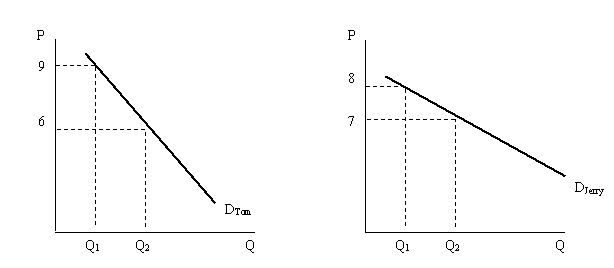
(Essay)
4.9/5 (71)
(71) 
Filters
- Essay(0)
- Multiple Choice(0)
- Short Answer(0)
- True False(0)
- Matching(0)