



 Chat with AI
Exam 16: Externalities, Public Goods, and Social Choice


Use a graph to explain how a tax can provide an incentive for a firm to produce a more efficient level of output.

 (72)
 Verified
If the tax is equal to the marginal damage cost, the firm's marginal cost curve will be the same as the marginal social cost. Since the industry supply curve is the sum of the marginal cost curves of the individual firms, the industry supply curve will shift to the left and the price will increase. The firm will now maximize profit by producing where marginal cost (which is now equal to MSC) equals P2. The firm will now be producing the efficient level of output. 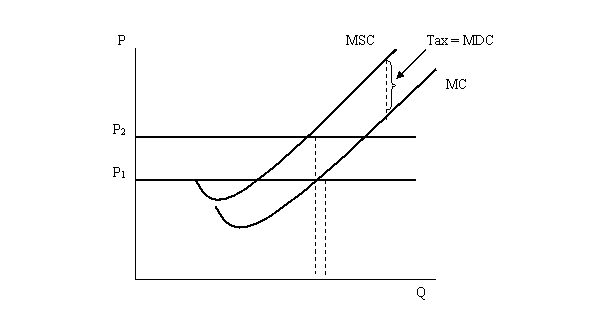
XYZ Corporation operates in a perfectly competitive market and is currently maximizing profit. To keep the firm's costs low, XYZ's managers have decided to dump waste in a nearby river. Explain why the level of output currently produced by XYZ is not efficient.
(75) VerifiedDumping in the river creates a negative externality. Thus, there is a cost involved in the production by XYZ that is being borne by third parties. If the firm is maximizing profit and producing where price is equal to the firm's marginal costs, the firm will produce a level of output for which the true cost (private + external cost) is greater than the price. This means that the level is output is greater than the efficient level of output.
The online encyclopedia known as Wikipedia is an example of a public good that provides information. Explain why this good did not need to be provided by the government.
(79) VerifiedIt didn't need to be provided by the government because there is enough of a spirit of public service in society to keep the effort going without coercion or inducement by government. That is people are willing to make their contributions to the encyclopedia because doing so gives them pleasure. This reward apparently is enough to sustain itself.
How does the selling of pollution rights lead to a more efficient outcome?
(73) Why does the absence of well-defined property rights serve as a stumbling block for the application of the Coase theorem?
(79) Explain why a freeway isn't always considered to be a pure public good.
(82) Give an example where a government subsidy can correct an externality. Explain how the subsidy would lead to a more efficient outcome.
(74) Oscar and Felix room together in an apartment in New York City. Oscar is very messy and Felix is obsessed with neatness. Felix cannot stand a messy apartment and is even willing to pay Oscar $50 per week for him to clean up after himself. Oscar hates to clean up so much that he is willing to pay Felix $30 per week to maintain his messy habits. If Felix has the right to a clean apartment explain why the apartment will be clean. If Oscar has the right to remain messy explain why the apartment will still be clean.
(82) Why do you suppose that taxes are often used in place of effluent charges in order to combat pollution?
(69) Give an example of a public good. Explain what characteristics make this good a public good.
(74) What is the largest problem associated with using a tax to correct for an externality? Explain.
(77) Assume a company has a cafeteria where it lets all its workers eat without making them pay up front. Instead, at the end of the month the total cost of eating at the company cafeteria is added up and divided by the total number of workers. This amount is then deducted from each worker's paycheck. Explain how this practice may lead to a negative externality.
(72) What do you believe is one of the chief criticisms of the Coase Theorem that render it useless in real-world situations.
(68) Comment on the following statement: "The Coase theorem implies that the contending parties will come to the efficient solution regardless of where rights are initially assigned."
(77) Fred enjoys smoking cigars, but his wife Wilma feels ill whenever she is around cigar smoke. Use the Coase theorem to explain how this problem could be solved without government involvement.
(82) 
Filters
- Essay(0)
- Multiple Choice(0)
- Short Answer(0)
- True False(0)
- Matching(0)