



 Chat with AI
Exam 6: Household Behavior and Consumer Choice

Exam 1: The Scope and Method of Economics68 Questions
Exam 2: The Economic Problem: Scarcity and Choice50 Questions
Exam 3: Demand, Supply, and Market Equilibrium52 Questions
Exam 4: Demand and Supply Applications41 Questions
Exam 5: Elasticity74 Questions
Exam 6: Household Behavior and Consumer Choice50 Questions
Exam 7: The Production Process: the Behavior of Profit-Maximizing Firms64 Questions
Exam 8: Short-Run Costs and Output Decisions59 Questions
Exam 9: Long-Run Costs and Output Decisions87 Questions
Exam 10: Input Demand: the Labor and Land Markets77 Questions
Exam 11: Input Demand: the Capital Market and the Investment Decision66 Questions
Exam 12: General Equilibrium and the Efficiency of Perfect Competition44 Questions
Exam 13: Monopoly and Antitrust Policy45 Questions
Exam 14: Oligopoly53 Questions
Exam 15: Monopolistic Competition31 Questions
Exam 16: Externalities, Public Goods, and Social Choice54 Questions
Select questions type


Misty spends her entire weekly allowance of $15 on two goods: T-shirts (which cost $10 each) and lipstick (which costs $5). What is the opportunity cost of a T-shirt? If her parents raise her allowance to $20 per week, what happens to the opportunity cost of a T-shirt?

Free
(Essay)
4.9/5  (62)
(62) Correct Answer: Verified
The opportunity cost of a T-shirt is 2 lipsticks. If her parents change her allowance, the opportunity cost of a T-shirt is unaffected.
What role do households play in output markets? What role do households play in factor
markets?
Free
(Essay)
4.9/5 (68)
(68) Correct Answer:Verified
VerifiedHouseholds are the buyers in output markets and are the sellers in factor markets.
Evaluate the following statement. "As long as I am still enjoying this candy I am going to keep buying and eating more of it".
Free
(Essay)
4.8/5 (63)
(63) Correct Answer:Verified
VerifiedThis confuses marginal and total utility. While it might be true that he is still receiving positive marginal utility from eating more of the candy it might not be the most rational thing for him to do in order to maximize his total utility. That is, he might be better off redirecting some of this expenditures toward another good that has a higher marginal utility per dollar.
Refer to the information provided in Scenario 3 below to answer the following questions.
SCENARIO 3: Consider the budget allocation decision of a family of four on vacation in a beach resort. The family has $300 budgeted for entertainment for the weekend and two options: Renting bicycles for $10 an hour per bicycle or playing miniature golf for $4 a game per person. Consider each question separately, and place golfing on the vertical axis and bicycling on the horizontal axis. Assume that all four family members must do everything together.
-Refer to Scenario 3. Graph the effect of a 100% increase in the price of miniature golf.
(Essay)
4.9/5 (89)
(89) Justin has a part-time job and earns $50 per week. He spends his entire income on two goods: Hamburgers (which cost $2 each) and movie rentals (which cost $3 each). Draw Justin's budget constraint. Suppose that Justin decides to purchase 10 hamburgers and rent 10 movies this week. Is this choice within Justin's opportunity set? Show this choice on your graph.
(Essay)
4.8/5 (63)
(63) Below represents a total utility function for someone that goes to the gym. Add a second column in which you calculate the marginal utility of each visit to the gym. Use this information to determine when diminishing marginal utility sets in.
(Essay)
4.7/5 (74)
(74) Assume that income in year 1 is 1000 and 1200 in year 2 and the individual can against his future income or lend his current income at zero cost. Graph the budget constraint. Measure consumption in year 1 along the horizontal axis and consumption in year 2 along the vertical axis.
(Essay)
4.9/5 (78)
(78) Graph the budget constraint for Px = 2, Py = 3, and I = 1500 with the additional condition that X is free for the first 250 units. Measure units of X along the horizontal axis and units of Y along the vertical axis.
(Essay)
4.9/5 (83)
(83) Using the consumer equilibrium condition which is expressed in algebraic form below prove that this is the same thing as saying that consumer equilibrium occurs when the ration of the marginal utilities per dollar are equal for both goods. 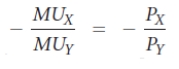
(Essay)
4.9/5 (75)
(75) Refer to the information provided in Scenario 3 below to answer the following questions.
SCENARIO 3: Consider the budget allocation decision of a family of four on vacation in a beach resort. The family has $300 budgeted for entertainment for the weekend and two options: Renting bicycles for $10 an hour per bicycle or playing miniature golf for $4 a game per person. Consider each question separately, and place golfing on the vertical axis and bicycling on the horizontal axis. Assume that all four family members must do everything together.
-Refer to Scenario 3. Graph the budget constraint.
(Essay)
4.9/5 (82)
(82) What are the three basic economic decisions each household must make?
(Essay)
4.9/5 (81)
(81) Refer to the information provided in Scenario 3 below to answer the following questions.
SCENARIO 3: Consider the budget allocation decision of a family of four on vacation in a beach resort. The family has $300 budgeted for entertainment for the weekend and two options: Renting bicycles for $10 an hour per bicycle or playing miniature golf for $4 a game per person. Consider each question separately, and place golfing on the vertical axis and bicycling on the horizontal axis. Assume that all four family members must do everything together.
-Refer to Scenario 3. Graph the effect of a "Rent 3 Get 1 Bicycle Free" promotion.
(Essay)
4.9/5 (79)
(79) Susie receives an allowance from her parents of $10 per week. She spends her entire allowance on two goods: cans of hairspray and bubble gum. The price of a can of hairspray is $2 and the price of a pack of bubble gum is $1. What is the opportunity cost of a can of hairspray? What is the opportunity cost of a pack of bubble gum?
(Essay)
4.8/5 (71)
(71) Suppose that macaroni and cheese is an inferior good and the price of macaroni and cheese rises. Explain the income and substitution effects of this price change.
(Essay)
4.9/5 (74)
(74) Mike is a college student who works part time and earns $100 per week. He spends his entire income on two goods: pepperoni pizzas and bottles of soda. The price of a pepperoni pizza is $10 and the price of a bottle of soda is $2. Draw Mike's budget constraint.
(Essay)
4.9/5 (76)
(76) 
Filters
- Essay(0)
- Multiple Choice(0)
- Short Answer(0)
- True False(0)
- Matching(0)