



 Chat with AI
Exam 6: Household Behavior and Consumer Choice

Exam 1: The Scope and Method of Economics68 Questions
Exam 2: The Economic Problem: Scarcity and Choice50 Questions
Exam 3: Demand, Supply, and Market Equilibrium52 Questions
Exam 4: Demand and Supply Applications41 Questions
Exam 5: Elasticity74 Questions
Exam 6: Household Behavior and Consumer Choice50 Questions
Exam 7: The Production Process: the Behavior of Profit-Maximizing Firms64 Questions
Exam 8: Short-Run Costs and Output Decisions59 Questions
Exam 9: Long-Run Costs and Output Decisions87 Questions
Exam 10: Input Demand: the Labor and Land Markets77 Questions
Exam 11: Input Demand: the Capital Market and the Investment Decision66 Questions
Exam 12: General Equilibrium and the Efficiency of Perfect Competition44 Questions
Exam 13: Monopoly and Antitrust Policy45 Questions
Exam 14: Oligopoly53 Questions
Exam 15: Monopolistic Competition31 Questions
Exam 16: Externalities, Public Goods, and Social Choice54 Questions
Select questions type


The table below shows how the total utility that Alan derives from watching basketball games changes as he watches more and more games each week:
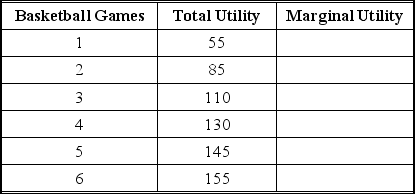 Fill in the table above. Do the numbers in the table support the law of diminishing marginal utility? Explain.
 (Essay)
4.9/5  (84)
(84) Connor receives a weekly allowance of $20 from his parents that he uses to purchase two goods: Pokemon cards (which cost $5 per pack) and comic books (which cost $4 each). Draw Connor's budget constraint. Show what would happen if Connor's parents lower his allowance to $15 per week. Does the opportunity cost of a comic book change?
(Essay)
4.7/5 (78)
(78) When total utility is rising but at a decreasing rate what must be happening to marginal utility? When will total utility stop rising?
(Essay)
4.9/5 (80)
(80) Joseph earns $200 per week and spends his entire income on cheese (which costs $5 per pound) and crackers (which cost $2 per box). Draw Joseph's budget constraint. If the price of cheese increases to $8 per pound, what will happen to Joseph's budget constraint?
(Essay)
4.8/5 (69)
(69) Colin spends his income of $100 per week on two goods: pizzas (which cost $8 each) and milk (which costs $1 per gallon). At his current level of consumption, the marginal utility from the last pizza consumed is 32 and the marginal utility from the last gallon of milk is 4. Is Colin maximizing his utility? Why or why not? If not, what should Colin do to achieve a higher level of utility?
(Essay)
4.8/5 (77)
(77) 
Filters
- Essay(0)
- Multiple Choice(0)
- Short Answer(0)
- True False(0)
- Matching(0)