



 Chat with AI
Exam 13: Monopoly and Antitrust Policy

Exam 1: The Scope and Method of Economics68 Questions
Exam 2: The Economic Problem: Scarcity and Choice50 Questions
Exam 3: Demand, Supply, and Market Equilibrium52 Questions
Exam 4: Demand and Supply Applications41 Questions
Exam 5: Elasticity74 Questions
Exam 6: Household Behavior and Consumer Choice50 Questions
Exam 7: The Production Process: the Behavior of Profit-Maximizing Firms64 Questions
Exam 8: Short-Run Costs and Output Decisions59 Questions
Exam 9: Long-Run Costs and Output Decisions87 Questions
Exam 10: Input Demand: the Labor and Land Markets77 Questions
Exam 11: Input Demand: the Capital Market and the Investment Decision66 Questions
Exam 12: General Equilibrium and the Efficiency of Perfect Competition44 Questions
Exam 13: Monopoly and Antitrust Policy45 Questions
Exam 14: Oligopoly53 Questions
Exam 15: Monopolistic Competition31 Questions
Exam 16: Externalities, Public Goods, and Social Choice54 Questions
Select questions type


Use Figure 13.1 above to help with the following question. Why is it true that at every level of output except the first unit, the monopolist's marginal revenue (MR) is below price.
(Essay)
4.9/5  (82)
(82) Describe the marginal revenue curve in relationship to the demand curve for a monopoly. Why is it like that?
(Essay)
4.7/5 (85)
(85) The graph below shows a firm's demand, marginal revenue, and marginal cost curves. Find the profit-maximizing level of output and mark it q*. Find the price the firm should charge and mark it P*. 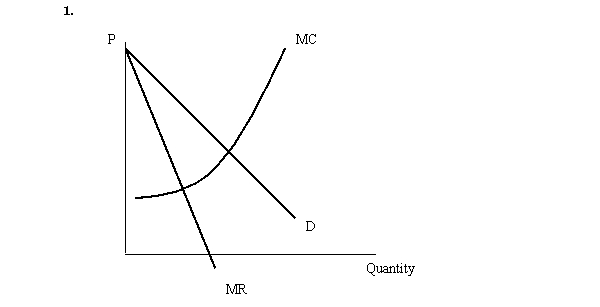
(Essay)
5.0/5 (57)
(57) 
Filters
- Essay(0)
- Multiple Choice(0)
- Short Answer(0)
- True False(0)
- Matching(0)