



 Chat with AI
Exam 19: Cost Behavior and Cost-Volume-Profit Analysis

Exam 1: Introduction to Accounting and Business234 Questions
Exam 2: Analyzing Transactions240 Questions
Exam 3: The Adjusting Process210 Questions
Exam 4: Completing the Accounting Cycle197 Questions
Exam 5: Accounting for Merchandising Businesses233 Questions
Exam 6: Inventories205 Questions
Exam 7: Sarbanes-Oxley, Internal Control, and Cash187 Questions
Exam 8: Receivables196 Questions
Exam 9: Fixed Assets and Intangible Assets226 Questions
Exam 10: Current Liabilities and Payroll194 Questions
Exam 11: Corporations: Organization, Stock Transactions, and Dividends207 Questions
Exam 12: Long-Term Liabilities: Bonds and Notes174 Questions
Exam 13: Investments and Fair Value Accounting167 Questions
Exam 14: Statement of Cash Flows187 Questions
Exam 15: Financial Statement Analysis199 Questions
Exam 16: Managerial Accounting Concepts and Principles202 Questions
Exam 17: Job Order Costing195 Questions
Exam 18: Process Cost Systems198 Questions
Exam 19: Cost Behavior and Cost-Volume-Profit Analysis225 Questions
Exam 20: Variable Costing for Management Analysis160 Questions
Exam 21: Budgeting197 Questions
Exam 22: Performance Evaluation Using Variances From Standard Costs175 Questions
Exam 23: Performance Evaluation for Decentralized Operations217 Questions
Exam 24: Differential Analysis, Product Pricing, and Activity-Based Costing176 Questions
Exam 25: Capital Investment Analysis188 Questions
Exam 26: Cost Allocation and Activity-Based Costing110 Questions
Exam 27: Lean Principles, Lean Accounting, and Activity Analysis137 Questions
Select questions type


Understanding how costs behave is useful to management for all the following reasons except
(Multiple Choice)
4.8/5  (90)
(90) Explain how variable costing net income will be different than absorption costing net income under the following situations:
1) A company had no beginning or ending inventory. During the year, it produced and sold 10,000 units.
2) A company had no beginning inventory. During the year, it produced 10,000 units and sold 8,000 units.
3) A company had 2,000 units in beginning inventory. During the year, it produced 10,000 units and sold 12,000 units.
(Essay)
4.9/5 (89)
(89) Match the following terms with their definitions.
-The excess of sales revenues over variable costs
(Multiple Choice)
4.9/5 (76)
(76) Louis Company sells a single product at a price of $65 per unit. Variable costs per unit are $45 and total fixed costs are $625,500. Louis is considering the purchase of a new piece of equipment that would increase the fixed costs to $800,000, but decrease the variable costs per unit to $42.
Required:
If Louis Company expects to sell 44,000 units next year, should they purchase this new equipment?
(Essay)
4.9/5 (72)
(72) 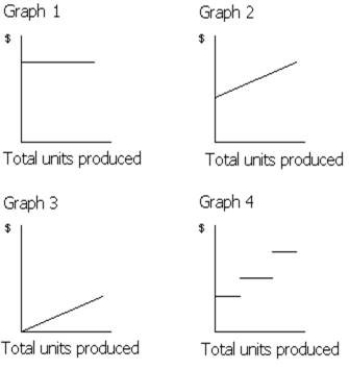 Figure 21-1
-Which of the graphs in Figure 21-1 illustrates the behavior of a total fixed cost?
Figure 21-1
-Which of the graphs in Figure 21-1 illustrates the behavior of a total fixed cost? (Multiple Choice)
4.9/5 (75)
(75) Given the following information:
Variable cost per unit = $5.00 July fixed cost per unit = $7.00
Units sold and produced in July = 28,000
What is total estimated cost for August if 30,000 units are projected to be produced and sold?
(Essay)
4.9/5 (91)
(91) If fixed costs are $400,000 and the unit contribution margin is $20, what amount of units must be sold in order to have a zero profit?
(Multiple Choice)
4.9/5 (62)
(62) Cost-volume-profit analysis cannot be used if which of the following occurs?
(Multiple Choice)
4.8/5 (69)
(69) If the contribution margin ratio for France Company is 45%, sales were $425,000, and fixed costs were $100,000, what was the income from operations?
(Multiple Choice)
4.9/5 (85)
(85) Match the following terms with their definitions.
-Where a business's revenues exactly equal costs
(Multiple Choice)
4.8/5 (80)
(80) The contribution margin ratio is the same as the profit-volume ratio.
(True/False)
4.9/5 (90)
(90) Only a single line, which represents the difference between total sales revenues and total costs, is plotted on the cost-volume-profit chart.
(True/False)
4.8/5 (99)
(99) Match the following terms a-e) with their definitions.
-Contribution margin divided by income from operations
(Multiple Choice)
4.9/5 (89)
(89) Costs that vary in total in direct proportion to changes in an activity level are called
(Multiple Choice)
4.8/5 (86)
(86) A mixed cost has characteristics of both a variable and a fixed cost.
(True/False)
4.8/5 (71)
(71) A low operating leverage is normal for highly automated industries.
(True/False)
4.8/5 (95)
(95) If variable costs per unit decreased because of a decrease in utility rates, the break-even point would
(Multiple Choice)
4.9/5 (96)
(96) Zeke Company sells 25,000 units at $21 per unit. Variable costs are $10 per unit, and fixed costs are $75,000. The contribution margin ratio and the unit contribution margin are
(Multiple Choice)
4.9/5 (75)
(75) 
Filters
- Essay(0)
- Multiple Choice(0)
- Short Answer(0)
- True False(0)
- Matching(0)