



 Chat with AI
Exam 19: Cost Behavior and Cost-Volume-Profit Analysis

Exam 1: Introduction to Accounting and Business234 Questions
Exam 2: Analyzing Transactions240 Questions
Exam 3: The Adjusting Process210 Questions
Exam 4: Completing the Accounting Cycle197 Questions
Exam 5: Accounting for Merchandising Businesses233 Questions
Exam 6: Inventories205 Questions
Exam 7: Sarbanes-Oxley, Internal Control, and Cash187 Questions
Exam 8: Receivables196 Questions
Exam 9: Fixed Assets and Intangible Assets226 Questions
Exam 10: Current Liabilities and Payroll194 Questions
Exam 11: Corporations: Organization, Stock Transactions, and Dividends207 Questions
Exam 12: Long-Term Liabilities: Bonds and Notes174 Questions
Exam 13: Investments and Fair Value Accounting167 Questions
Exam 14: Statement of Cash Flows187 Questions
Exam 15: Financial Statement Analysis199 Questions
Exam 16: Managerial Accounting Concepts and Principles202 Questions
Exam 17: Job Order Costing195 Questions
Exam 18: Process Cost Systems198 Questions
Exam 19: Cost Behavior and Cost-Volume-Profit Analysis225 Questions
Exam 20: Variable Costing for Management Analysis160 Questions
Exam 21: Budgeting197 Questions
Exam 22: Performance Evaluation Using Variances From Standard Costs175 Questions
Exam 23: Performance Evaluation for Decentralized Operations217 Questions
Exam 24: Differential Analysis, Product Pricing, and Activity-Based Costing176 Questions
Exam 25: Capital Investment Analysis188 Questions
Exam 26: Cost Allocation and Activity-Based Costing110 Questions
Exam 27: Lean Principles, Lean Accounting, and Activity Analysis137 Questions
Select questions type


If employees accept a wage contract that decreases the unit contribution margin, the break-even point will decrease.

Free
(True/False)
4.9/5  (68)
(68) Correct Answer: Verified
False
Which of the following is not an example of a cost that varies in total as the number of units produced changes?
Free
(Multiple Choice)
4.9/5 (86)
(86) Correct Answer:Verified
VerifiedC
Only a single line, which represents the difference between total sales revenues and total costs, is plotted on the profit-volume chart.
Free
(True/False)
4.8/5 (81)
(81) Correct Answer:Verified
VerifiedTrue
Variable costs are costs that vary in total in direct proportion to changes in the activity level.
(True/False)
4.8/5 (75)
(75) The adoption of variable costing for managerial decision making is based on the premise that fixed factory overhead costs are related to productive capacity of the manufacturing plant and are normally not affected by the number of units produced.
(True/False)
4.9/5 (78)
(78) Rental charges of $40,000 per year plus $3 for each machine hour over 18,000 hours is an example of a fixed cost.
(True/False)
4.8/5 (76)
(76) A production supervisor's salary that does not vary with the number of units produced is an example of a fixed cost.
(True/False)
4.8/5 (79)
(79) In order to choose the proper activity base for a cost, managerial accountants must be familiar with the operations of the entity.
(True/False)
4.7/5 (77)
(77) Rusty Co. sells two products, X and Y. Last year, Rusty sold 5,000 units of X and 35,000 units of Y. Related data are: Unit Selling Price Unit Variable Unit Contribution Product Price Cost Margin \ 110.00 \ 70.00 \ 40.00 70.00 50.00 20.00
-What was Rusty Co.'s unit variable cost of E?
(Multiple Choice)
4.9/5 (88)
(88) Charlotte Co. has budgeted salary increases to factory supervisors totaling 9%. If selling prices and all other cost relationships are held constant, next year's break-even point
(Multiple Choice)
4.9/5 (76)
(76) Because variable costs are assumed to change in direct proportion to changes in the activity level, the graph of the variable costs when plotted against the activity level appears as a circle.
(True/False)
4.9/5 (87)
(87) Rusty Co. sells two products, X and Y. Last year, Rusty sold 5,000 units of X and 35,000 units of Y. Related data are: Unit Selling Price Unit Variable Unit Contribution Product Price Cost Margin \ 110.00 \ 70.00 \ 40.00 70.00 50.00 20.00
-What was Rusty Co.'s sales mix last year?
(Multiple Choice)
5.0/5 (73)
(73) If a business sells four products, it is not possible to estimate the break-even point.
(True/False)
4.8/5 (67)
(67) Which of the following is not an example of a cost that varies in total as the number of units produced changes?
(Multiple Choice)
4.7/5 (82)
(82) Which of the following conditions would cause the break-even point to decrease?
(Multiple Choice)
4.8/5 (76)
(76) If fixed costs are $500,000 and variable costs are 60% of break-even sales, profit is zero when sales revenue is $930,000.
(True/False)
4.8/5 (67)
(67) If yearly insurance premiums are increased, this change in fixed costs will result in an increase in the break-even point.
(True/False)
4.8/5 (69)
(69) Garmo Co. has an operating leverage of 5. Next year's sales are expected to increase by 10%. The company's operating income will increase by 50%.
(True/False)
4.9/5 (76)
(76) If fixed costs are $500,000 and the unit contribution margin is $20, what is the break-even point in units if fixed costs are reduced by $80,000?
(Multiple Choice)
4.7/5 (76)
(76) 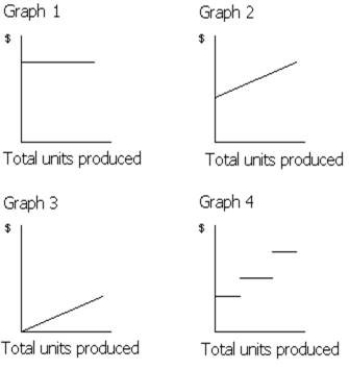 Figure 21-1
-Which of the following describes the behavior of the fixed cost per unit?
Figure 21-1
-Which of the following describes the behavior of the fixed cost per unit? (Multiple Choice)
5.0/5 (83)
(83) 
Filters
- Essay(0)
- Multiple Choice(0)
- Short Answer(0)
- True False(0)
- Matching(0)