



 Chat with AI
Exam 19: Cost Behavior and Cost-Volume-Profit Analysis

Exam 1: Introduction to Accounting and Business234 Questions
Exam 2: Analyzing Transactions240 Questions
Exam 3: The Adjusting Process210 Questions
Exam 4: Completing the Accounting Cycle197 Questions
Exam 5: Accounting for Merchandising Businesses233 Questions
Exam 6: Inventories205 Questions
Exam 7: Sarbanes-Oxley, Internal Control, and Cash187 Questions
Exam 8: Receivables196 Questions
Exam 9: Fixed Assets and Intangible Assets226 Questions
Exam 10: Current Liabilities and Payroll194 Questions
Exam 11: Corporations: Organization, Stock Transactions, and Dividends207 Questions
Exam 12: Long-Term Liabilities: Bonds and Notes174 Questions
Exam 13: Investments and Fair Value Accounting167 Questions
Exam 14: Statement of Cash Flows187 Questions
Exam 15: Financial Statement Analysis199 Questions
Exam 16: Managerial Accounting Concepts and Principles202 Questions
Exam 17: Job Order Costing195 Questions
Exam 18: Process Cost Systems198 Questions
Exam 19: Cost Behavior and Cost-Volume-Profit Analysis225 Questions
Exam 20: Variable Costing for Management Analysis160 Questions
Exam 21: Budgeting197 Questions
Exam 22: Performance Evaluation Using Variances From Standard Costs175 Questions
Exam 23: Performance Evaluation for Decentralized Operations217 Questions
Exam 24: Differential Analysis, Product Pricing, and Activity-Based Costing176 Questions
Exam 25: Capital Investment Analysis188 Questions
Exam 26: Cost Allocation and Activity-Based Costing110 Questions
Exam 27: Lean Principles, Lean Accounting, and Activity Analysis137 Questions
Select questions type


Carter Co. sells two products, Arks and Bins. Last year, Carter sold 14,000 units of Arks and 56,000 units of Bins. Related data are: Unit Selling Unit Variable Unit Contribution Product Price Cost Margin Arks \ 120 \ 80 \ 40 Bins 80 60 20
-What was Carter Co.'s unit selling price of E, with E representing one overall "enterprise" product?
(Multiple Choice)
4.9/5  (73)
(73) The dollars available from each unit of sales to cover fixed cost and profit is the unit variable cost.
(True/False)
4.8/5 (79)
(79) If direct materials cost per unit decreases, the amount of sales necessary to earn a desired amount of profit will decrease.
(True/False)
4.7/5 (72)
(72)  Figure 21-1
-Which of the following activity bases would be the most appropriate for food costs of a hospital?
Figure 21-1
-Which of the following activity bases would be the most appropriate for food costs of a hospital? (Multiple Choice)
4.7/5 (76)
(76) With the aid of computer software, managers can vary assumptions regarding selling prices, costs, and volume, and can immediately see the effects of each change on the break-even point and profit. This is called
(Multiple Choice)
4.9/5 (74)
(74) What would Timmer's net income be for the year using absorption costing?
(Multiple Choice)
4.7/5 (78)
(78) The cost graphs in the illustration below shows various types of cost behaviors. 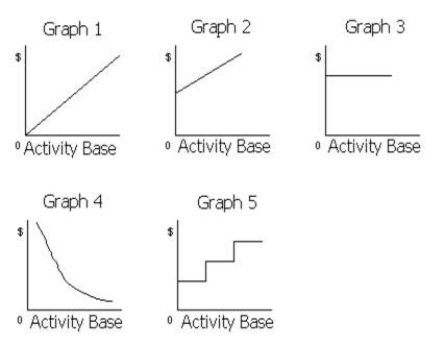 For each of the following costs, identify the cost graph that best describes its cost behavior as the number of units produced and sold increases:
a) Sales commissions of $6,000 plus $0.05 for each item sold.
b) Rent on warehouse of $12,000 per month.
c) Insurance costs of $2,500 per month.
d) Per-unit cost of direct labor.
e) Total salaries of quality control supervisors. One supervisor must be added for each additional work shift.
f) Total employer pension costs of $0.35 per direct labor hour.
g) Per-unit straight-line depreciation costs.
h) Per-unit cost of direct materials.
i) Total direct materials cost.
j) Electricity costs of $5,000 per month plus $0.0004 per kilowatt-hour.
k) Per-unit cost of plant superintendent's salary.
l) Salary of the night-time security guard of $3,800 per month.
m) Repairs and maintenance costs of $3,000 for each 2,000 hours of factory machine usage.
n) Total direct labor cost.
o) Straight-line depreciation on factory equipment.
For each of the following costs, identify the cost graph that best describes its cost behavior as the number of units produced and sold increases:
a) Sales commissions of $6,000 plus $0.05 for each item sold.
b) Rent on warehouse of $12,000 per month.
c) Insurance costs of $2,500 per month.
d) Per-unit cost of direct labor.
e) Total salaries of quality control supervisors. One supervisor must be added for each additional work shift.
f) Total employer pension costs of $0.35 per direct labor hour.
g) Per-unit straight-line depreciation costs.
h) Per-unit cost of direct materials.
i) Total direct materials cost.
j) Electricity costs of $5,000 per month plus $0.0004 per kilowatt-hour.
k) Per-unit cost of plant superintendent's salary.
l) Salary of the night-time security guard of $3,800 per month.
m) Repairs and maintenance costs of $3,000 for each 2,000 hours of factory machine usage.
n) Total direct labor cost.
o) Straight-line depreciation on factory equipment. (Essay)
4.9/5 (97)
(97) Given the following cost and activity observations for Bounty Company's utilities, use the highlow method to calculate Bounty' variable utilities costs per machine hour. Round your answer to the nearest cent. 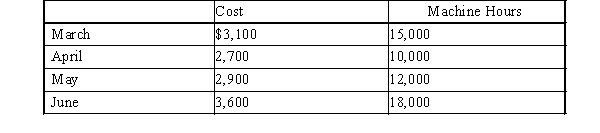
(Multiple Choice)
4.7/5 (84)
(84) A cost that has characteristics of both a variable cost and a fixed cost is called a
(Multiple Choice)
4.9/5 (78)
(78) Variable costs are costs that vary on a per-unit basis with changes in the activity level.
(True/False)
4.7/5 (81)
(81) If sales are $820,000, variable costs are 55% of sales, and operating income is $260,000, what is the contribution margin ratio?
(Multiple Choice)
4.8/5 (68)
(68) Given the following cost data, what type of cost is shown? 
(Multiple Choice)
5.0/5 (71)
(71) A company has a margin of safety of 25%, a contribution margin ratio of 30%, and sales of $1,000,000.
a) What is the break-even point in sales dollars?
b) What is the operating income?
c) If neither the relationship between variable costs and sales nor the amount of fixed costs is expected to change in the next year, how much additional operating income can be earned by increasing sales by $110,000?
(Essay)
4.8/5 (77)
(77) Assuming no other changes, operating income will be the same under both the variable and absorption costing methods when the number of units manufactured equals the number of units sold.
(True/False)
4.8/5 (71)
(71) Bluegill Company sells 45,000 units at $18 per unit. Fixed costs are $62,000 and income from operations is $298,000. Determine the a) variable cost per unit, b) unit contribution margin, and c) contribution margin ratio.
(Essay)
4.7/5 (72)
(72) Rusty Co. sells two products, X and Y. Last year, Rusty sold 5,000 units of X and 35,000 units of Y. Related data are: Unit Selling Price Unit Variable Unit Contribution Product Price Cost Margin \ 110.00 \ 70.00 \ 40.00 70.00 50.00 20.00
-What was Rusty Co.'s weighted average unit selling price?
(Multiple Choice)
4.9/5 (90)
(90) The Dean Company has sales of $500,000, and the break-even point in sales dollars of $300,000. Determine the company's margin of safety percentage.
(Short Answer)
4.8/5 (70)
(70) Match the following terms with their definitions.
-A specific activity range over which the cost changes are of interest.
(Multiple Choice)
4.7/5 (83)
(83) A business had a margin of safety ratio of 20%, variable costs of 75% of sales, fixed costs of $240,000, a break- even point of $960,000, and operating income of $60,000 for the current year. Calculate the current year's sales.
(Short Answer)
4.8/5 (68)
(68) 
Filters
- Essay(0)
- Multiple Choice(0)
- Short Answer(0)
- True False(0)
- Matching(0)