



 Chat with AI
Exam 12: Long-Term Liabilities: Bonds and Notes

Exam 1: Introduction to Accounting and Business234 Questions
Exam 2: Analyzing Transactions240 Questions
Exam 3: The Adjusting Process210 Questions
Exam 4: Completing the Accounting Cycle197 Questions
Exam 5: Accounting for Merchandising Businesses233 Questions
Exam 6: Inventories205 Questions
Exam 7: Sarbanes-Oxley, Internal Control, and Cash187 Questions
Exam 8: Receivables196 Questions
Exam 9: Fixed Assets and Intangible Assets226 Questions
Exam 10: Current Liabilities and Payroll194 Questions
Exam 11: Corporations: Organization, Stock Transactions, and Dividends207 Questions
Exam 12: Long-Term Liabilities: Bonds and Notes174 Questions
Exam 13: Investments and Fair Value Accounting167 Questions
Exam 14: Statement of Cash Flows187 Questions
Exam 15: Financial Statement Analysis199 Questions
Exam 16: Managerial Accounting Concepts and Principles202 Questions
Exam 17: Job Order Costing195 Questions
Exam 18: Process Cost Systems198 Questions
Exam 19: Cost Behavior and Cost-Volume-Profit Analysis225 Questions
Exam 20: Variable Costing for Management Analysis160 Questions
Exam 21: Budgeting197 Questions
Exam 22: Performance Evaluation Using Variances From Standard Costs175 Questions
Exam 23: Performance Evaluation for Decentralized Operations217 Questions
Exam 24: Differential Analysis, Product Pricing, and Activity-Based Costing176 Questions
Exam 25: Capital Investment Analysis188 Questions
Exam 26: Cost Allocation and Activity-Based Costing110 Questions
Exam 27: Lean Principles, Lean Accounting, and Activity Analysis137 Questions
Select questions type


On January 1, Gemstone Company obtained a $165,000, 10-year, 7% installment note from Guarantee Bank. The note requires annual payments of $23,492, with the first payment occurring on the last day of the fiscal year. The first payment consists of interest of $11,550 and principal repayment of $11,942. The journal entry to record the payment of the first annual amount due on the note would include a
(Multiple Choice)
4.8/5  (77)
(77) When the corporation issuing the bonds has the right to redeem the bonds prior to the maturity, the bonds are
(Multiple Choice)
4.8/5 (73)
(73) Both callable and noncallable bonds can be purchased by the issuing corporation in the open market.
(True/False)
4.8/5 (83)
(83) On the first day of the fiscal year, a company issues a $500,000, 8%, 10-year bond that pays semiannual interest of $20,000 $500,000 × 8% × 1/2), receiving cash of $530,000. Journalize the entry to record the issuance of the bonds.
(Essay)
4.8/5 (88)
(88) The journal entry a company records for the issuance of bonds when the contract rate is less than the market rate would be
(Multiple Choice)
5.0/5 (87)
(87) If a company borrows money from a bank as an installment note, the interest portion of each annual payment will
(Multiple Choice)
4.9/5 (84)
(84) Sorenson Co., is considering the following alternative plans for financing the company: 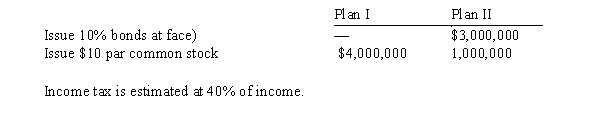 Determine the earnings per share of common stock under the two alternative financing plans, assuming income before bond interest and income tax is $1,000,000.
 (Essay)
5.0/5 (91)
(91) If the market rate of interest is greater than the contractual rate of interest, bonds will sell
(Multiple Choice)
4.8/5 (76)
(76) Match each description below to the appropriate term a-g).
-The entire principal of the bond is paid back on maturity date
(Multiple Choice)
4.8/5 (81)
(81) Numbers of times interest charges are earned is computed as
(Multiple Choice)
4.9/5 (77)
(77) When the maturities of a bond issue are spread over several dates, the bonds are called
(Multiple Choice)
4.8/5 (79)
(79) The higher the number of times interest charges are earned ratio, the better the creditors' protection.
(True/False)
4.9/5 (80)
(80) Match each description below to the appropriate term a-g).
-Allows the bond holder to exchange bond for shares of stock
(Multiple Choice)
4.8/5 (76)
(76) The balance in Premium on Bonds Payable should be reported as a deduction from Bonds Payable on the balance sheet.
(True/False)
4.9/5 (77)
(77) The number of times interest charges are earned ratio is calculated by dividing Bonds Payable by Interest Expense.
(True/False)
4.8/5 (89)
(89) Luke Corp. issued $2,000,000 of 20-year, 9% callable bonds on July 1, Year 1, with interest payable on June 30 and December 31. The fiscal year of the company is the calendar year. Journalize the entries to record the following selected transactions:
Year 1
July 1 Issued the bonds for cash at their face amount. Dec. 31 Paid the interest on the bonds.
Year 5
Dec. 31 Called the bond issue at 97, the rate provided in the bond indenture. Omit entry for payment of interest.)
(Essay)
4.9/5 (76)
(76) The prices of bonds are quoted as a percentage of the bonds' market value.
(True/False)
4.7/5 (84)
(84) A corporation issues for cash $9,000,000 of 8%, 30-year bonds, interest payable semiannually. The amount received for the bonds will be
(Multiple Choice)
4.8/5 (88)
(88) Match each description below to the appropriate term a-g).
-The value of a bond stated on the bond certificate
(Multiple Choice)
4.9/5 (88)
(88) 
Filters
- Essay(0)
- Multiple Choice(0)
- Short Answer(0)
- True False(0)
- Matching(0)