



 Chat with AI
Exam 12: Long-Term Liabilities: Bonds and Notes

Exam 1: Introduction to Accounting and Business234 Questions
Exam 2: Analyzing Transactions240 Questions
Exam 3: The Adjusting Process210 Questions
Exam 4: Completing the Accounting Cycle197 Questions
Exam 5: Accounting for Merchandising Businesses233 Questions
Exam 6: Inventories205 Questions
Exam 7: Sarbanes-Oxley, Internal Control, and Cash187 Questions
Exam 8: Receivables196 Questions
Exam 9: Fixed Assets and Intangible Assets226 Questions
Exam 10: Current Liabilities and Payroll194 Questions
Exam 11: Corporations: Organization, Stock Transactions, and Dividends207 Questions
Exam 12: Long-Term Liabilities: Bonds and Notes174 Questions
Exam 13: Investments and Fair Value Accounting167 Questions
Exam 14: Statement of Cash Flows187 Questions
Exam 15: Financial Statement Analysis199 Questions
Exam 16: Managerial Accounting Concepts and Principles202 Questions
Exam 17: Job Order Costing195 Questions
Exam 18: Process Cost Systems198 Questions
Exam 19: Cost Behavior and Cost-Volume-Profit Analysis225 Questions
Exam 20: Variable Costing for Management Analysis160 Questions
Exam 21: Budgeting197 Questions
Exam 22: Performance Evaluation Using Variances From Standard Costs175 Questions
Exam 23: Performance Evaluation for Decentralized Operations217 Questions
Exam 24: Differential Analysis, Product Pricing, and Activity-Based Costing176 Questions
Exam 25: Capital Investment Analysis188 Questions
Exam 26: Cost Allocation and Activity-Based Costing110 Questions
Exam 27: Lean Principles, Lean Accounting, and Activity Analysis137 Questions
Select questions type


The amount of interest expense reported on the income statement will be more than the interest paid to bondholders if the bonds were originally sold at a discount.
(True/False)
4.8/5  (76)
(76) Premium on bonds payable may be amortized by the straight-line method if the results obtained by its use do not materially differ from the results obtained by use of the interest method.
(True/False)
4.9/5 (68)
(68) Basil Corporation issues for cash $1,000,000 of 8%, 10-year bonds, interest payable annually, at a time when the market rate of interest is 7%. The straight-line method is adopted for the amortization of bond discount or premium. Which of the following statements is true?
(Multiple Choice)
4.7/5 (79)
(79) If the amount of a bond premium on an issued 11%, 4-year, $100,000 bond is $12,928, the annual interest expense is $5,500.
(True/False)
4.9/5 (78)
(78) Match each description below to the appropriate term a-g).
-The contract between bond issuer and bond purchaser
(Multiple Choice)
4.8/5 (76)
(76) Franklin Corporation issues $50,000, 10%, 5-year bonds on January 1, for $52,100. Interest is paid semiannually on January 1 and July 1. If Franklin uses the straight-line method of amortization of bond premium, the amount of bond interest expense to be recognized on July 1 is
(Multiple Choice)
5.0/5 (92)
(92) On January 1 of the current year, the Barton Corporation issued 10% bonds with a face value of $200,000. The bonds are sold for $191,000. The bonds pay interest semiannually on June 30 and December 31 and the maturity date is December 31, five years from now. Barton records straight-line amortization of the bond discount. The bond interest expense for the year ended December 31 is
(Multiple Choice)
4.7/5 (84)
(84) One potential advantage of financing corporations through the use of bonds rather than common stock is
(Multiple Choice)
4.8/5 (60)
(60) The journal entry a company records for the payment of interest, interest expense, and amortization of bond discount is
(Multiple Choice)
4.9/5 (95)
(95) Using the following table, what is the present value of $15,000 to be received in 10 years, if the market rate is 5% compounded annually? 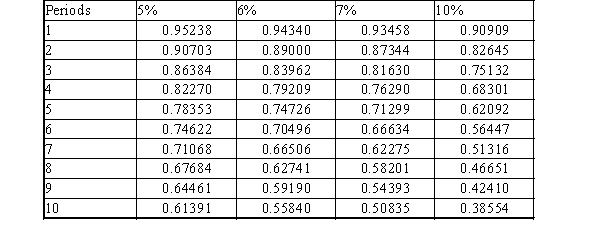
(Short Answer)
4.9/5 (81)
(81) The interest expense recorded on an interest payment date is increased
(Multiple Choice)
4.8/5 (68)
(68) If $1,000,000 of 8% bonds are issued at 102 3/4, the amount of cash received from the sale is
(Multiple Choice)
4.8/5 (94)
(94) Balance sheet and income statement data indicate the following: Bonds payable, 6% this is year 4 of 20 years)Preferred 8% stock, $100 par no change during the year)$1,200,000
200,000
Common stock, $50 par
No change during the year)1,000,000
Income before income tax for year
340,000
Income tax for year
80,000
Common dividends paid
60,000
Preferred dividends paid
16,000
Based on the data presented above, what is the number of times bond interest charges were earned round to two decimal places)?
(Multiple Choice)
4.9/5 (76)
(76) The face value of a term bond is payable at a single specific date in the future.
(True/False)
4.8/5 (83)
(83) Gains and losses on the redemption of bonds are reported as other income or other expense on the income statement.
(True/False)
4.7/5 (81)
(81) The present value of $5,000 to be received in 4 years at a market rate of interest of 6% compounded annually is $3,636.30.
(True/False)
4.9/5 (78)
(78) On January 1, the Elias Corporation issued 10% bonds with a face value of $50,000. The bonds are sold for $46,000. The bonds pay interest semiannually on June 30 and December 31 and the maturity date is December 31, ten years from now. Elias records straight-line amortization of the bond discount. The bond interest expense for the year ended December 31 of the first year is
(Multiple Choice)
4.9/5 (77)
(77) Ulmer Company is considering the following alternative financing plans:  Income tax is estimated at 35% of income. Dividends of $1 per share were declared and paid on the preferred stock.
Required: Determine the earnings per share of common stock, assuming income before bond interest and income tax is $600,000.
Income tax is estimated at 35% of income. Dividends of $1 per share were declared and paid on the preferred stock.
Required: Determine the earnings per share of common stock, assuming income before bond interest and income tax is $600,000. (Essay)
4.9/5 (74)
(74) There is a loss on redemption of bonds when bonds are redeemed above carrying value.
(True/False)
4.9/5 (81)
(81) 
Filters
- Essay(0)
- Multiple Choice(0)
- Short Answer(0)
- True False(0)
- Matching(0)