



 Chat with AI
Exam 7: Production Costs

Exam 1: Introducing the Economic Way of Thinking251 Questions
Exam 2: Production Possibilities, Opportunity Cost, and Economic Growth202 Questions
Exam 3: Market Demand and Supply412 Questions
Exam 4: Markets in Action253 Questions
Exam 5: Price Elasticity of Demand and Supply280 Questions
Exam 6: Consumer Choice Theory272 Questions
Exam 7: Production Costs243 Questions
Exam 8: Perfect Competition237 Questions
Exam 9: Monopoly168 Questions
Exam 10: Monopolistic Competition and Oligopoly187 Questions
Exam 11: Labor Markets202 Questions
Exam 12: Income Distribution, Poverty, and Discrimination130 Questions
Exam 13: Antitrust and Regulation203 Questions
Exam 14: Environmental Economics106 Questions
Exam 15: International Trade and Finance241 Questions
Exam 16: Economies in Transition108 Questions
Exam 17: Growth and the117 Questions
Select questions type


A farm is able to produce 10,000 bushels of peanuts per season on 10 acres. Assume it adds one more acre and is able to produce 12,000 bushels per season. The marginal product of the additional acre of land for this farm is:
(Multiple Choice)
4.8/5  (93)
(93) If the units of variable input in a production process are 1, 2, 3, 4, and 5, and the corresponding total outputs are 30, 34, 37, 39, and 40, respectively. The marginal product of the fourth unit is:
(Multiple Choice)
4.9/5 (74)
(74) Economies of scale imply that within some range one can increase the size of operation and:
(Multiple Choice)
4.8/5 (77)
(77) A large aircraft manufacturer, like Boeing, may have a cost advantage over a new smaller manufacturer because of:
(Multiple Choice)
4.9/5 (91)
(91) Exhibit 7-17 Long-run average cost curve 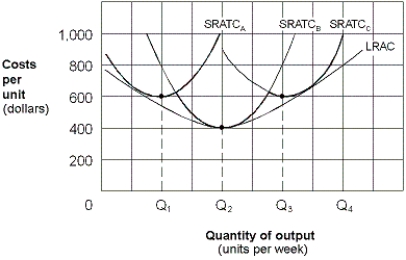 -In Exhibit 7-17, economies of scale exist up to:
 (Multiple Choice)
4.9/5 (73)
(73) Exhibit 7-8 Costs schedules for producing pizza Pizzas Fixed Cost Variable Cost Total Cost Marginal Cost 0 \ \ \ \ 1 5 2 13 3 10 4 100 140 5 20 6 85 7 215
-By filling in the blanks in Exhibit 7-8, the fixed cost of producing 6 pizzas is shown to be equal to:
(Multiple Choice)
4.7/5 (74)
(74) Exhibit 7-9 Cost schedule for firm X Output Quantity Total Fixed Cost Total Variable Cost 0 \ 100 \ 0 1 100 50 2 100 84 3 100 108 4 100 127 5 100 150
-As shown in Exhibit 7-9, the marginal cost of producing the third unit is:
(Multiple Choice)
4.8/5 (78)
(78) A young chef is considering opening his own sushi bar. To do so, he would have to quit his current job, which pays $20,000 a year, and take over a store building that he owns and currently rents to his brother for $6,000 a year. His expenses at the sushi bar would be $50,000 for food and $2,000 for gas and electricity. What are his explicit costs?
(Multiple Choice)
4.8/5 (80)
(80) Exhibit 7-15 Long-run average cost 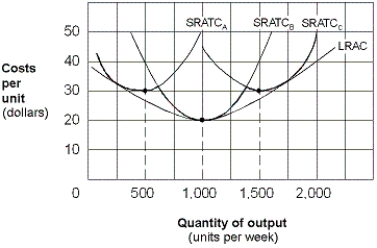 -In Exhibit 7-15, diseconomies of scale are shown in the range of:
 (Multiple Choice)
5.0/5 (82)
(82) Exhibit 7-3 A marginal product curve 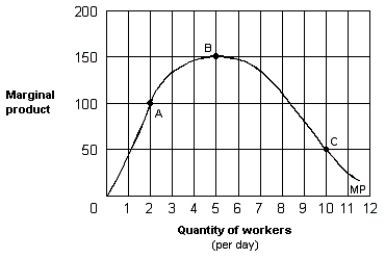 -As shown in Exhibit 7-3, the marginal product of labor for the last worker hired when 5 workers are employed per day is:
 (Multiple Choice)
4.9/5 (84)
(84) Exhibit 7-1 Production of pizza data Workers Pizzas 0 0 1 4 2 10 3 15 4 18 5 19
-Exhibit 7-1 shows the change in the production of pizzas as more workers are hired. The marginal product of the second employee equals:
(Multiple Choice)
4.8/5 (79)
(79) Suppose a publisher faces the following costs of producing 10,000 newspapers each month: $5,500 cost of labor; $2,200 monthly mortgage payment; $250 cost of electricity to run the printing presses; $800 for ink and paper; and $200 in city property taxes (based on the value of the building and land). Its total variable costs are:
(Multiple Choice)
4.7/5 (73)
(73) Exhibit 7-3 A marginal product curve
-As shown in Exhibit 7-3, the law of diminishing returns applies where there are:
-As shown in Exhibit 7-3, the law of diminishing returns applies where there are: (Multiple Choice)
4.8/5 (76)
(76) Marginal cost is calculated by dividing the change in total cost by the change in total output.
(True/False)
4.9/5 (63)
(63) Exhibit 7-4 A marginal product curve 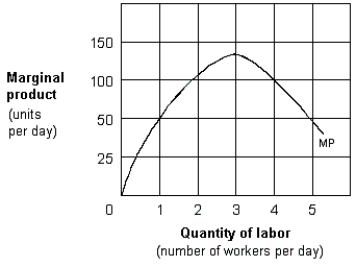 -As shown in Exhibit 7-4, the law of diminishing returns applies in the range of:
 (Multiple Choice)
4.9/5 (80)
(80) Exhibit 7-2 Cost schedule for pizza production Pizzas Labor Cost Energy Cost Materials Cost 0 \ 10 \ 0 \ 0 1 10 12 4 2 24 22 8 3 40 30 12 4 60 36 16 5 90 40 20
-Exhibit 7-2 shows the labor, energy, and materials cost of making various quantities of pizzas. The table shows that the energy cost of making pizzas will:
(Multiple Choice)
5.0/5 (81)
(81) Exhibit 7-15 Long-run average cost
-In Exhibit 7-15, economies of scale exist up to:
-In Exhibit 7-15, economies of scale exist up to: (Multiple Choice)
4.8/5 (77)
(77) Exhibit 7-12 Cost schedule for producing pizza Pizzas Fixed Cost Variable Cost Total Cost 0 \ \ \ 1 48 2 17 3 27 4 78 5 40 6 64 7 80
-By filling in the blanks in Exhibit 7-12, the marginal cost of the fourth pizza is shown to be equal to:
(Multiple Choice)
4.8/5 (62)
(62) Bill lives in Montana and likes to grow zucchini. He applies fertilizer to his crops twice during the growing season and notices that the second layer of fertilizer increases his crop, but not as much as the first layer. What economic concept best explains this observation?
(Multiple Choice)
4.8/5 (77)
(77) The law of diminishing returns applies to which of the following segments of the marginal product of labor curve?
(Multiple Choice)
4.9/5 (75)
(75) 
Filters
- Essay(0)
- Multiple Choice(0)
- Short Answer(0)
- True False(0)
- Matching(0)