



 Chat with AI
Exam 9: Monopoly

Exam 1: Introducing the Economic Way of Thinking251 Questions
Exam 2: Production Possibilities, Opportunity Cost, and Economic Growth202 Questions
Exam 3: Market Demand and Supply412 Questions
Exam 4: Markets in Action253 Questions
Exam 5: Price Elasticity of Demand and Supply280 Questions
Exam 6: Consumer Choice Theory272 Questions
Exam 7: Production Costs243 Questions
Exam 8: Perfect Competition237 Questions
Exam 9: Monopoly168 Questions
Exam 10: Monopolistic Competition and Oligopoly187 Questions
Exam 11: Labor Markets202 Questions
Exam 12: Income Distribution, Poverty, and Discrimination130 Questions
Exam 13: Antitrust and Regulation203 Questions
Exam 14: Environmental Economics106 Questions
Exam 15: International Trade and Finance241 Questions
Exam 16: Economies in Transition108 Questions
Exam 17: Growth and the117 Questions
Select questions type


For a monopolist to practice price discrimination, one necessary condition is that the product offered for sale must be:
(Multiple Choice)
4.8/5  (91)
(91) A monopolist always selects a price on the elastic portion of its demand curve.
(True/False)
4.8/5 (74)
(74) A monopolist faces a downward-sloping demand curve because:
(Multiple Choice)
4.8/5 (94)
(94) Exhibit 9-8 Profit maximizing for a monopolist
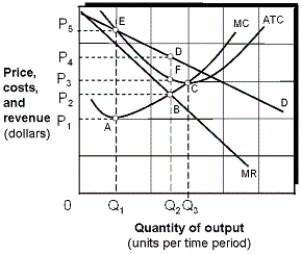 -As shown in Exhibit 9-8, the profit-maximizing price for the monopolist is:
 (Multiple Choice)
4.8/5 (77)
(77) Exhibit 9-7 Monopolist
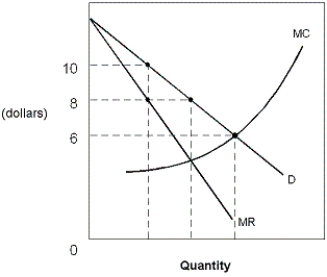 -According to the information provided in Exhibit 9-7, if the Rudd Ice Company was a monopoly and is currently charging a price of $8, what would you advise Rudd to do?
 (Multiple Choice)
4.8/5 (70)
(70) When a monopoly price discriminates, it charges the highest price to the group of buyers with the least elastic demand.
(True/False)
4.8/5 (72)
(72) A profit-maximizing monopolist will continue expanding output as long as:
(Multiple Choice)
4.8/5 (77)
(77) At the long-run equilibrium level of output, the monopolist's marginal cost will:
(Multiple Choice)
4.9/5 (82)
(82) A monopoly firm can sell its fourth unit of output for a price of $250. In order to sell more than five units, it must expect to receive a price:
(Multiple Choice)
4.9/5 (77)
(77) Suppose a monopolist and a perfectly competitive firm have the same cost curves. The monopolistic firm would:
(Multiple Choice)
4.9/5 (91)
(91) If a monopolist finds that at the present level of output marginal revenue exceeds marginal cost, the firm should:
(Multiple Choice)
4.7/5 (87)
(87) Which of the following represents an arbitrage transaction?
(Multiple Choice)
4.8/5 (76)
(76) An example of price discrimination is the price charged for:
(Multiple Choice)
5.0/5 (95)
(95) Suppose a monopolist charges a price corresponding to the intersection of the marginal cost and marginal revenue curves. If this price is between its average variable cost and average total cost curves, the firm will:
(Multiple Choice)
4.9/5 (72)
(72) Regardless of the demand for its product, a monopolist will be able to earn positive economic profits.
(True/False)
4.7/5 (62)
(62) Which of the following best explains an economic criticism of unregulated monopolists?
(Multiple Choice)
4.9/5 (88)
(88) What is a natural monopoly? Why is government justified in regulating a natural monopoly?
(Essay)
4.8/5 (65)
(65) Assume a monopolist's marginal cost and marginal revenue curves intersect and the demand curve passes above its average total cost curve. The firm will:
(Multiple Choice)
4.9/5 (73)
(73) 
Filters
- Essay(0)
- Multiple Choice(0)
- Short Answer(0)
- True False(0)
- Matching(0)