



 Chat with AI
Exam 9: Monopoly

Exam 1: Introducing the Economic Way of Thinking251 Questions
Exam 2: Production Possibilities, Opportunity Cost, and Economic Growth202 Questions
Exam 3: Market Demand and Supply412 Questions
Exam 4: Markets in Action253 Questions
Exam 5: Price Elasticity of Demand and Supply280 Questions
Exam 6: Consumer Choice Theory272 Questions
Exam 7: Production Costs243 Questions
Exam 8: Perfect Competition237 Questions
Exam 9: Monopoly168 Questions
Exam 10: Monopolistic Competition and Oligopoly187 Questions
Exam 11: Labor Markets202 Questions
Exam 12: Income Distribution, Poverty, and Discrimination130 Questions
Exam 13: Antitrust and Regulation203 Questions
Exam 14: Environmental Economics106 Questions
Exam 15: International Trade and Finance241 Questions
Exam 16: Economies in Transition108 Questions
Exam 17: Growth and the117 Questions
Select questions type


A price-discriminating monopoly charges the lowest price to the group that:
(Multiple Choice)
4.9/5  (71)
(71) Exhibit 9-4 Demand and cost curves for a monopolist
 -As shown in Exhibit 9-4, in order to maximize its profit (or minimize its loss), what price should the monopoly charge for its product?
 (Multiple Choice)
4.8/5 (72)
(72) One necessary condition for effective price discrimination is:
(Multiple Choice)
4.8/5 (84)
(84) Exhibit 9-8 Profit maximizing for a monopolist
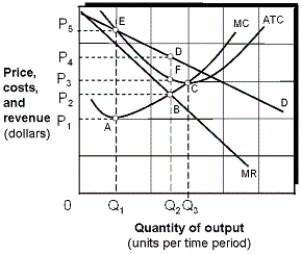 -As shown in Exhibit 9-8, if the monopolist produces the profit-maximizing output, total revenue is the rectangular area:
 (Multiple Choice)
4.7/5 (80)
(80) Exhibit 9-4 Demand and cost curves for a monopolist
-What should a profit maximizing monopolist do if she is currently producing where MC < MR?
-What should a profit maximizing monopolist do if she is currently producing where MC < MR? (Multiple Choice)
5.0/5 (87)
(87) A monopolist will be able to earn positive pure economic profits regardless of the price elasticity of demand.
(True/False)
4.8/5 (85)
(85) Compared to a perfectly competitive industry, a monopolist with the same marginal cost and demand curve will charge:
(Multiple Choice)
4.8/5 (85)
(85) Exhibit 9-10 A monopolist
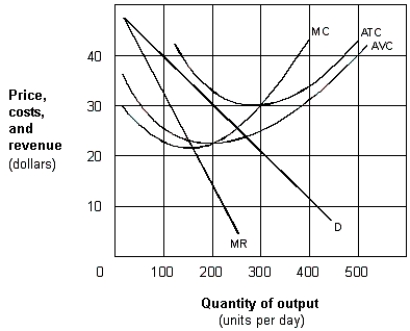 -In Exhibit 9-10, the monopolist would charge which of the following prices to maximize profit or minimize its loss?
 (Multiple Choice)
4.9/5 (80)
(80) Exhibit 9-2 Demand and cost information for a monopoly
0 40 10 1 30 15 2 20 25 3 10 40 4 0 60
-Refer to Exhibit 9-2. Using the rule that focuses on the marginal approach to maximizing profits, the monopolist maximizes profit by choosing price equal to:
(Multiple Choice)
4.9/5 (88)
(88) In order for a monopolist to earn an economic profit in short-run equilibrium, marginal revenue must be equal to zero.
(True/False)
4.8/5 (71)
(71) Exhibit 9-10 A monopolist
-In Exhibit 9-10, the profit-maximizing or loss-minimizing output for the monopolist is:
-In Exhibit 9-10, the profit-maximizing or loss-minimizing output for the monopolist is: (Multiple Choice)
4.9/5 (67)
(67) The two theoretical extremes of the market structure spectrum are occupied at one end by perfect competition and on the other end by monopoly.
(True/False)
4.9/5 (86)
(86) A monopoly market is characterized by a single seller of a product which has few, if any, suitable substitutes.
(True/False)
4.9/5 (85)
(85) Exhibit 9-9 A monopolist
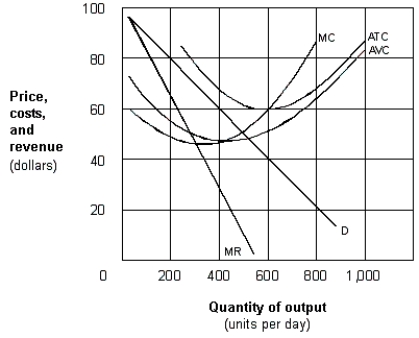 -In Exhibit 9-9, at the profit-maximizing or loss-minimizing output, the monopolist's total economic profit is:
 (Multiple Choice)
4.8/5 (83)
(83) In contrast to a perfectly competitive firm, a monopolist operates in the long run at a quantity of output at which:
(Multiple Choice)
4.9/5 (87)
(87) 
Filters
- Essay(0)
- Multiple Choice(0)
- Short Answer(0)
- True False(0)
- Matching(0)