



 Chat with AI
Exam 27: Manufacturing Accounting: The Work Sheet and Financial Statements

Exam 1: Introduction to Accounting50 Questions
Exam 2: Analyzing Transactions: the Accounting Equation57 Questions
Exam 3: The Double-Entry Framework78 Questions
Exam 4: Journalizing and Posting Transactions94 Questions
Exam 5: Adjusting Entries and the Work Sheet101 Questions
Exam 6: Financial Statements and the Closing Process92 Questions
Exam 7: Accounting for Cash93 Questions
Exam 8: Payroll Accounting: Employee Earnings and Deductions85 Questions
Exam 9: Payroll Accounting: Employer Taxes and Reports79 Questions
Exam 10: Accounting for Sales and Cash Receipts66 Questions
Exam 11: Accounting for Purchases and Cash Payments79 Questions
Exam 12: Special Journals56 Questions
Exam 13: Accounting for Merchandise Inventory87 Questions
Exam 14: Adjustments and the Work Sheet for a Merchandising Business70 Questions
Exam 15: Financial Statements and Year-End Accounting for a Merchandising Business96 Questions
Exam 16: Accounting for Accounts Receivable77 Questions
Exam 17: Accounting for Notes and Interest97 Questions
Exam 18: Accounting for Long-Term Assets103 Questions
Exam 19: Accounting for Partnerships77 Questions
Exam 20: Corporations: Organization and Capital Stocks105 Questions
Exam 21: Corporations: Earnings, Taxes, Distributions, and the Retained Earnings Statement92 Questions
Exam 22: Corporations: Bonds98 Questions
Exam 23: Statement of Cash Flows102 Questions
Exam 24: Analysis of Financial Statements101 Questions
Exam 25: Departmental Accounting72 Questions
Exam 26: Manufacturing Accounting: The Job Order Cost System97 Questions
Exam 27: Manufacturing Accounting: The Work Sheet and Financial Statements66 Questions
Select questions type


The balance of retained earnings at the beginning of the year was $475,000, and the balance at the end of the year was $550,000. Cash dividends declared during the year were $35,000. The amount of net income for the year was
(Multiple Choice)
4.8/5  (79)
(79) Which of the following adjustments is NOT made to Factory Overhead on the work sheet?
(Multiple Choice)
4.8/5 (92)
(92) From the adjusting entries below, prepare the reversing entry(ies) that would be needed for January 1. 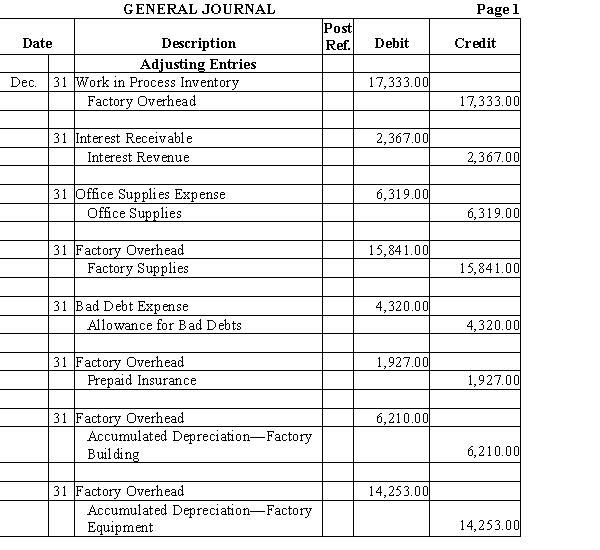
(Essay)
4.8/5 (86)
(86) If factory overhead applied is more than the adjusted debit balance of Factory Overhead, the difference is known as
(Multiple Choice)
4.7/5 (89)
(89) Which of the following accounts on the manufacturing company work sheet is NOT an asset account?
(Multiple Choice)
4.7/5 (83)
(83) From the data below for Wong Company, prepare the closing entries for the year ended December 31. Cash dividends \ 47,000 Sales 982,600 Sales returns and allowances 3,960 Inter est revenue 10,521 Factory overhead (debit) 210,620 Factory overhead (credit) 210,620 Cost of goods sold 726,820 Wages expense 130,745 Supplies expense 9,900 Depreciation expense-office equipment 6,900 Utilities expense 5,840 Bad debt expense 1,680 Advertising expense 11,120 Interest expense 9,860 Income tax expense 32,050 
(Essay)
4.9/5 (75)
(75) In a periodic inventory system, costs of goods sold are computed through an adjustment process at the end of the period.
(True/False)
4.9/5 (88)
(88) Factory overhead must be applied to work in process at the end of the year, even though those jobs are not yet finished.
(True/False)
5.0/5 (79)
(79) To close Income Summary at the end of the year, Retained Earnings is credited for the amount of net income.
(True/False)
4.9/5 (88)
(88) If factory overhead applied is less than the adjusted debit balance of Factory Overhead, the difference is known as
(Multiple Choice)
4.9/5 (79)
(79) Prepare the year-end adjusting entries in general journal form for Dombrowski Corporation. Information for the year-end adjustments is as follows: Factory overhead to be applied to work in process ending inventory \ 21,700 Interest receivable 1,400 Office supplies used 8,400 Factory supplies used 10,600 Provision for uncollectible accounts 13,900 Insurance expired on factory buil ding and equipment 3,100 Depreciation on factory building 17,800 Depreciation on factory equipment 8,600 
(Essay)
4.9/5 (86)
(86) Which of the following steps are involved in closing the temporary accounts of a manufacturing business?
(Multiple Choice)
4.8/5 (77)
(77) Debits in the factory overhead account represent the actual overhead costs incurred.
(True/False)
4.8/5 (91)
(91) Source data for work in process at the beginning of the accounting period comes from the
(Multiple Choice)
4.8/5 (76)
(76) The entry to apply factory overhead to work in process ending inventory includes a debit to Work in Process Inventory and a credit to Factory Overhead.
(True/False)
4.9/5 (80)
(80) The income statement of a manufacturer is commonly supported by a schedule of cost of goods manufactured.
(True/False)
4.8/5 (74)
(74) 
Filters
- Essay(0)
- Multiple Choice(0)
- Short Answer(0)
- True False(0)
- Matching(0)