



 Chat with AI
Exam 18: Accounting for Long-Term Assets

Exam 1: Introduction to Accounting50 Questions
Exam 2: Analyzing Transactions: the Accounting Equation57 Questions
Exam 3: The Double-Entry Framework78 Questions
Exam 4: Journalizing and Posting Transactions94 Questions
Exam 5: Adjusting Entries and the Work Sheet101 Questions
Exam 6: Financial Statements and the Closing Process92 Questions
Exam 7: Accounting for Cash93 Questions
Exam 8: Payroll Accounting: Employee Earnings and Deductions85 Questions
Exam 9: Payroll Accounting: Employer Taxes and Reports79 Questions
Exam 10: Accounting for Sales and Cash Receipts66 Questions
Exam 11: Accounting for Purchases and Cash Payments79 Questions
Exam 12: Special Journals56 Questions
Exam 13: Accounting for Merchandise Inventory87 Questions
Exam 14: Adjustments and the Work Sheet for a Merchandising Business70 Questions
Exam 15: Financial Statements and Year-End Accounting for a Merchandising Business96 Questions
Exam 16: Accounting for Accounts Receivable77 Questions
Exam 17: Accounting for Notes and Interest97 Questions
Exam 18: Accounting for Long-Term Assets103 Questions
Exam 19: Accounting for Partnerships77 Questions
Exam 20: Corporations: Organization and Capital Stocks105 Questions
Exam 21: Corporations: Earnings, Taxes, Distributions, and the Retained Earnings Statement92 Questions
Exam 22: Corporations: Bonds98 Questions
Exam 23: Statement of Cash Flows102 Questions
Exam 24: Analysis of Financial Statements101 Questions
Exam 25: Departmental Accounting72 Questions
Exam 26: Manufacturing Accounting: The Job Order Cost System97 Questions
Exam 27: Manufacturing Accounting: The Work Sheet and Financial Statements66 Questions
Select questions type


Under the declining-balance method, salvage value is considered directly in the determination of the depreciation amount.
(True/False)
4.9/5  (85)
(85) The write-off of the cost of a wasting asset is called amortization.
(True/False)
5.0/5 (74)
(74) The depreciation method using a steadily decreasing rate applied to the depreciable cost of the asset, resulting in successively smaller depreciation charges over the life of the asset is called the
(Multiple Choice)
5.0/5 (84)
(84) Match the terms with the definitions.
-The loss of usefulness because of deterioration from age and wear.
(Multiple Choice)
4.8/5 (80)
(80) Assets such as patents, copyrights, and trademarks are intangible assets.
(True/False)
4.8/5 (68)
(68) Gains are similar to revenue and increase net income, and losses are similar to expenses and decrease net income.
(True/False)
4.8/5 (69)
(69) An asset is purchased on January 1 at a cost of $78,000. It is expected to be used for five years and have a salvage value of $8,000. Calculate the depreciation expense for each year of the asset's useful life under each of the following methods:
a.
Straight-line method
b.
Double-declining-balance method
c.
Sum-of-the-years-digits' method
(Essay)
4.7/5 (87)
(87) In accounting for exchanges of similar assets considered to have "commercial substance," financial accounting recognizes all gains and losses.
(True/False)
4.9/5 (88)
(88) Under the Modified Accelerated Cost Recovery System (MACRS) depreciation method, the salvage value is
(Multiple Choice)
4.7/5 (72)
(72) Depreciation is a process of cost allocation, not a process of valuation.
(True/False)
4.9/5 (76)
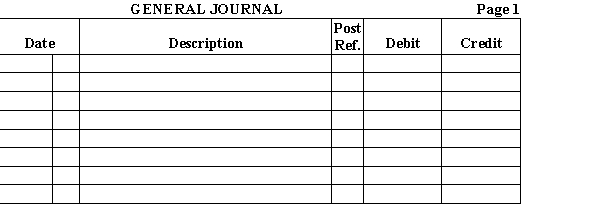
(76) Prepare journal entries for the following transactions for Star Haulage InC.Jan. 1
Replaced the engine in Truck #1, paying cash, $5,400.
Feb. 13
Paid cash for a tune-up of the engine in Truck #2, $570.
19
Paid cash to add a lift to Truck #2, $3,700.
(Essay)
4.8/5 (72)
(72) A delivery truck that cost $26,000 has been owned for 3 years and is traded in for another delivery truck to be used for a similar purpose. Depreciation in the amount of $5,200 has been taken each year⎯a total of $15,600. If the trade-in value of the old truck is $12,000 and the new truck has a fair market value of $30,000, the new truck would be recorded at
(Multiple Choice)
4.9/5 (78)
(78) A farm tractor costing $80,000 is depreciated using the MACRS method. The tractor qualifies as a 3-year property, has a scrap value of $20,000, and is depreciated at the following rates: Year 1, 33.33%; Year 2, 44.45%; Year 3, 14.81%; and Year 4, 7.41%. The amount of depreciation to be entered for the second year would be
(Multiple Choice)
4.7/5 (83)
(83) Over the life of an asset, the total of the amounts of the calculated annual net income will be about the same, regardless of the method of depreciation.
(True/False)
4.8/5 (77)
(77) For tax purposes, both gains and losses are recognized on exchanges of similar assets.
(True/False)
4.9/5 (75)
(75) Which of the following is NOT a way of calculating the amount of depreciation for each period?
(Multiple Choice)
4.9/5 (81)
(81) The cost of planting trees and shrubs, installing fences, and paving parking areas are normally charged to the land improvements account and are later depreciated over their expected useful lives.
(True/False)
4.7/5 (80)
(80) The depreciation method using a fixed rate applied to the undepreciated cost of the asset each year, resulting in successively smaller depreciation charges as the undepreciated cost diminishes year by year is called the
(Multiple Choice)
4.7/5 (86)
(86) The accounting entry for additions and improvements that increase the usefulness of equipment includes
(Multiple Choice)
4.8/5 (65)
(65) 
Filters
- Essay(0)
- Multiple Choice(0)
- Short Answer(0)
- True False(0)
- Matching(0)