



 Chat with AI
Exam 12: Derivatives Continued

Exam 1: Algebraic Concepts308 Questions
Exam 2: Linear Equations and Functions243 Questions
Exam 3: Quadratic and Other Special Functions113 Questions
Exam 4: Matrices227 Questions
Exam 5: Inequalities and Linear Programming120 Questions
Exam 6: Exponential and Logarithmic Functions108 Questions
Exam 7: Mathematics of Finance131 Questions
Exam 8: Introduction to Probability178 Questions
Exam 9: Further Topics in Probability; Data Description114 Questions
Exam 10: Derivatives248 Questions
Exam 11: Applications of Derivatives172 Questions
Exam 12: Derivatives Continued139 Questions
Exam 13: Indefinite Integrals120 Questions
Exam 14: Definite Integrals: Techniques of Integration185 Questions
Exam 15: Functions of Two or More Variables119 Questions
Select questions type


Suppose that the supply of x units of a product at price p dollars per unit is given by  . Approximate the price increase associated with the number of units supplied changing from 36 to 37. Round your answer to the nearest cent.
 (Multiple Choice)
4.9/5  (82)
(82) Assume that x and y are differentiable functions of t. If  find dx/dt when
 ,
 , and
 .
find dx/dt when , , and . (Multiple Choice)
4.9/5 (84)
(84) Boyle's law for enclosed gases states that at a constant temperature, the pressure is related to the volume by the equation  , where k is a constant. If the volume is increasing at a rate of 7 cubic inches per hour, at what rate is the pressure changing when the volume is 40 cubic inches and
 inch-pounds? Round your answer to three decimal places.
, where k is a constant. If the volume is increasing at a rate of 7 cubic inches per hour, at what rate is the pressure changing when the volume is 40 cubic inches and inch-pounds? Round your answer to three decimal places. (Multiple Choice)
4.9/5 (78)
(78) The loudness of sound (L, measured in decibels) perceived by the human ear depends on intensity levels (I) according to  , where
 is the standard threshold of audibility. If
 then using the change-of-base formula, we get
 . At what rate is the loudness changing with respect to x when the intensity is 1,000 times the standard threshold of audibility (that is, when x = 1,000)?
, where is the standard threshold of audibility. If then using the change-of-base formula, we get . At what rate is the loudness changing with respect to x when the intensity is 1,000 times the standard threshold of audibility (that is, when x = 1,000)? (Multiple Choice)
4.9/5 (85)
(85)  .
Suppose the weekly demand for a product is given by  and the weekly supply before taxation is given by
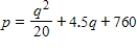 . Find the tax per item that produces maximum tax revenue. Round your answer to the nearest cent.
and the weekly supply before taxation is given by . Find the tax per item that produces maximum tax revenue. Round your answer to the nearest cent. (Multiple Choice)
4.7/5 (81)
(81) Assume that x, y, and z are differentiable functions of t. If  find
 when
 ,
 ,
 ,
 and
 . Round your answer to two decimal places.
find when , , , and . Round your answer to two decimal places. (Multiple Choice)
5.0/5 (71)
(71) p is in dollars and q is the number of units. Find the elasticity of the demand function  at the price p = $10. Round your answer to two decimal places.
 (Multiple Choice)
4.8/5 (80)
(80) 
The demand function for a product is given by  , where p is the price per unit in dollars when x units are demanded. Find the second derivative to see whether the rate at which the price is changing at 30 units is increasing or decreasing.
 (Multiple Choice)
4.8/5 (71)
(71) p is in dollars and q is the number of units. Suppose that the demand for a product is given by  . Find the elasticity when
 and
 . Round your answer to four decimal places.
. Find the elasticity when and . Round your answer to four decimal places. (Multiple Choice)
4.8/5 (71)
(71)  if
 .
Suppose that the number of mosquitoes N (in thousands) in a certain swampy area near a community is related to the number of pounds of insecticide x sprayed on the nesting areas according to  Find the rate of change of N, with respect to x when 49 pounds of insecticide are used. Round your answer to two decimal places.
 (Multiple Choice)
4.8/5 (79)
(79) The future value that accrues when $200 is invested at 7%, compounded continuously, is  , where t is the number of years. At what rate is the money in this account growing when t = 7? Round your answer to the nearest cent.
 (Multiple Choice)
4.9/5 (76)
(76) At what y-value does the curve defined by 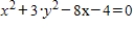 have a vertical tangent?
 (Multiple Choice)
4.9/5 (80)
(80) Write the equation of the line tangent to the graph of  at
 .
at . (Multiple Choice)
4.8/5 (74)
(74) Total personal income in the U.S. (in billions of dollars) for selected years from 1960 to 2002 is given in the following table. 
These data can be modeled by
 , where x is the number of years past 1960. If this model is accurate, find the rate of change of the total U.S. personal income in 2001. Round your answer to the nearest ten million dollar.
These data can be modeled by , where x is the number of years past 1960. If this model is accurate, find the rate of change of the total U.S. personal income in 2001. Round your answer to the nearest ten million dollar.
(Multiple Choice)
4.7/5 (102)
(102) p is in dollars and q is the number of units. Suppose that the demand for a product is given by 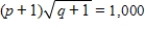 . Find the elasticity when
 . Round your answer to two decimal places.
. Find the elasticity when . Round your answer to two decimal places. (Multiple Choice)
4.9/5 (73)
(73) Find dy/dx at the given point without first solving for y. Round your answer to two decimal places.  at

at (Multiple Choice)
4.8/5 (89)
(89)  .


Filters
- Essay(0)
- Multiple Choice(0)
- Short Answer(0)
- True False(0)
- Matching(0)