



 Chat with AI
Exam 10: Derivatives

Exam 1: Algebraic Concepts308 Questions
Exam 2: Linear Equations and Functions243 Questions
Exam 3: Quadratic and Other Special Functions113 Questions
Exam 4: Matrices227 Questions
Exam 5: Inequalities and Linear Programming120 Questions
Exam 6: Exponential and Logarithmic Functions108 Questions
Exam 7: Mathematics of Finance131 Questions
Exam 8: Introduction to Probability178 Questions
Exam 9: Further Topics in Probability; Data Description114 Questions
Exam 10: Derivatives248 Questions
Exam 11: Applications of Derivatives172 Questions
Exam 12: Derivatives Continued139 Questions
Exam 13: Indefinite Integrals120 Questions
Exam 14: Definite Integrals: Techniques of Integration185 Questions
Exam 15: Functions of Two or More Variables119 Questions
Select questions type


Write the equation of the tangent line to the graph of the function at the indicated point. Check the reasonableness of your answer by graphing both the function and the tangent line. 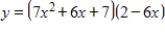 at

at (Multiple Choice)
4.8/5  (75)
(75) For the function in this problem, approximate  by using the numerical derivative feature of a graphing utility.
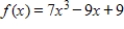
by using the numerical derivative feature of a graphing utility. (Multiple Choice)
4.7/5 (70)
(70) For the function in this problem, approximate  by computing
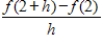 with
 . Round your answer to four decimal places.
by computing with . Round your answer to four decimal places. (Multiple Choice)
4.7/5 (82)
(82) The monthly charge in dollars for x kilowatt-hours (kWh) of electricity used by a residential consumer of Excelsior Electric Membership Corporation from November through June is given by the function 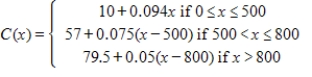 . Is C continuous at
 ?
. Is C continuous at ?
(Multiple Choice)
4.8/5 (73)
(73) A certain calling card costs 6.3 cents per minute to make a call, rounded up to the nearest minute. However, when the card is used at a pay phone, there is an additional 63 cent connection fee. If  is the charge from a pay phone for a call lasting t minutes, create a table of charges for calls lasting close to 1 minute and use it to find the following limit, if it exists. Round your answer to the nearest cent.

is the charge from a pay phone for a call lasting t minutes, create a table of charges for calls lasting close to 1 minute and use it to find the following limit, if it exists. Round your answer to the nearest cent. (Multiple Choice)
4.8/5 (87)
(87) 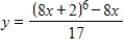
Graph the function with a graphing utility and use it to predict the limit. Check your work either by using the table feature of the graphing utility or by finding the limit algebraically. 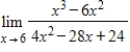
(Multiple Choice)
4.9/5 (82)
(82) Identify x-values where  has a maximum point or a minimum point, where
 is increasing, and where
 is decreasing.
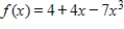
has a maximum point or a minimum point, where is increasing, and where is decreasing. (Multiple Choice)
5.0/5 (61)
(61) Suppose that for selected years from 1970 to 2006, the following table shows the percent of total U.S. workers who are female. 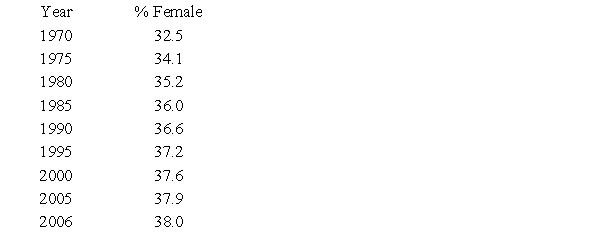
Assume these data can be modeled with the function
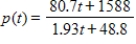 where p(t) is the percent of the U.S. workforce that is female and t is the number of years past 1970. Find the function that models the instantaneous rate of change of the percent of U.S. workers who are female.
Assume these data can be modeled with the function where p(t) is the percent of the U.S. workforce that is female and t is the number of years past 1970. Find the function that models the instantaneous rate of change of the percent of U.S. workers who are female.
(Multiple Choice)
4.9/5 (76)
(76) Find the derivative of the given function. Simplify and express the answer using positive exponents only. 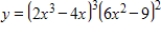
(Multiple Choice)
4.7/5 (73)
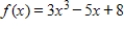
(73)  and
 .
 and

Find the derivative of the given function. Simplify and express the answer using positive exponents only. 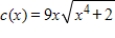
(Multiple Choice)
5.0/5 (93)
(93) Find the derivative of the given function. Simplify and express the answer using positive exponents only. 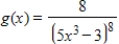
(Multiple Choice)
4.8/5 (91)
(91) Use analytic methods to find the limit as  for the given function.
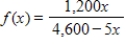
for the given function. (Multiple Choice)
4.8/5 (82)
(82) The monthly charge in dollars for x kilowatt-hours (kWh) of electricity used by a residential consumer of Excelsior Electric Membership Corporation from November through June is given by the function 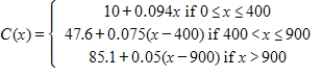 . Is C continuous at
 ?
. Is C continuous at ? (Multiple Choice)
4.7/5 (75)
(75) 
The graph of a company's profit function is shown. For the given problem, use the graph to answer the following questions about points A, B, and C. Rank from smallest to largest the marginal profit at these points. 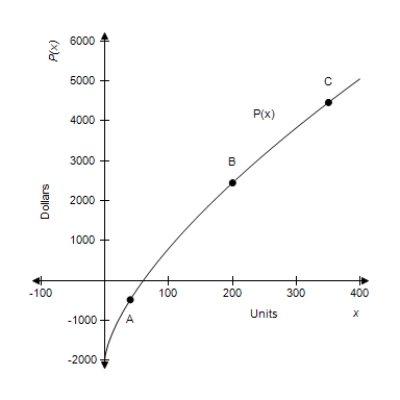
(Multiple Choice)
4.8/5 (75)
(75) If the formula describing the distance s (in feet) an object travels as a function of time t (in seconds) is 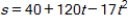 . What is the acceleration of the object when
 ?
. What is the acceleration of the object when ? (Multiple Choice)
4.7/5 (82)
(82) 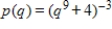
Determine whether the given function is continuous. If it is not, identify where it is discontinuous and which condition fails to hold. You can verify your conclusions by graphing the function with a graphing utility, if one is available. 
(Multiple Choice)
4.9/5 (79)
(79) 
Filters
- Essay(0)
- Multiple Choice(0)
- Short Answer(0)
- True False(0)
- Matching(0)