



 Chat with AI
Exam 10: Derivatives

Exam 1: Algebraic Concepts308 Questions
Exam 2: Linear Equations and Functions243 Questions
Exam 3: Quadratic and Other Special Functions113 Questions
Exam 4: Matrices227 Questions
Exam 5: Inequalities and Linear Programming120 Questions
Exam 6: Exponential and Logarithmic Functions108 Questions
Exam 7: Mathematics of Finance131 Questions
Exam 8: Introduction to Probability178 Questions
Exam 9: Further Topics in Probability; Data Description114 Questions
Exam 10: Derivatives248 Questions
Exam 11: Applications of Derivatives172 Questions
Exam 12: Derivatives Continued139 Questions
Exam 13: Indefinite Integrals120 Questions
Exam 14: Definite Integrals: Techniques of Integration185 Questions
Exam 15: Functions of Two or More Variables119 Questions
Select questions type


For the function in this problem, approximate  near the point
 by graphing the function on a graphing utility. Then, zoom in near the point until the graph appears straight, pick two points, and find the slope of the line you see. Round your answer to three decimal places.
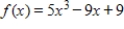
near the point by graphing the function on a graphing utility. Then, zoom in near the point until the graph appears straight, pick two points, and find the slope of the line you see. Round your answer to three decimal places. (Multiple Choice)
4.8/5  (78)
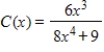
(78) The cost per unit of producing a product is  dollars, where x represents the number of units produced per week. If the equilibrium price determined by a competitive market is $200, how many units should the firm produce and sell each week to maximize its profit?
 (Multiple Choice)
4.7/5 (75)
(75) For the function in this problem, approximate  by computing
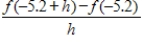 with
 .

by computing with . (Multiple Choice)
4.9/5 (80)
(80) Because the derivative of a function represents both the slope of the tangent to the curve and the instantaneous rate of change of the function, it is possible to use information about one to gain information about the other. In this problem, use the graph of the function  given in the figure.
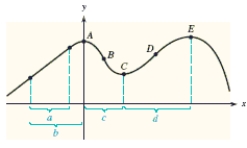 Over what interval(s) (a) through (d) is the rate of change of f (x) positive?
given in the figure. Over what interval(s) (a) through (d) is the rate of change of f (x) positive? (Multiple Choice)
4.9/5 (65)
(65)  if
 .
Determine whether the given function 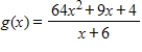 is continuous. If
 is not continuous, identify where it is discontinuous and which condition(s) fails to hold.
is continuous. If is not continuous, identify where it is discontinuous and which condition(s) fails to hold. (Multiple Choice)
4.8/5 (65)
(65) Complete the table and use it to predict the limit, if it exists. 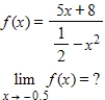
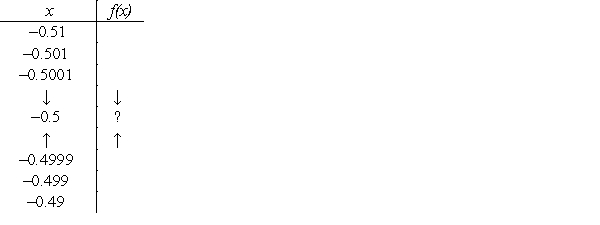
(Multiple Choice)
4.9/5 (82)
(82) Use analytic methods to find any point of discontinuity for the given function. 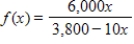
(Multiple Choice)
4.9/5 (80)
(80)  if
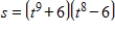 .
Suppose the lowest temperature recorded in Indianapolis, Indiana, was  If x is the wind speed in miles per hour and
 , then the wind chill (in degrees Fahrenheit) for an air temperature of
 can be approximated by the function
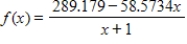 . At what rate is the wind chill changing when the wind speed is 50 mph? Round your answer to two decimal places.
If x is the wind speed in miles per hour and , then the wind chill (in degrees Fahrenheit) for an air temperature of can be approximated by the function . At what rate is the wind chill changing when the wind speed is 50 mph? Round your answer to two decimal places. (Multiple Choice)
4.9/5 (87)
(87) 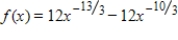
 for
The graph of a company's profit function is shown. For the given problem, use the graph to answer the following question about points A, B, and C. Rank from smallest to largest the amounts of profit received at these points. 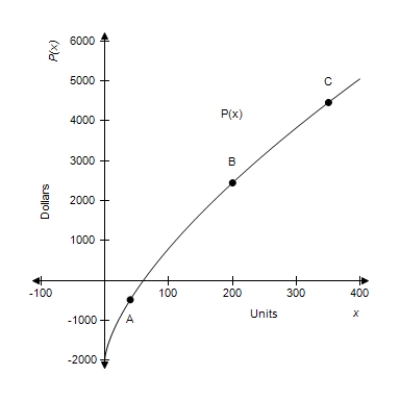
(Multiple Choice)
4.9/5 (68)
(68) 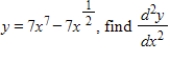 .
Because the derivative of a function represents both the slope of the tangent to the curve and the instantaneous rate of change of the function, it is possible to use information about one to gain information about the other. In this problem, use the graph of the function  given in the figure.
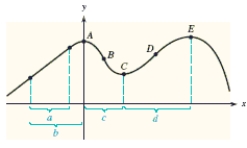
At what point(s) A through E is the rate of change of f (x) equal to zero?
given in the figure.
At what point(s) A through E is the rate of change of f (x) equal to zero?
(Multiple Choice)
4.8/5 (100)
(100) This problem contains a function and its graph, where  . Use the graph to determine, as well as you can,
 . Check your conclusion by using the function to determine
 analytically.

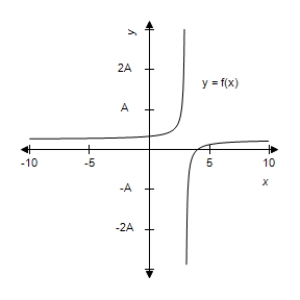
. Use the graph to determine, as well as you can, . Check your conclusion by using the function to determine analytically. (Multiple Choice)
4.9/5 (89)
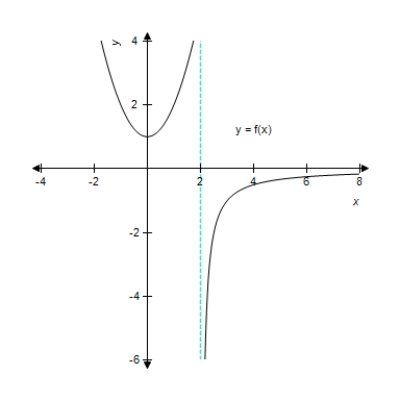
(89) For the given x-value, use the figure to determine whether the function is continuous or discontinuous at that x-value. 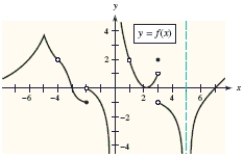

(Multiple Choice)
4.9/5 (68)
(68) The data entry speed (in words per minute) of a data clerk trainee is  , where x is the number of hours of training he has had. What is the rate at which his speed is changing and what does this rate mean when he has had 15 hours of training?
 (Multiple Choice)
4.9/5 (91)
(91) Suppose the revenue (in dollars) from the sale of x units of a product is given by the equation 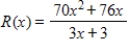 . Find the marginal revenue when 45 units are sold. Round your answer to the nearest dollar.
 (Multiple Choice)
4.8/5 (76)
(76)  and the given c-value to find
 .


Filters
- Essay(0)
- Multiple Choice(0)
- Short Answer(0)
- True False(0)
- Matching(0)