



 Chat with AI
Exam 10: Savings, Investment Spending, and the Financial Syst

Exam 1: First Principles183 Questions
Exam 2: Economic Models: Trade-Offs and Trade341 Questions
Exam 3: Supply and Demand230 Questions
Exam 4: Price Controls and Quotas: Meddling With Markets187 Questions
Exam 5: International Trade224 Questions
Exam 6: Macroeconomics: the Big Picture128 Questions
Exam 7: GDP and the CPI: Tracking the Macroeconomy213 Questions
Exam 8: Unemployment and Inflation300 Questions
Exam 9: Long-Run Economic Growth268 Questions
Exam 10: Savings, Investment Spending, and the Financial Syst355 Questions
Exam 11: Income and Expenditure114 Questions
Exam 12: Aggregate Demand and Aggregate Supply308 Questions
Exam 13: Fiscal Policy120 Questions
Exam 14: Money, Banking, and the Federal Reserve System135 Questions
Exam 15: Monetary Policy316 Questions
Exam 16: Inflation, Disinflation, and Deflation194 Questions
Exam 17: Macroeconomics: Events and Ideas283 Questions
Exam 18: International Macroeconomics411 Questions
Select questions type


A person who is risk averse loses less welfare from losing $100 than he or she gains in welfare from winning $100.
(True/False)
4.8/5  (85)
(85) If a one-year project costs $100,000 and is expected to return the firm $105,000, the rate of return of the project is:
(Multiple Choice)
4.8/5 (76)
(76) You have purchased a new mattress for $2,000, and the store has given you a "12 months, same as cash" deal. This means that you do not actually have to pay for the mattress for another year. One year from now, you will have to give the store the full price of $2,000. If the annual interest rate is 10%, how much money do you need today to ensure that you will have $2,000 one year from today?
(Multiple Choice)
4.9/5 (87)
(87) Use the following to answer questions:  -(Figure: The Market for Loanable Funds II) Use Figure: The Market for Loanable Funds II. If the interest rate is lower than 8%, the quantity supplied of loanable funds will be _____ the quantity of loanable funds demanded.
 (Multiple Choice)
4.9/5 (96)
(96) Use the following to answer questions:
-(Figure: The Market for Loanable Funds II) Use Figure: The Market for Loanable Funds II. Other things being equal, an increase in taxes on savings and investment income will shift _____ to the _____ and _____ the interest rate.
-(Figure: The Market for Loanable Funds II) Use Figure: The Market for Loanable Funds II. Other things being equal, an increase in taxes on savings and investment income will shift _____ to the _____ and _____ the interest rate. (Multiple Choice)
5.0/5 (65)
(65) GDP is $12 trillion this year in a closed economy. Consumption is $8 trillion and government spending is $2 trillion. Taxes are $0.5 trillion. How much is national saving?
(Multiple Choice)
4.8/5 (73)
(73) An illiquid asset can be quickly converted to cash with little or no loss of value.
(True/False)
4.8/5 (91)
(91) Stocks are usually riskier than bonds but also typically earn a higher rate of return than do bonds.
(True/False)
4.8/5 (83)
(83) Usually the rate of return on stock is lower than the rate of return on bonds.
(True/False)
4.8/5 (79)
(79) Use the following to answer questions:  -(Figure: Crowding Out) Use Figure: Crowding Out. The supply of loanable funds curve SLF1 shifts to SLF2. This shift implies that:
 (Multiple Choice)
4.9/5 (73)
(73) A business will be likely to borrow to fund projects if the:
(Multiple Choice)
4.8/5 (96)
(96) In an open economy, GDP is $12 trillion this year. Consumption is $8 trillion, and government spending is $2 trillion. Taxes are $0.5 trillion. Exports are $1 trillion, and imports are $3 trillion. How much is investment spending?
(Multiple Choice)
4.8/5 (70)
(70) An asset that can be quickly converted to cash with relatively little loss of value is:
(Multiple Choice)
4.9/5 (92)
(92) Banks are nonprofit financial intermediaries that collect the savings of their members and invest those funds in a diversified portfolio of assets to provide income to members when they retire.
(True/False)
4.9/5 (83)
(83) Use the following to answer question 93: 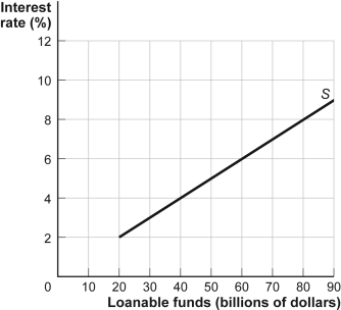 -(Figure: Supply of Loanable Funds) Use Figure: Supply of Loanable Funds. When the interest rate rises from 6% to 8%, the:
 (Multiple Choice)
5.0/5 (78)
(78) In a closed economy, all investment spending must come from:
(Multiple Choice)
4.9/5 (87)
(87) 
Filters
- Essay(0)
- Multiple Choice(0)
- Short Answer(0)
- True False(0)
- Matching(0)