



 Chat with AI
Exam 12: Aggregate Demand and Aggregate Supply

Exam 1: First Principles183 Questions
Exam 2: Economic Models: Trade-Offs and Trade341 Questions
Exam 3: Supply and Demand230 Questions
Exam 4: Price Controls and Quotas: Meddling With Markets187 Questions
Exam 5: International Trade224 Questions
Exam 6: Macroeconomics: the Big Picture128 Questions
Exam 7: GDP and the CPI: Tracking the Macroeconomy213 Questions
Exam 8: Unemployment and Inflation300 Questions
Exam 9: Long-Run Economic Growth268 Questions
Exam 10: Savings, Investment Spending, and the Financial Syst355 Questions
Exam 11: Income and Expenditure114 Questions
Exam 12: Aggregate Demand and Aggregate Supply308 Questions
Exam 13: Fiscal Policy120 Questions
Exam 14: Money, Banking, and the Federal Reserve System135 Questions
Exam 15: Monetary Policy316 Questions
Exam 16: Inflation, Disinflation, and Deflation194 Questions
Exam 17: Macroeconomics: Events and Ideas283 Questions
Exam 18: International Macroeconomics411 Questions
Select questions type


Use the following to answer questions:
Figure: AD-AS Model I 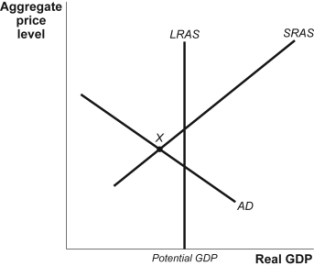 -(Figure: AD-AS Model I) Refer to Figure: AD-AS Model I. If the economy is at point X, there is a(n) _____ gap with _____ unemployment.
 (Multiple Choice)
5.0/5  (75)
(75) The _____ curve shows the positive relationship between the aggregate price level and the quantity of aggregate output supplied when wages and prices are not fully flexible.
(Multiple Choice)
4.9/5 (90)
(90) An increase in the price of oil is likely to shift the short-run aggregate supply curve to the right.
(True/False)
4.9/5 (78)
(78) Use the following to answer questions:
Figure: AD-AS 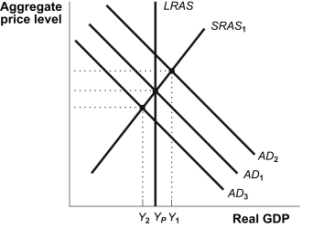 -(Figure: AD-AS) Refer to Figure: AD-AS. Suppose the economy is in an inflationary gap so that SRAS1 intersects AD2. The size of the gap is equal to:
 (Multiple Choice)
4.9/5 (81)
(81) Use the following to answer questions:
Figure: AD-AS Model II 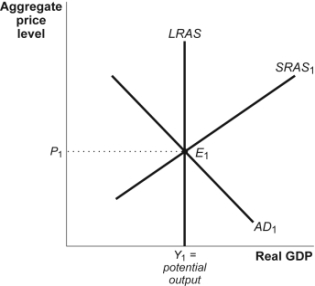 -(Figure: AD-AS Model II) Refer to Figure: AD-AS Model II. Which occurrence will raise the price level?
 (Multiple Choice)
4.9/5 (89)
(89) As a recessionary gap self-corrects, the equilibrium price level _____ and the equilibrium real output _____.
(Multiple Choice)
4.8/5 (63)
(63) Use the following to answer questions:
Figure: Shifts of the AD-AS Curves 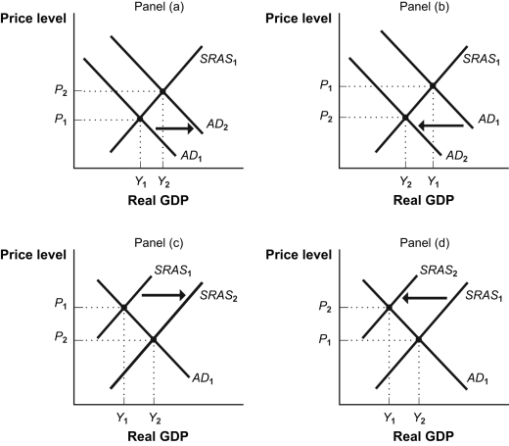 -(Figure: Shifts of the AD-AS Curves) Refer to Figure: Shifts of the AD-AS Curves. A short run decrease in investment spending is illustrated by panel:
 (Multiple Choice)
4.7/5 (83)
(83) The Great Depression was caused by _____ shocks, and the stagflation of the 1970s was caused by _____ shocks.
(Multiple Choice)
5.0/5 (87)
(87) The economic slump in the 1970s looked different from the slump at the beginning of the Great Depression because it was:
(Multiple Choice)
4.8/5 (86)
(86) If government increases income tax rates, the aggregate demand curve is likely to:
(Multiple Choice)
4.9/5 (79)
(79) The interest rate effect of the price level is reflected in the:
(Multiple Choice)
4.9/5 (74)
(74) The three consequences of the decline in demand during the Great Depression were _____ prices, _____ output, and a surge in unemployment.
(Multiple Choice)
4.9/5 (81)
(81) The positive relationship between the aggregate price level and aggregate output supplied gives the short-run aggregate supply curve a(n) _____ slope.
(Multiple Choice)
4.9/5 (74)
(74) If the SRAS curve intersects the aggregate demand curve to the right of LRAS, the result will be:
(Multiple Choice)
4.8/5 (73)
(73) Use the following to answer questions:
Figure: Inflationary and Recessionary Gaps 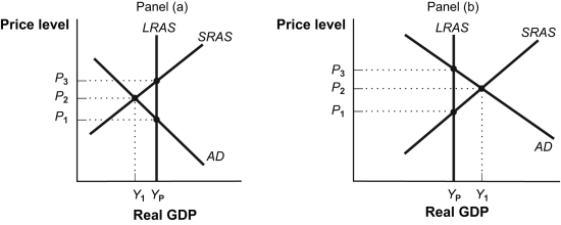 -(Figure: Inflationary and Recessionary Gaps) Refer to Figure: Inflationary and Recessionary Gaps. If the economy is in short-run equilibrium at Y1 in panel (b), a contractionary policy to bring the economy back to potential output at YP would attempt to shift the:
 (Multiple Choice)
4.9/5 (71)
(71) 
Filters
- Essay(0)
- Multiple Choice(0)
- Short Answer(0)
- True False(0)
- Matching(0)