



 Chat with AI
Exam 13: Translation and Proteins

Exam 1: Introduction to Genetics43 Questions
Exam 2: Mitosis and Meiosis48 Questions
Exam 3: Mendelian Genetics58 Questions
Exam 4: Modifications of Mendelian Ratios59 Questions
Exam 5: Sex Determination and Sex Chromosomes50 Questions
Exam 6: Chromosome Mutations: Variation in Number and Arrangement47 Questions
Exam 7: Linkage and Chromosome Mapping in Eukaryotes38 Questions
Exam 8: Genetic Analysis and Mapping in Bacteria and Bactierophages47 Questions
Exam 9: DNA Structure and Analysis49 Questions
Exam 10: DNA Replication and Recombination45 Questions
Exam 11: Chromosome Structure and Dna Sequence Organization34 Questions
Exam 12: The Genetic Code and Transcription51 Questions
Exam 13: Translation and Proteins44 Questions
Exam 14: Gene Mutation, Dna Repair, and Transposition53 Questions
Exam 15: Regulation of Gene Expression64 Questions
Exam 16: The Genetics of Cancer48 Questions
Exam 17: Recombinant Dna Technology50 Questions
Exam 18: Genomics and Proteomics44 Questions
Exam 19: Applications and Ethics of Genetic Engineering and Biotechnology37 Questions
Exam 20: Developmental Genetics36 Questions
Exam 21: Quantitative Genetics and Multifactorial Traits52 Questions
Exam 22: Population and Evolutionary Genetics53 Questions
Select questions type


Side groups of amino acids are typically classified under which of the following?
(Multiple Choice)
4.9/5  (73)
(73) The following drawing represents simultaneous transcription and translation in E. coli.
Answer the questions below the drawing. The arrow gives the direction of the RNA polymerase.
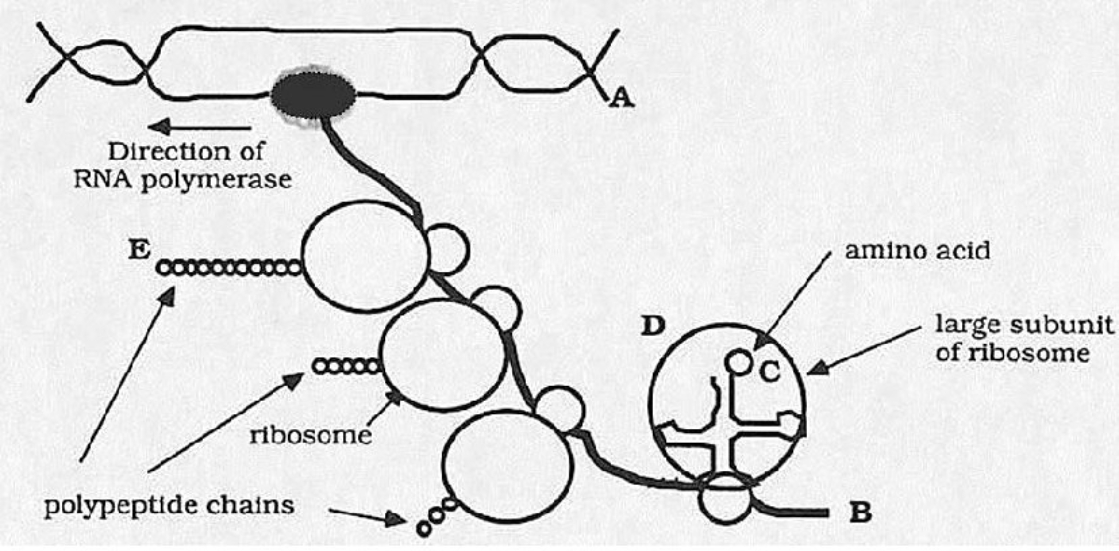 a() Is the letter A nearer the 5' or the 3' end of the molecule?
b() Is the letter B nearer the 5' or the 3' end of the molecule?
c() Is the letter C nearer the 5' or the 3' end of the tRNA molecule?
d() What is the "S" value for the large rRNA that is closest to the letter D?
e() Which terminus (N or
C) of the growing polypeptide chain is nearer to the letter E?
a() Is the letter A nearer the 5' or the 3' end of the molecule?
b() Is the letter B nearer the 5' or the 3' end of the molecule?
c() Is the letter C nearer the 5' or the 3' end of the tRNA molecule?
d() What is the "S" value for the large rRNA that is closest to the letter D?
e() Which terminus (N or
C) of the growing polypeptide chain is nearer to the letter E? (Short Answer)
4.7/5 (84)
(84) Describe the conceptual basis for constructing biochemical pathways using nutrient supplement experiments with Neurospora.

(Essay)
4.9/5 (74)
(74) Describe the basic structure of normal adult hemoglobin and the abnormality observed in sickle -cell hemoglobin.
(Essay)
4.8/5 (63)
(63) Given the following table:
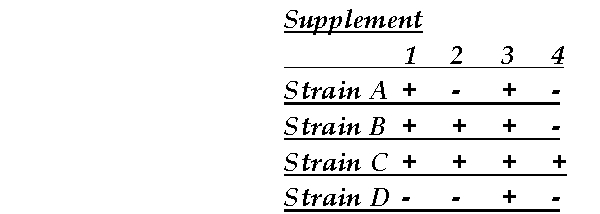 where numbers 1 through 4 indicate four supplements that must be added to sustain growth of the organism, determine a possible metabolic pathway that would give the results seen for the four mutant strains, A through D.
 (Essay)
4.9/5 (75)
(75) Assuming that an amino acid sequence is 250 amino acids long, how many different molecules, each with a unique sequence, could be formed?
(Short Answer)
4.9/5 (86)
(86) Sickle -cell anemia is caused by the absence of the alpha chain of hemoglobin.
(True/False)
4.7/5 (75)
(75) By their experimentation using the Neurospora fungus, Beadle and Tatum were able to propose the far -reaching hypothesis that _.
(Multiple Choice)
4.8/5 (74)
(74) The ribonucleic acid components known to exist in eukaryotic ribosomes are the following: 5.8S, 18S, 28S, and 5S.
(True/False)
4.9/5 (75)
(75) Describe each of the following parameters that relate to the structure and function of tRNA:
a() four functional domains
b() Wobble hypothesis
(Essay)
5.0/5 (70)
(70) A protein is 300 amino acids long. Which of the following could be the number of nucleotides in the section of DNA that codes for this protein? (Remember: DNA is double -stranded.)
(Multiple Choice)
4.7/5 (75)
(75) Knowing that the base sequence of any given messenger RNA is responsible for
precisely ordering the amino acids in a respective protein, present two mechanisms by which intrinsic properties of mRNA may regulate the "net output" of a given gene.
(Essay)
4.9/5 (84)
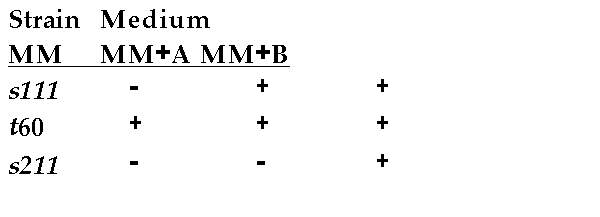
(84) Below is a set of experimental results relating the growth (+) of Neurospora on several media (MM = minimal medium). Based on the information provided, present the
biochemical pathway and the locations of the metabolic blocks.
(Essay)
4.7/5 (84)
(84) Prokaryotic and eukaryotic ribosomes are structurally and chemically identical.
(True/False)
4.9/5 (81)
(81) Which protein class directly controls many of the metabolic reactions within a cell?
(Multiple Choice)
4.9/5 (78)
(78) 
Filters
- Essay(0)
- Multiple Choice(0)
- Short Answer(0)
- True False(0)
- Matching(0)