



 Chat with AI
Exam 6: Bone Tissue

Exam 1: An Introduction to the Human Body78 Questions
Exam 2: Cells75 Questions
Exam 3: Tissues75 Questions
Exam 4: Development85 Questions
Exam 5: The Integumentary System75 Questions
Exam 6: Bone Tissue75 Questions
Exam 7: The Skeletal System: the Axial Skeleton75 Questions
Exam 8: The Skeletal System: the Appendicular Skeleton75 Questions
Exam 9: Joints75 Questions
Exam 10: Muscular Tissue75 Questions
Exam 11: The Muscular System75 Questions
Exam 12: The Cardiovascular System: Blood75 Questions
Exam 13: The Cardiovascular System: the Heart75 Questions
Exam 14: The Cardiovascular System: Blood Vessels75 Questions
Exam 15: The Lymphatic Lymphoid System and Immunity75 Questions
Exam 16: Nervous Tissue75 Questions
Exam 17: The Spinal Cord and the Spinal Nerves75 Questions
Exam 18: The Brain and the Cranial Nerves75 Questions
Exam 19: The Autonomic Nervous System75 Questions
Exam 20: Somatic Senses and Motor Control75 Questions
Exam 21: Special Senses75 Questions
Exam 22: The Endocrine System75 Questions
Exam 23: The Respiratory System87 Questions
Exam 24: The Digestive System75 Questions
Exam 25: The Urinary System100 Questions
Exam 26: The Reproductive Systems75 Questions
Exam 27: Surface Anatomy74 Questions
Select questions type


Primary ossification proceeds from the external surfaces inward; secondary ossification proceeds from the interior outward toward the external surface of a bone.
(True/False)
4.8/5  (80)
(80) Most bones develop in a process whereby hyaline cartilage models are replaced by bone tissue.
(True/False)
4.8/5 (81)
(81) Osteocytes are the mature bone cells that develop directly from _____.
(Multiple Choice)
4.8/5 (71)
(71) The epiphyseal plate separates the epiphysis and diaphysis of a growing bone. The four zones of cartilage found here, in order from epiphyseal edge to diaphyseal edge are _____, _____, _____, and _____.
(Essay)
5.0/5 (89)
(89) Which of the following is an organic part of bone matrix that gives bone its flexibility and tensile strength?
(Multiple Choice)
4.8/5 (82)
(82) Medications used to treat osteoporosis are generally of two types: _____ and _____.
(Short Answer)
4.8/5 (83)
(83) In the diagram of bone tissue, which label is on the central canal? 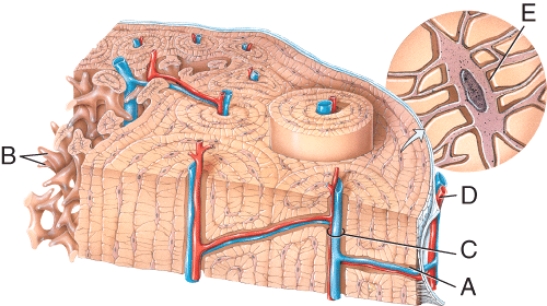
(Multiple Choice)
4.9/5 (76)
(76) Microscopic canals that run longitudinally through bone tissue and that contain blood vessels and nerves are called perforating (Volkmann's) canals.
(True/False)
4.9/5 (71)
(71) Growth in length as a long bone develops is called _____ growth.
(Multiple Choice)
4.7/5 (76)
(76) The bone tissue of the distal region of the femur is replaced about every 4 months, whereas some regions of the shaft of the femur may never be replaced.
(True/False)
5.0/5 (80)
(80) The perichondrium of the cartilage model becomes the periosteum of compact bone.
(True/False)
4.8/5 (85)
(85) The process by which bone tissue replaces hyaline cartilage is _____ ossification.
(Short Answer)
4.9/5 (81)
(81) 
Filters
- Essay(0)
- Multiple Choice(0)
- Short Answer(0)
- True False(0)
- Matching(0)