



 Chat with AI
Exam 16: Nervous Tissue

Exam 1: An Introduction to the Human Body78 Questions
Exam 2: Cells75 Questions
Exam 3: Tissues75 Questions
Exam 4: Development85 Questions
Exam 5: The Integumentary System75 Questions
Exam 6: Bone Tissue75 Questions
Exam 7: The Skeletal System: the Axial Skeleton75 Questions
Exam 8: The Skeletal System: the Appendicular Skeleton75 Questions
Exam 9: Joints75 Questions
Exam 10: Muscular Tissue75 Questions
Exam 11: The Muscular System75 Questions
Exam 12: The Cardiovascular System: Blood75 Questions
Exam 13: The Cardiovascular System: the Heart75 Questions
Exam 14: The Cardiovascular System: Blood Vessels75 Questions
Exam 15: The Lymphatic Lymphoid System and Immunity75 Questions
Exam 16: Nervous Tissue75 Questions
Exam 17: The Spinal Cord and the Spinal Nerves75 Questions
Exam 18: The Brain and the Cranial Nerves75 Questions
Exam 19: The Autonomic Nervous System75 Questions
Exam 20: Somatic Senses and Motor Control75 Questions
Exam 21: Special Senses75 Questions
Exam 22: The Endocrine System75 Questions
Exam 23: The Respiratory System87 Questions
Exam 24: The Digestive System75 Questions
Exam 25: The Urinary System100 Questions
Exam 26: The Reproductive Systems75 Questions
Exam 27: Surface Anatomy74 Questions
Select questions type


A neuron having one axon and one dendrite, such as those located in the retina or inner ear, are classified as _____ neurons.
(Short Answer)
4.8/5  (74)
(74) Neurons that originate in the central nervous system and that function to carry information to smooth, skeletal, or cardiac muscle are efferent (motor) neurons.
(True/False)
4.7/5 (86)
(86) For a typical (multipolar) neuron, use correct anatomical terms to describe the structure of an axon from the point where it is attached to the neuron cell body to where it ends at a synapse.
(Essay)
4.7/5 (64)
(64) There are two types of neuroglia that produce myelin sheaths: oligodendrocytes and Schwann cells (neurolemmocytes).
(True/False)
4.9/5 (69)
(69) The afferent (sensory) portion of the autonomic nervous system carries sensory information from the viscera to the central nervous system.
(True/False)
4.8/5 (105)
(105) A bundle of axons in the central nervous system is called a/an _____.
(Short Answer)
4.7/5 (78)
(78) Neurogenesis, the birth of new neurons, does NOT happen in adult humans.
(True/False)
4.7/5 (85)
(85) The name of the structure indicated by the line in the diagram is: _____. 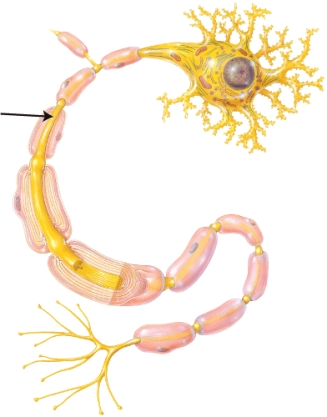
(Short Answer)
4.8/5 (82)
(82) The name of the cell type indicated by the (c) in the diagram is: _____. 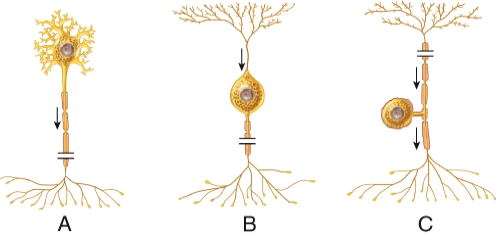
(Short Answer)
4.7/5 (91)
(91) The name of the cell type indicated by the (b) in the diagram is: _____. 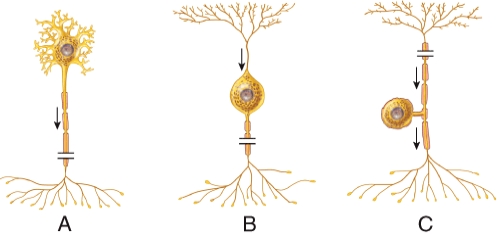
(Short Answer)
4.7/5 (81)
(81) The name of the structure indicated by the line in the diagram is: _____. 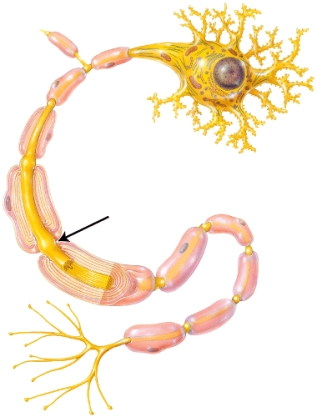
(Short Answer)
5.0/5 (81)
(81) In order to flex your fingers, which type of impulse will the flexor digitorum superficialis muscle need to receive?
(Multiple Choice)
4.7/5 (64)
(64) 
Filters
- Essay(0)
- Multiple Choice(0)
- Short Answer(0)
- True False(0)
- Matching(0)