



 Chat with AI
Exam 20: Somatic Senses and Motor Control

Exam 1: An Introduction to the Human Body78 Questions
Exam 2: Cells75 Questions
Exam 3: Tissues75 Questions
Exam 4: Development85 Questions
Exam 5: The Integumentary System75 Questions
Exam 6: Bone Tissue75 Questions
Exam 7: The Skeletal System: the Axial Skeleton75 Questions
Exam 8: The Skeletal System: the Appendicular Skeleton75 Questions
Exam 9: Joints75 Questions
Exam 10: Muscular Tissue75 Questions
Exam 11: The Muscular System75 Questions
Exam 12: The Cardiovascular System: Blood75 Questions
Exam 13: The Cardiovascular System: the Heart75 Questions
Exam 14: The Cardiovascular System: Blood Vessels75 Questions
Exam 15: The Lymphatic Lymphoid System and Immunity75 Questions
Exam 16: Nervous Tissue75 Questions
Exam 17: The Spinal Cord and the Spinal Nerves75 Questions
Exam 18: The Brain and the Cranial Nerves75 Questions
Exam 19: The Autonomic Nervous System75 Questions
Exam 20: Somatic Senses and Motor Control75 Questions
Exam 21: Special Senses75 Questions
Exam 22: The Endocrine System75 Questions
Exam 23: The Respiratory System87 Questions
Exam 24: The Digestive System75 Questions
Exam 25: The Urinary System100 Questions
Exam 26: The Reproductive Systems75 Questions
Exam 27: Surface Anatomy74 Questions
Select questions type


Axons of _____-order neurons cross over to the other side in the brain or spinal cord before ascending to the thalamus.
(Multiple Choice)
4.8/5  (100)
(100) Select the best description for the function of the lateral corticospinal tract:
(Multiple Choice)
4.9/5 (93)
(93) Incoming sensory information is integrated; that is, it is processed and interpreted and a course of action is taken. At which of the following locations does the integration process occur?
(Multiple Choice)
4.8/5 (71)
(71) Ascending somatic sensory pathways to the cerebral cortex consist of thousands of sets of three neurons: first-order neurons, second-order neurons, and third-order neurons.
(True/False)
4.7/5 (75)
(75) Select the best description for the function of the corticobulbar tract:
(Multiple Choice)
4.8/5 (81)
(81) _____ are proprioceptors located at the junction of a tendon and a muscle.
(Multiple Choice)
4.7/5 (86)
(86) Name three spinal tracts that carry conscious sensory information. For each tract, describe the location and the types of sensations transmitted.
(Essay)
4.8/5 (74)
(74) First-order neurons transmit signals from somatic receptors along cranial and spinal nerves into the brain stem and spinal cord respectively.
(True/False)
4.7/5 (93)
(93) The cell bodies of _____-order sensory neurons are located in the thalamus.
(Multiple Choice)
4.9/5 (81)
(81) _____ is defined as the conscious or subconscious awareness of changes in the external or internal conditions of the body.
(Multiple Choice)
4.9/5 (76)
(76) From the following list of spinal cord pathways, choose the ones that are together responsible for carrying all conscious sensory information in the spinal cord:
1) spinothalamic
2) gracile fasciculus
3) spinocerebellar
4) posterior column-medial lemniscus
5) cuneate fasciculus
(Multiple Choice)
5.0/5 (78)
(78) Decussation of sensory pathways occurs before the pathway reaches the thalamus.
(True/False)
4.8/5 (74)
(74) The major control region for planning and initiating voluntary movements is the primary motor area (precentral gyrus) of the cortex.
(True/False)
4.9/5 (77)
(77) 
Type II cutaneous mechanoreceptors, found deep in the dermis, function as receptors for touch as well as for pressure.
(True/False)
4.8/5 (83)
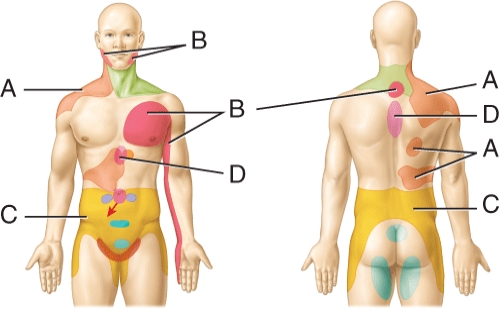
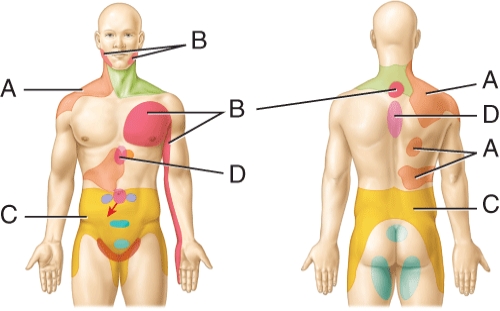
(83) What is referred pain? Using an example, explain how referred pain occurs.
(Essay)
5.0/5 (89)
(89) 
Filters
- Essay(0)
- Multiple Choice(0)
- Short Answer(0)
- True False(0)
- Matching(0)