



 Chat with AI
Exam 21: Special Senses

Exam 1: An Introduction to the Human Body78 Questions
Exam 2: Cells75 Questions
Exam 3: Tissues75 Questions
Exam 4: Development85 Questions
Exam 5: The Integumentary System75 Questions
Exam 6: Bone Tissue75 Questions
Exam 7: The Skeletal System: the Axial Skeleton75 Questions
Exam 8: The Skeletal System: the Appendicular Skeleton75 Questions
Exam 9: Joints75 Questions
Exam 10: Muscular Tissue75 Questions
Exam 11: The Muscular System75 Questions
Exam 12: The Cardiovascular System: Blood75 Questions
Exam 13: The Cardiovascular System: the Heart75 Questions
Exam 14: The Cardiovascular System: Blood Vessels75 Questions
Exam 15: The Lymphatic Lymphoid System and Immunity75 Questions
Exam 16: Nervous Tissue75 Questions
Exam 17: The Spinal Cord and the Spinal Nerves75 Questions
Exam 18: The Brain and the Cranial Nerves75 Questions
Exam 19: The Autonomic Nervous System75 Questions
Exam 20: Somatic Senses and Motor Control75 Questions
Exam 21: Special Senses75 Questions
Exam 22: The Endocrine System75 Questions
Exam 23: The Respiratory System87 Questions
Exam 24: The Digestive System75 Questions
Exam 25: The Urinary System100 Questions
Exam 26: The Reproductive Systems75 Questions
Exam 27: Surface Anatomy74 Questions
Select questions type


In bright light, impulses from sympathetic neurons cause a constriction of the pupil due to contraction of the radial muscle fibers of the iris.
(True/False)
4.8/5  (75)
(75) Which of the following statements about the cornea is TRUE?
(Multiple Choice)
5.0/5 (81)
(81) A layer of dense connective tissue that covers the entire eyeball except the cornea is called _____.
(Multiple Choice)
4.8/5 (89)
(89) The facial (VII) nerve and vestibulocochlear (VIII) nerve both travel through the facial canal of the petrous portion of the temporal bone. A tumor located in this canal will potentially interfere with the special sense(s) of:
(Multiple Choice)
4.7/5 (76)
(76) The bony labyrinth contains perilymph; the membranous labyrinth contains endolymph.
(True/False)
4.7/5 (83)
(83) Large papillae that always contain taste buds and that are found in a V-shaped row on the posterior region of the tongue are called vallate (circumvallate) papillae.
(True/False)
4.8/5 (70)
(70) In the wall of the utricle and saccule, the gelatinous layer of the macula that rests on the hair cells contains calcium carbonate crystals called _____.
(Multiple Choice)
4.8/5 (90)
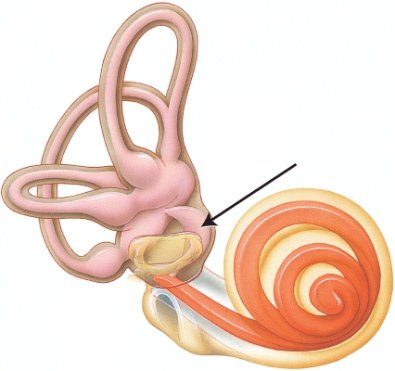
(90) 
The first-order neurons of the olfactory pathway are bipolar neurons called olfactory receptor cells.
(True/False)
4.9/5 (77)
(77) The cranial nerves containing neurons of the gustatory pathway are:
1) facial (VII) nerve
2) vagus (X) nerve
3) glossopharyngeal (IX) nerve
4) trigeminal (V) nerve
5) abducens (VI) nerve
(Multiple Choice)
4.8/5 (93)
(93) Olfactory receptors, which are specialized neurons, are replaced regularly by the basal cells of the olfactory epithelium.
(True/False)
4.9/5 (75)
(75) Define the two kinds of equilibrium and name and describe the receptors for each.
(Essay)
4.8/5 (61)
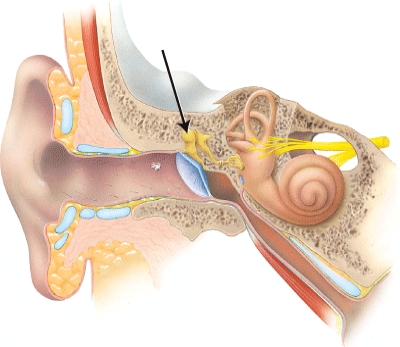
(61) 
Which of the following types of cells is the first to receive a light ray as it travels through the retina?
(Multiple Choice)
4.9/5 (85)
(85) 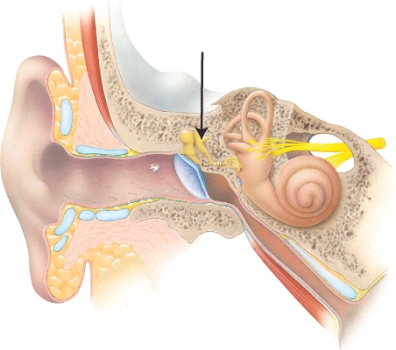
Summarize the events that occur as sound waves enter the external ear and are transmitted through the middle and inner ears to produce sensations of hearing. Accompany your summary with labeled sketches that illustrate the anatomical features in your answer.
(Short Answer)
4.8/5 (82)
(82) Obstruction or blockage of the nasolacrimal duct will prevent drainage of tears into the:
(Multiple Choice)
4.8/5 (85)
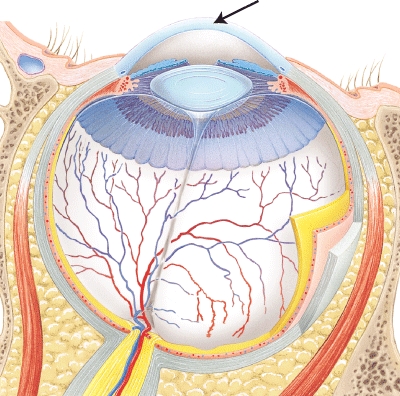
(85) 

Filters
- Essay(0)
- Multiple Choice(0)
- Short Answer(0)
- True False(0)
- Matching(0)