



 Chat with AI
Exam 27: Surface Anatomy

Exam 1: An Introduction to the Human Body78 Questions
Exam 2: Cells75 Questions
Exam 3: Tissues75 Questions
Exam 4: Development85 Questions
Exam 5: The Integumentary System75 Questions
Exam 6: Bone Tissue75 Questions
Exam 7: The Skeletal System: the Axial Skeleton75 Questions
Exam 8: The Skeletal System: the Appendicular Skeleton75 Questions
Exam 9: Joints75 Questions
Exam 10: Muscular Tissue75 Questions
Exam 11: The Muscular System75 Questions
Exam 12: The Cardiovascular System: Blood75 Questions
Exam 13: The Cardiovascular System: the Heart75 Questions
Exam 14: The Cardiovascular System: Blood Vessels75 Questions
Exam 15: The Lymphatic Lymphoid System and Immunity75 Questions
Exam 16: Nervous Tissue75 Questions
Exam 17: The Spinal Cord and the Spinal Nerves75 Questions
Exam 18: The Brain and the Cranial Nerves75 Questions
Exam 19: The Autonomic Nervous System75 Questions
Exam 20: Somatic Senses and Motor Control75 Questions
Exam 21: Special Senses75 Questions
Exam 22: The Endocrine System75 Questions
Exam 23: The Respiratory System87 Questions
Exam 24: The Digestive System75 Questions
Exam 25: The Urinary System100 Questions
Exam 26: The Reproductive Systems75 Questions
Exam 27: Surface Anatomy74 Questions
Select questions type


Pulses from the dorsalis pedis artery can be palpated lateral to the extensor hallucis longus tendon.
(True/False)
4.9/5  (79)
(79) The point at which the trachea (windpipe) divides into right and left primary bronchi may be determined by locating the sternal angle.
(True/False)
4.7/5 (72)
(72) The trachea (windpipe) can be palpated posterior to the suprasternal (jugular) notch of the sternum.
(True/False)
5.0/5 (74)
(74) If a patient folds the arms across the chest and bends forward, the lung sounds can be heard (at the triangular area shown in the figure) in the intercostal space between which two ribs? 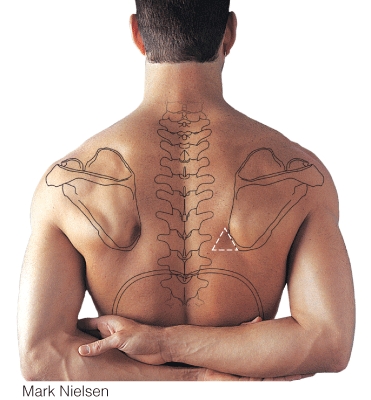
(Essay)
4.9/5 (76)
(76) When the thumb is bent backward, a depression forms called the _____ between the tendons of the extensor pollicis brevis and extensor pollicis longus.
(Short Answer)
4.9/5 (83)
(83) Which surface anatomy feature consists of the inferior edges of the costal cartilages of ribs 7-10? At its superior end is the xiphisternal joint.
(Multiple Choice)
4.9/5 (83)
(83) The _____ ligament is the lower (inferior) border of the external oblique muscle.
(Short Answer)
4.9/5 (90)
(90) The tendon of the _____ muscle is visible when the wrist is slightly flexed and the base of the thumb and little finger are drawn together.
(Short Answer)
4.8/5 (81)
(81) A portion of the ear that does not contain cartilage is the lobule.
(True/False)
4.8/5 (83)
(83) The ramus, body, and angle of the mandible can be palpated at the _____ and _____ regions of the head.
(Short Answer)
4.9/5 (77)
(77) McBurney's point, a landmark used in locating the appendix:
(Multiple Choice)
4.9/5 (79)
(79) 
Filters
- Essay(0)
- Multiple Choice(0)
- Short Answer(0)
- True False(0)
- Matching(0)