



 Chat with AI
Exam 16: The Evolution of Plants and Fungi

Exam 1: Learning About Life45 Questions
Exam 2: Essential Chemistry for Biology50 Questions
Exam 3: The Molecules of Life56 Questions
Exam 4: A Tour of the Cell57 Questions
Exam 5: The Working Cell58 Questions
Exam 6: Cellular Respiration: Obtaining Energy From Food53 Questions
Exam 7: Photosynthesis: Using Light to Make Food52 Questions
Exam 8: Cellular Reproduction: Cells From Cells59 Questions
Exam 9: Patterns of Inheritance55 Questions
Exam 10: The Structure and Function of Dna59 Questions
Exam 11: How Genes Are Controlled55 Questions
Exam 12: Dna Technology54 Questions
Exam 13: How Populations Evolve52 Questions
Exam 14: How Biological Diversity Evolves47 Questions
Exam 15: The Evolution of Microbial Life59 Questions
Exam 16: The Evolution of Plants and Fungi56 Questions
Exam 17: The Evolution of Animals60 Questions
Exam 18: An Introduction to Ecology and the Biosphere56 Questions
Exam 19: Population Ecology52 Questions
Exam 20: Communities and Ecosystems63 Questions
Exam 21: Unifying Concepts of Animal Structure and Function57 Questions
Exam 22: Nutrition and Digestion67 Questions
Exam 23: Circulation and Respiration69 Questions
Exam 24: The Bodys Defenses59 Questions
Exam 25: Hormones53 Questions
Exam 26: Reproduction and Development59 Questions
Exam 27: Nervous, Sensory, and Locomotor Systems62 Questions
Exam 28: The Life of a Flowering Plant81 Questions
Exam 29: The Working Plant73 Questions
Select questions type


Scenario
People utilize plants to meet many everyday needs, including food, fiber, and building materials. However, not many of the over 300,000 known species of plants are used by people. One species with a lot of future promise is the jatropha tree. This species is native to Central America and is now found throughout the tropics. Many people believe the jatropha could help alleviate poverty in many areas of the world, as the seeds produce an oil that can be used for cooking, lighting, or generating electricity. This oil can also be mixed with diesel fuel or petrol to produce a biofuel. Mature trees produce between 5 and 15 kg of seeds per year and can live more than 30 years.
-Suppose a weather catastrophe occurred such that the bird pollinators of the jatropha tree were significantly diminished. Which form of dispersal might jatropha trees need for a chance to continue producing flowers and seeds?
(Multiple Choice)
4.8/5  (83)
(83) Which lineage of green algae is believed to most resemble early plant ancestors?
(Multiple Choice)
4.7/5 (76)
(76) What adaptation accounts for the unparalleled success of the angiosperms?
(Multiple Choice)
4.8/5 (79)
(79) Scenario
People utilize plants to meet many everyday needs, including food, fiber, and building materials. However, not many of the over 300,000 known species of plants are used by people. One species with a lot of future promise is the jatropha tree. This species is native to Central America and is now found throughout the tropics. Many people believe the jatropha could help alleviate poverty in many areas of the world, as the seeds produce an oil that can be used for cooking, lighting, or generating electricity. This oil can also be mixed with diesel fuel or petrol to produce a biofuel. Mature trees produce between 5 and 15 kg of seeds per year and can live more than 30 years.
-What is a possible disadvantage of using jatropha seeds to produce oil?
(Multiple Choice)
4.8/5 (75)
(75) Suppose that, while on a forest hike, you notice a blue fungus and a pink plant growing along the hiking trail. As you continue walking, you observe that if a blue fungus and a pink plant are growing side by side, they are both much larger than if the fungus and the plant are farther apart. What can you hypothesize about the relationship between the fungus and the plant?
(Multiple Choice)
4.7/5 (83)
(83) ________, a chemical that hardens cell walls and supports terrestrial plants, is found in all plants EXCEPT ________.
(Multiple Choice)
4.8/5 (60)
(60) Gymnosperms and angiosperms share multiple similarities. All of these are similarities except one. Choose the exception.
(Multiple Choice)
4.8/5 (97)
(97) In ________ the gametophyte is more obvious than the sporophyte.
(Multiple Choice)
4.8/5 (86)
(86) Mutualistic associations of plant roots and fungi are called ________.
(Multiple Choice)
4.8/5 (74)
(74) In a laboratory experiment, researchers treated pine seedlings from Puerto Rico with mycorrhizae collected from pine forests in the southeastern United States. Results were favorable for increased seedling growth in the trees treated with mycorrhizae. Suppose when the researchers then tried this same experiment in the field, pine tree seedlings treated with mycorrhizae showed minimal growth differences from the control group. All but one of the listed factors could have contributed to these results. Choose the exception.
(Multiple Choice)
4.9/5 (76)
(76) 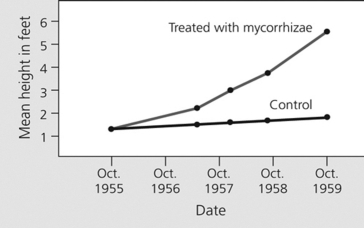 The figure shows results of a study where pine trees were treated with fungal mycorrhize to determine if the mycorrhize would affect the growth of the trees. Over the four-year study, only 36% of the control trees survived, while 85% of the pines treated with mycorrhizae survived. If the study was extended for another two years to the year 1961, what would you predict would occur with the control data and mean height of the pine trees?
 (Multiple Choice)
4.8/5 (80)
(80) 
Filters
- Essay(0)
- Multiple Choice(0)
- Short Answer(0)
- True False(0)
- Matching(0)