



 Chat with AI
Exam 18: An Introduction to Ecology and the Biosphere

Exam 1: Learning About Life45 Questions
Exam 2: Essential Chemistry for Biology50 Questions
Exam 3: The Molecules of Life56 Questions
Exam 4: A Tour of the Cell57 Questions
Exam 5: The Working Cell58 Questions
Exam 6: Cellular Respiration: Obtaining Energy From Food53 Questions
Exam 7: Photosynthesis: Using Light to Make Food52 Questions
Exam 8: Cellular Reproduction: Cells From Cells59 Questions
Exam 9: Patterns of Inheritance55 Questions
Exam 10: The Structure and Function of Dna59 Questions
Exam 11: How Genes Are Controlled55 Questions
Exam 12: Dna Technology54 Questions
Exam 13: How Populations Evolve52 Questions
Exam 14: How Biological Diversity Evolves47 Questions
Exam 15: The Evolution of Microbial Life59 Questions
Exam 16: The Evolution of Plants and Fungi56 Questions
Exam 17: The Evolution of Animals60 Questions
Exam 18: An Introduction to Ecology and the Biosphere56 Questions
Exam 19: Population Ecology52 Questions
Exam 20: Communities and Ecosystems63 Questions
Exam 21: Unifying Concepts of Animal Structure and Function57 Questions
Exam 22: Nutrition and Digestion67 Questions
Exam 23: Circulation and Respiration69 Questions
Exam 24: The Bodys Defenses59 Questions
Exam 25: Hormones53 Questions
Exam 26: Reproduction and Development59 Questions
Exam 27: Nervous, Sensory, and Locomotor Systems62 Questions
Exam 28: The Life of a Flowering Plant81 Questions
Exam 29: The Working Plant73 Questions
Select questions type


Scenario
Salmon eggs hatch in freshwater streams and, during their first year of life, the young salmon migrate distances up to 1,000 km in order to reach the ocean. Here they spend up to 5 years where they feed and grow, acquiring more than 95% of their biomass. During the summer of their maturing year, they begin the long journey back to their home streams to spawn. Although it is still uncertain how salmon navigate back to their spawning grounds, current hypotheses suggest that they have a highly developed sense of smell that allows them to remember odors they encountered on their migration to the ocean. They then use these odors to help them navigate back to the streams where they were born. At the spawning grounds, females use their tails to form a hollow cavity in the stream gravel where they lay up to 8,000 eggs. The males fertilize the eggs, and both adults typically die soon thereafter.
-The physiological response that allows salmon to survive in fresh water, then in salt water, and then fresh water again is an example of ________.
(Multiple Choice)
4.8/5  (76)
(76) What level of ecology is concerned with groups of individuals of different species?
(Multiple Choice)
4.7/5 (77)
(77) What level of ecology is concerned with energy flow and the cycling of chemicals among various biotic and abiotic factors?
(Multiple Choice)
4.9/5 (91)
(91) Scenario
Salmon eggs hatch in freshwater streams and, during their first year of life, the young salmon migrate distances up to 1,000 km in order to reach the ocean. Here they spend up to 5 years where they feed and grow, acquiring more than 95% of their biomass. During the summer of their maturing year, they begin the long journey back to their home streams to spawn. Although it is still uncertain how salmon navigate back to their spawning grounds, current hypotheses suggest that they have a highly developed sense of smell that allows them to remember odors they encountered on their migration to the ocean. They then use these odors to help them navigate back to the streams where they were born. At the spawning grounds, females use their tails to form a hollow cavity in the stream gravel where they lay up to 8,000 eggs. The males fertilize the eggs, and both adults typically die soon thereafter.
-At different times in their lives, salmon can be found in all but one of these biomes. Choose the EXCEPTION.
(Multiple Choice)
4.8/5 (71)
(71) If their own solute concentration does not match that of their surroundings, aquatic organisms ________.
(Multiple Choice)
4.8/5 (83)
(83) All but one of these are causes for increasing carbon dioxide levels. Choose the EXCEPTION.
(Multiple Choice)
5.0/5 (84)
(84) Long, snowy winters as well as evergreen trees such as pine and fir are found in ________.
(Multiple Choice)
4.9/5 (91)
(91) Water-storing plants and deeply rooted shrubs are plants that characterize ________.
(Multiple Choice)
4.9/5 (75)
(75) The figure shows regions of an ocean. In what region do phytoplankton live? 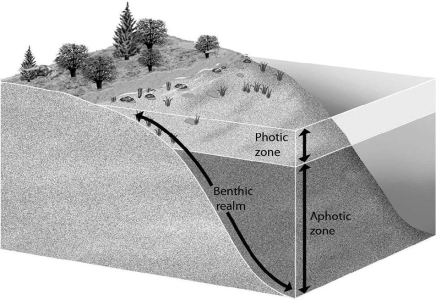
(Multiple Choice)
4.7/5 (75)
(75) 
Filters
- Essay(0)
- Multiple Choice(0)
- Short Answer(0)
- True False(0)
- Matching(0)