



 Chat with AI
Exam 19: Population Ecology

Exam 1: Learning About Life45 Questions
Exam 2: Essential Chemistry for Biology50 Questions
Exam 3: The Molecules of Life56 Questions
Exam 4: A Tour of the Cell57 Questions
Exam 5: The Working Cell58 Questions
Exam 6: Cellular Respiration: Obtaining Energy From Food53 Questions
Exam 7: Photosynthesis: Using Light to Make Food52 Questions
Exam 8: Cellular Reproduction: Cells From Cells59 Questions
Exam 9: Patterns of Inheritance55 Questions
Exam 10: The Structure and Function of Dna59 Questions
Exam 11: How Genes Are Controlled55 Questions
Exam 12: Dna Technology54 Questions
Exam 13: How Populations Evolve52 Questions
Exam 14: How Biological Diversity Evolves47 Questions
Exam 15: The Evolution of Microbial Life59 Questions
Exam 16: The Evolution of Plants and Fungi56 Questions
Exam 17: The Evolution of Animals60 Questions
Exam 18: An Introduction to Ecology and the Biosphere56 Questions
Exam 19: Population Ecology52 Questions
Exam 20: Communities and Ecosystems63 Questions
Exam 21: Unifying Concepts of Animal Structure and Function57 Questions
Exam 22: Nutrition and Digestion67 Questions
Exam 23: Circulation and Respiration69 Questions
Exam 24: The Bodys Defenses59 Questions
Exam 25: Hormones53 Questions
Exam 26: Reproduction and Development59 Questions
Exam 27: Nervous, Sensory, and Locomotor Systems62 Questions
Exam 28: The Life of a Flowering Plant81 Questions
Exam 29: The Working Plant73 Questions
Select questions type


Scenario
Michigan's Isle Royale is an island located in Lake Superior that is 45 miles long and 9 miles wide. Ecologists estimate that the moose population on the island has been there since approximately the year 1900. The wolf population on the island, on the other hand, has been there only since the winter of 1949. Weather conditions had to be calm and cold enough for the lake to freeze so that the first wolves could make the passage over to the island. When the wolves arrived, they were greeted with a large moose population that had no predators. The moose population was at a dangerously high level but was kept in check by the arrival of the wolves. This "harmonious" pattern continued for at least 20 years.
In 1982, the wolf population suddenly crashed because of a new canine virus believed to have been carried to the island carried on the shoe of a human traveler. While the wolf population size decreased from 50 to 14 individuals in a year, the moose population increased. However, the winter of 1996 was extremely harsh and the moose population experienced a major crash. More than 500 moose died during the winter months, reducing the population to less than 800 animals.
-The virus introduced to the island in 1982 that reduced the wolf population is an example of ________.
(Multiple Choice)
4.9/5  (80)
(80) The Endangered Species Act aims to help protect species that ________.
(Multiple Choice)
4.8/5 (73)
(73) Competition among individuals of the same species for the same limited resources is ________ competition.
(Multiple Choice)
4.8/5 (72)
(72) This figure depicts population growth for three different populations. 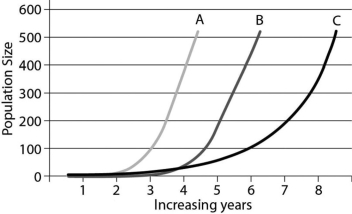 -Which population is growing at the fastest rate?
 (Multiple Choice)
4.9/5 (83)
(83) Scenario
Michigan's Isle Royale is an island located in Lake Superior that is 45 miles long and 9 miles wide. Ecologists estimate that the moose population on the island has been there since approximately the year 1900. The wolf population on the island, on the other hand, has been there only since the winter of 1949. Weather conditions had to be calm and cold enough for the lake to freeze so that the first wolves could make the passage over to the island. When the wolves arrived, they were greeted with a large moose population that had no predators. The moose population was at a dangerously high level but was kept in check by the arrival of the wolves. This "harmonious" pattern continued for at least 20 years.
In 1982, the wolf population suddenly crashed because of a new canine virus believed to have been carried to the island carried on the shoe of a human traveler. While the wolf population size decreased from 50 to 14 individuals in a year, the moose population increased. However, the winter of 1996 was extremely harsh and the moose population experienced a major crash. More than 500 moose died during the winter months, reducing the population to less than 800 animals.
-What most likely happened after the wolves first arrived on the island?
(Multiple Choice)
4.9/5 (77)
(77) Suppose a plane is forced to make an emergency landing on a desert island. The passengers must use the resources in their new environment to survive. The number of people who can survive depends on the availability of these resources. This is an example of ________.
(Multiple Choice)
4.8/5 (84)
(84) If there are 500 oak trees in a forest covering 50 square kilometers (km2), then the population density is ________.
(Multiple Choice)
5.0/5 (81)
(81) Scenario
Michigan's Isle Royale is an island located in Lake Superior that is 45 miles long and 9 miles wide. Ecologists estimate that the moose population on the island has been there since approximately the year 1900. The wolf population on the island, on the other hand, has been there only since the winter of 1949. Weather conditions had to be calm and cold enough for the lake to freeze so that the first wolves could make the passage over to the island. When the wolves arrived, they were greeted with a large moose population that had no predators. The moose population was at a dangerously high level but was kept in check by the arrival of the wolves. This "harmonious" pattern continued for at least 20 years.
In 1982, the wolf population suddenly crashed because of a new canine virus believed to have been carried to the island carried on the shoe of a human traveler. While the wolf population size decreased from 50 to 14 individuals in a year, the moose population increased. However, the winter of 1996 was extremely harsh and the moose population experienced a major crash. More than 500 moose died during the winter months, reducing the population to less than 800 animals.
-The harsh winter that led to the death of many moose in 1996 is an example of ________.
(Multiple Choice)
4.8/5 (80)
(80) 
The intentional release of a natural enemy to attack a pest population is called ________.
(Multiple Choice)
4.8/5 (87)
(87) This figure depicts population growth for three different populations.
-Assume the three populations represent three populations of the same species of bird that all live in the same geographic area. All population sizes are equal, and data collected on the populations' growth rates all started on the same day. There are several plausible reasons why population C has the slowest growth rate. Choose the exception.
-Assume the three populations represent three populations of the same species of bird that all live in the same geographic area. All population sizes are equal, and data collected on the populations' growth rates all started on the same day. There are several plausible reasons why population C has the slowest growth rate. Choose the exception. (Multiple Choice)
4.8/5 (75)
(75) 
Filters
- Essay(0)
- Multiple Choice(0)
- Short Answer(0)
- True False(0)
- Matching(0)