



 Chat with AI
Exam 23: Circulation and Respiration

Exam 1: Learning About Life45 Questions
Exam 2: Essential Chemistry for Biology50 Questions
Exam 3: The Molecules of Life56 Questions
Exam 4: A Tour of the Cell57 Questions
Exam 5: The Working Cell58 Questions
Exam 6: Cellular Respiration: Obtaining Energy From Food53 Questions
Exam 7: Photosynthesis: Using Light to Make Food52 Questions
Exam 8: Cellular Reproduction: Cells From Cells59 Questions
Exam 9: Patterns of Inheritance55 Questions
Exam 10: The Structure and Function of Dna59 Questions
Exam 11: How Genes Are Controlled55 Questions
Exam 12: Dna Technology54 Questions
Exam 13: How Populations Evolve52 Questions
Exam 14: How Biological Diversity Evolves47 Questions
Exam 15: The Evolution of Microbial Life59 Questions
Exam 16: The Evolution of Plants and Fungi56 Questions
Exam 17: The Evolution of Animals60 Questions
Exam 18: An Introduction to Ecology and the Biosphere56 Questions
Exam 19: Population Ecology52 Questions
Exam 20: Communities and Ecosystems63 Questions
Exam 21: Unifying Concepts of Animal Structure and Function57 Questions
Exam 22: Nutrition and Digestion67 Questions
Exam 23: Circulation and Respiration69 Questions
Exam 24: The Bodys Defenses59 Questions
Exam 25: Hormones53 Questions
Exam 26: Reproduction and Development59 Questions
Exam 27: Nervous, Sensory, and Locomotor Systems62 Questions
Exam 28: The Life of a Flowering Plant81 Questions
Exam 29: The Working Plant73 Questions
Select questions type


The figure below is from an experiment on athletes. The "live high, train low" group lived for 18 days in rooms with a simulated altitude of 3,000 m, while training (exercising)at 1,200 m. Use this information and this figure to answer the following questions. 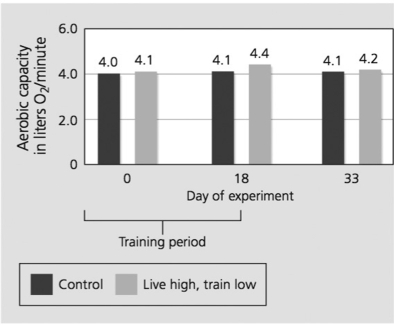 -The scientists who conducted this experiment were testing the hypothesis that living at high altitudes will boost red blood cell production, which can then affect stamina when training and competing at lower altitudes. What group of athletes is an appropriate control treatment for this experiment?
 (Multiple Choice)
4.9/5  (84)
(84) Which group of people is most likely to have an iron deficiency?
(Multiple Choice)
4.9/5 (82)
(82) In humans, oxygen is delivered from the environment to the cells of the body by ________.
(Multiple Choice)
4.9/5 (83)
(83) Scenario
In sickle cell disease (SCD), a mutation in hemoglobin causes deoxygenated hemoglobin to stick together in long chains, which in turn distorts red blood cells into an elongated, sickle (crescent) shape.
-In a person with SCD, where would red blood cells with a sickle shape be LEAST likely to be found?
(Multiple Choice)
4.7/5 (83)
(83) Red blood cells lack nuclei and other organelles which allows them to ________.
(Multiple Choice)
4.7/5 (80)
(80) The cardiovascular system of a mouse works like that of a human. A mouse is moved from sea level (low altitude)to the top of a mountain (high altitude). How could this mouse's cardiovascular system maintain a similar rate of oxygen delivery to its tissues now that the mouse is at the top of the mountain?
(Multiple Choice)
4.9/5 (80)
(80) White blood cells play a particularly important role in ________.
(Multiple Choice)
4.9/5 (87)
(87) What is one way in which the cardiovascular system of a mammal is different than that of an arthropod such as an insect?
(Multiple Choice)
4.7/5 (89)
(89) When tissue lining a blood vessel is damaged, the first thing that happens is ________.
(Multiple Choice)
4.7/5 (92)
(92) Scenario
Yawning is a reflexive action that is often associated with sleepiness. When a person yawns, the mouth opens, and a longer than normal breath of air is inhaled, followed by a longer than normal exhalation. Hypothesizing that yawning has a regulatory mechanism similar to breathing, scientists conducted an experiment on college students to test the effect of existing carbon dioxide levels on yawning.
-The structure where the respiratory and digestive systems meet expands during a yawn. What is the name of this structure?
(Multiple Choice)
4.9/5 (78)
(78) Why is blood pressure higher during systole than during diastole?
(Multiple Choice)
4.8/5 (79)
(79) Scenario
Yawning is a reflexive action that is often associated with sleepiness. When a person yawns, the mouth opens, and a longer than normal breath of air is inhaled, followed by a longer than normal exhalation. Hypothesizing that yawning has a regulatory mechanism similar to breathing, scientists conducted an experiment on college students to test the effect of existing carbon dioxide levels on yawning.
-The scientists investigated carbon dioxide levels in their experiment because high carbon dioxide levels in the ________ signal control centers in the brain to increase rate and depth of inhalations and exhalations.
(Multiple Choice)
4.8/5 (63)
(63) Scenario
Blood flowing away from the heart is under tremendous pressure, able to travel to just about any portion of the body. However, blood pressure drops considerably as it moves away from the heart. When blood finally reaches capillaries, the blood pressure drops to nearly zero. Therefore, when a person is standing, blood returning from the feet is not moved back towards the heart by contractions of the heart.
-Blood is propelled back to the heart by ________.
(Multiple Choice)
4.9/5 (85)
(85) If your blood pressure were 120/70, it would mean that ________.
(Multiple Choice)
4.8/5 (79)
(79) 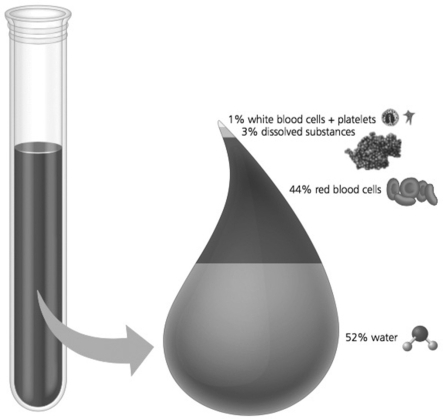 -In this figure, what could one of the dissolved substances be?
 (Multiple Choice)
4.8/5 (83)
(83) Together, inhalation and exhalation are referred to as ________.
(Multiple Choice)
4.7/5 (90)
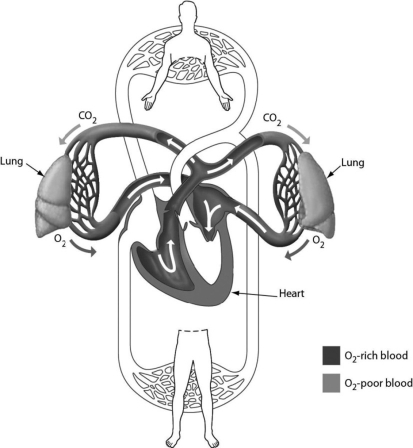
(90) 

Filters
- Essay(0)
- Multiple Choice(0)
- Short Answer(0)
- True False(0)
- Matching(0)