



 Chat with AI
Exam 7: Photosynthesis: Using Light to Make Food

Exam 1: Learning About Life45 Questions
Exam 2: Essential Chemistry for Biology50 Questions
Exam 3: The Molecules of Life56 Questions
Exam 4: A Tour of the Cell57 Questions
Exam 5: The Working Cell58 Questions
Exam 6: Cellular Respiration: Obtaining Energy From Food53 Questions
Exam 7: Photosynthesis: Using Light to Make Food52 Questions
Exam 8: Cellular Reproduction: Cells From Cells59 Questions
Exam 9: Patterns of Inheritance55 Questions
Exam 10: The Structure and Function of Dna59 Questions
Exam 11: How Genes Are Controlled55 Questions
Exam 12: Dna Technology54 Questions
Exam 13: How Populations Evolve52 Questions
Exam 14: How Biological Diversity Evolves47 Questions
Exam 15: The Evolution of Microbial Life59 Questions
Exam 16: The Evolution of Plants and Fungi56 Questions
Exam 17: The Evolution of Animals60 Questions
Exam 18: An Introduction to Ecology and the Biosphere56 Questions
Exam 19: Population Ecology52 Questions
Exam 20: Communities and Ecosystems63 Questions
Exam 21: Unifying Concepts of Animal Structure and Function57 Questions
Exam 22: Nutrition and Digestion67 Questions
Exam 23: Circulation and Respiration69 Questions
Exam 24: The Bodys Defenses59 Questions
Exam 25: Hormones53 Questions
Exam 26: Reproduction and Development59 Questions
Exam 27: Nervous, Sensory, and Locomotor Systems62 Questions
Exam 28: The Life of a Flowering Plant81 Questions
Exam 29: The Working Plant73 Questions
Select questions type


What is responsible for the yellow-orange coloration of leaves in the fall?
(Multiple Choice)
4.8/5  (85)
(85) Plants need carbon, hydrogen, and oxygen atoms to synthesize organic molecules to make new leaves, roots, or stems. Which statement about where they get these atoms is correct?
(Multiple Choice)
4.8/5 (92)
(92) In photosynthesis, redox reactions ultimately transfer electrons from ________ to ________.
(Multiple Choice)
4.9/5 (73)
(73) 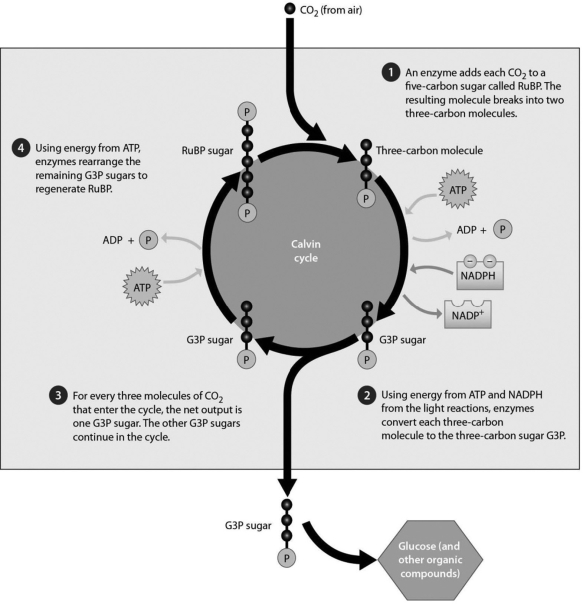 -The last stage of one complete turn of the Calvin cycle involves regeneration of ________.
 (Multiple Choice)
4.9/5 (69)
(69) A plant that was grown in the dark continuously would ________.
(Multiple Choice)
4.9/5 (89)
(89) The energy of wavelengths that appear ________ is LEAST useful to photosynthesis.
(Multiple Choice)
4.9/5 (87)
(87) All but one of these is an advantage of biofuels from food crops. Choose the EXCEPTION.
(Multiple Choice)
4.7/5 (84)
(84) What wavelength of light is reflected by a plant that appears blue to us?
(Multiple Choice)
4.8/5 (83)
(83) A shade-tolerant plant that is provided its preferred wavelength of light, but only minimal amounts of water, would likely experience ________.
(Multiple Choice)
4.9/5 (89)
(89) The rate of photosynthesis in an aquatic plant can be determined by the number of bubbles released from the plant. These bubbles ________.
(Multiple Choice)
4.9/5 (77)
(77) The products of the light reactions of photosynthesis are ________.
(Multiple Choice)
4.7/5 (83)
(83) Interconnected sacs of membranes inside the chloroplasts called ________ are suspended in a thick fluid called the ________.
(Multiple Choice)
4.8/5 (78)
(78) Scenario
You work for a company selling tropical rain forest plants commonly found in the understory of the forest. These plants are shade tolerant and can be grown indoors because they require low light. Your employer wants you to find out what is the best type of light to maximize growth of these understory plants. Using a full spectrum of natural light would cause these plants to die because they are a shade-tolerant plant species.
From your biology class, you recall that the light-dependent reactions of photosynthesis involve pigment molecules that absorb light of specific wavelengths. You also remember the experiments done by the German biologist Theodor Engelmann, in which he separated light using a prism into different wavelengths and then determined which wavelengths were best for promoting photosynthesis in the algae species he was examining. Your goal is to determine which wavelengths (colors)of light are best for promoting photosynthesis to enhance growth in your species of plant. To achieve this, you grew your plants under different wavelengths of light and measured their growth rates. The wavelengths were measured in nanometers (nm), and the growth rate was measured in millimeters per day (mm/day). The data you collected are as follows:
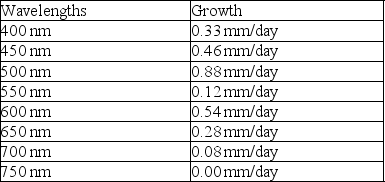 Make a bar graph plotting growth rates on the y-axis and wavelengths of light on the x-axis. Referring to your graph, answer the following questions:
-Which of these wavelengths is LEAST useful to your plants?
Make a bar graph plotting growth rates on the y-axis and wavelengths of light on the x-axis. Referring to your graph, answer the following questions:
-Which of these wavelengths is LEAST useful to your plants? (Multiple Choice)
4.8/5 (80)
(80) 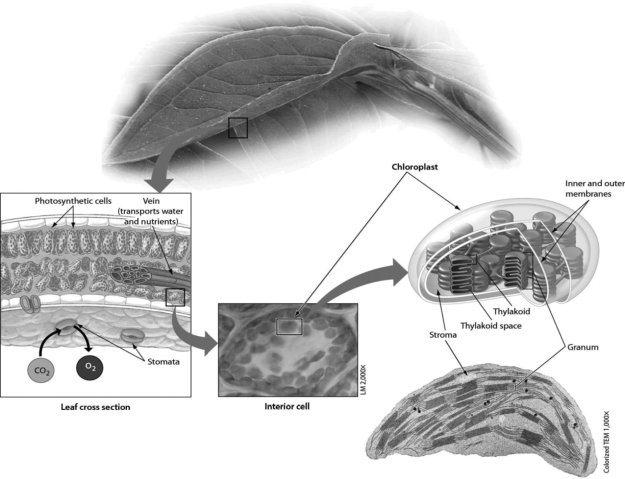 -In the accompanying figure, the molecule that makes up the bulk of the mass of the plant comes in mostly ________.
 (Multiple Choice)
4.7/5 (86)
(86) 
Filters
- Essay(0)
- Multiple Choice(0)
- Short Answer(0)
- True False(0)
- Matching(0)