



 Chat with AI
Exam 15: Income Inequality and Poverty

Exam 1: The Economic Approach225 Questions
Exam 2: Some Tools of the Economist239 Questions
Exam 3: Demand, Supply, and the Market Process408 Questions
Exam 4: Supply and Demand: Applications and Extensions270 Questions
Exam 5: Difficult Cases for the Market, and the Role of Government184 Questions
Exam 6: The Economics of Political Action208 Questions
Exam 7: Consumer Choice and Elasticity229 Questions
Exam 8: Costs and the Supply of Goods222 Questions
Exam 9: Price Takers and the Competitive Process261 Questions
Exam 10: Price-Searcher Markets With Low Entry Barriers232 Questions
Exam 11: Price-Searcher Markets With High Entry Barriers260 Questions
Exam 12: The Supply of and Demand for Productive Resources154 Questions
Exam 13: Earnings, Productivity, and the Job Market91 Questions
Exam 14: Investment, the Capital Market, and the Wealth of Nations106 Questions
Exam 15: Income Inequality and Poverty105 Questions
Exam 16: Gaining From International Trade179 Questions
Select questions type


Compared to low-income families, upper-income families are likely to
(Multiple Choice)
4.8/5  (77)
(77) 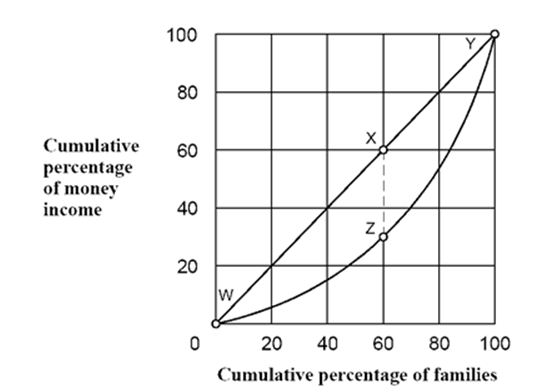 -As shown in Figure 15-3, 40 percent of families earned a cumulative share of about ____ percent of income.
 (Multiple Choice)
4.9/5 (75)
(75) Some people inherit money and wealth that they did nothing to earn. Why don't we tax inheritance at 100 percent?
(Essay)
5.0/5 (94)
(94) Assume that Ava is a single parent who is in poverty. She receives food stamps and Medicaid. For every $100 that she earns, Ava loses $20 of her food stamp benefits and $15 in her Medicaid benefits. Ava's implicit marginal tax rate from these two programs is
(Multiple Choice)
4.9/5 (88)
(88) If a family earned $10,000 and, as a consequence, sustained a reduction of $4,000 in government benefits, the family's implicit marginal tax rate would be
(Multiple Choice)
4.8/5 (74)
(74) 
Filters
- Essay(0)
- Multiple Choice(0)
- Short Answer(0)
- True False(0)
- Matching(0)