



 Chat with AI
Exam 15: Income Inequality and Poverty

Exam 1: The Economic Approach225 Questions
Exam 2: Some Tools of the Economist239 Questions
Exam 3: Demand, Supply, and the Market Process408 Questions
Exam 4: Supply and Demand: Applications and Extensions270 Questions
Exam 5: Difficult Cases for the Market, and the Role of Government184 Questions
Exam 6: The Economics of Political Action208 Questions
Exam 7: Consumer Choice and Elasticity229 Questions
Exam 8: Costs and the Supply of Goods222 Questions
Exam 9: Price Takers and the Competitive Process261 Questions
Exam 10: Price-Searcher Markets With Low Entry Barriers232 Questions
Exam 11: Price-Searcher Markets With High Entry Barriers260 Questions
Exam 12: The Supply of and Demand for Productive Resources154 Questions
Exam 13: Earnings, Productivity, and the Job Market91 Questions
Exam 14: Investment, the Capital Market, and the Wealth of Nations106 Questions
Exam 15: Income Inequality and Poverty105 Questions
Exam 16: Gaining From International Trade179 Questions
Select questions type


As the War on Poverty programs were instituted and transfer payments expanded in the last half of the 1960s, what happened to the poverty rate?
(Multiple Choice)
4.8/5  (75)
(75) When a person who receives welfare benefits earns income, those benefits are reduced as earned income rises. This is referred to as
(Multiple Choice)
4.8/5 (78)
(78)  -As shown in Figure 15-1, 60 percent of families earned a cumulative share of about ____ of income.
 (Multiple Choice)
4.9/5 (62)
(62) Data on income inequality in the United States indicate that
(Multiple Choice)
4.9/5 (87)
(87) Assume that DeShawn is a single parent who is in poverty. He receives food stamps and Medicaid. For every $100 that he earns, DeShawn loses $35 of his food stamp benefits and $20 in his Medicaid benefits. Also, DeShawn's income is taxed at a rate of 10 percent. Then, Peter's effective marginal tax rate is
(Multiple Choice)
4.8/5 (84)
(84) 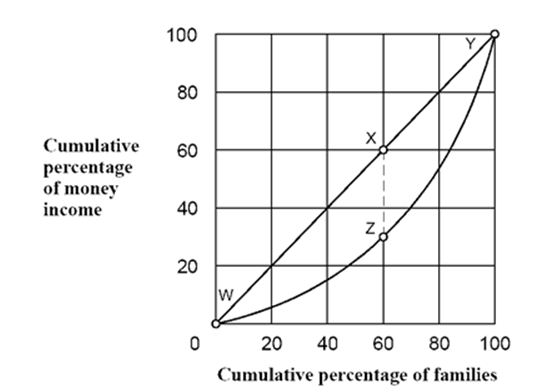 -As shown in Figure 15-3, the perfect equality line is drawn between points
 (Multiple Choice)
4.9/5 (79)
(79) When determining whether an income places a family or individual in poverty, the official poverty rate excludes
(Multiple Choice)
4.8/5 (76)
(76) The phenomenon that describes how transfer programs, which significantly reduce the adversities of poverty, also reduce the opportunity cost of choices that often lead to poverty is known as
(Multiple Choice)
4.9/5 (71)
(71) If a family earned an additional $6,000 and, as a consequence, sustained a reduction of $3,600 in government benefits, the implicit marginal tax rate for this family would be
(Multiple Choice)
4.9/5 (85)
(85) Which of the following contributed to the increase in income inequality among families in the United States during the 1980s and 1990s?
(Multiple Choice)
4.8/5 (70)
(70) Suppose you had the choice of attending two universities. University A pays all of its professors the same wage and awards the same raises. University B pays each professor according to market wages and productivity. Which university would you rather attend and why?
(Essay)
4.8/5 (78)
(78) Which of the following is not counted as income when the official poverty rate is calculated?
(Multiple Choice)
4.9/5 (86)
(86) The amount of additional earnings that must be paid explicitly in taxes or implicitly in the form of a reduction in income supplements is known as the
(Multiple Choice)
4.9/5 (77)
(77) 
Filters
- Essay(0)
- Multiple Choice(0)
- Short Answer(0)
- True False(0)
- Matching(0)